
Remuneration of Executive Board members
The remuneration system for Executive Board members takes account of the Company’s size, complexity and economic situation, as well as its future prospects. It is also aligned with the corporate strategy, thereby creating an incentive for successful and sustainable governance. At the same time, it takes into account the responsibilities and performance of the Executive Board as a whole and of its individual members, as well as the Company’s current position. For this reason, the remuneration system is based on transparent, performance-related parameters relevant to the Company’s success and sustainability.
The Supervisory Board is responsible for the structure of the remuneration system for Executive Board members, and for defining the individual benefits. The Steering and Remuneration Committee assists the Supervisory Board, monitors the appropriateness of the remuneration system and prepares the Supervisory Board’s resolutions. In the event of material changes to the remuneration system, and at least every four years, the remuneration system is presented for approval to the Annual General Meeting.
Overview of the remuneration system for the 2025 financial year
The remuneration of the Executive Board in the 2025 financial year is based on the remuneration system 2025 for Carsten Spohr, Michael Niggemann and Till Streichert. For Grazia Vittadini and Dieter Vranckx, the remuneration for the 2025 financial year is based on the remuneration system 2023. The following table provides an overview of the components of the remuneration system for Executive Board members, the underlying targets and specific application in the 2025 financial year. Differences between the two remuneration systems, which generally relate to the amount of contributions to the company pension and the target amounts (see T209) for the variable remuneration components are marked as such.
| T208 | Executive Board remuneration system 2025 | ||
|---|---|---|---|
| Component | Objective | Structure | |
| Performance-unrelated remuneration | |||
| Basic salary | Shall reflect the role and responsibilities in the Executive Board. Should ensure a reasonable basic income and prevent unreasonable risk-taking | • Annual basic salary • Paid in twelve monthly instalments - CEO: EUR 1,892,000 - Particularly important Executive Board member: EUR 1,118,000 - Ordinary Executive Board member: EUR 860,000 |
|
| Ancillary benefits | Company car with driver, industry-standard concessionary flights for private travel, insurance premiums | ||
| Retirement benefits | Shall ensure adequate retirement benefits | Annual allocation of a fixed amount within the scope of a defined-contribution system or, alternatively, as a cash allowance - CEO: EUR 572,000 - Particularly important Executive Board member: EUR 338,000 - Ordinary Executive Board member (2025 remuneration system): EUR 260,000 - Ordinary Executive Board member (2023 remuneration system): EUR 450,000 |
|
| Performance-related remuneration | |||
| One-year variable remuneration (STI) |
Intended to support profitable growth while taking into consideration liquidity management as well as the collective responsibility of the Executive Board and the individual performance of its members | • Adjusted EBIT versus target (40%) • Adjusted free cash flow versus target (40%) • Overall and individual commercial and sustainability targets (20%) • Individual performance factor (bonus/malus, 0.8–1.2) • Cap: 200% of target amount • Settlement in cash or shares |
|
| Long-term variable remuneration (LTI) |
Intended to promote a sustainable increase in enterprise value, while aligning the interests of the Executive Board members with those of shareholders | • Conditional award of virtual Lufthansa shares with four-year duration • Final number of virtual shares depends on: - Adjusted ROCE during the performance period versus annual target (50%) - Relative TSR of the Lufthansa share versus sector index (NYSE Arca Global Airlines Index) (30%) - Strategic and sustainability targets (20%) • Value depends on the absolute performance of the Lufthansa share (including dividends) over the course of the programme • Cap: 200% of target amount • Settlement in cash or shares |
|
| End-of-service benefits | |||
| Mutually agreed termination Not exercised in the 2025 financial year. |
Shall avoid unreasonably high severance payments | Severance payment limited to remainder of service contract or two times annual remuneration (cap) | |
| Non-compete clause Not exercised in the 2025 financial year. |
Protects the Company’s interests | • One-year non-compete clause after departure from the Executive Board, with compensation of 50% of basic salary payable • Waiver of non-compete clause by Company possible (with six-month notice period) |
|
| Change-of-control clause Not exercised in the 2025 financial year. |
Shall ensure independence in takeover situations | • Severance payment corresponding to the remuneration owed for the remainder of the service contract, up to 100% of the cap on severance pay | |
| Other compensation rules | |||
| Share Ownership Guidelines | Intended to strengthen the equity culture and align the interests of Executive Board members and shareholders | • Obligation to invest in Lufthansa shares within a period of four years - CEO: 200% of basic salary - Ordinary Executive Board member: 100% of basic salary • Holding obligation for the duration of work on the Executive Board; graduated annual reduction of 25% of shareholding after departure from the Executive Board |
|
| Compliance and performance clawback Not exercised in the 2025 financial year. |
Aims to ensure sustainable Company development | Supervisory Board has the right to withhold STI and LTI or recover remuneration already paid | |
| Maximum remuneration in accordance with Section 87a Paragraph 1 Sentence 2 No. 1 AktG |
Shall prevent uncontrolled high payments | Reduction in variable remuneration where the maximum for a financial year is exceeded: - CEO: EUR 11.0m - Particularly important Executive Board member: EUR 6.5m - Ordinary Executive Board member: EUR 5.0m |
|
Review of the appropriateness of Executive Board remuneration
In the 2025 financial year, the Supervisory Board once again considered in detail the appropriateness of the Executive Board’s remuneration and reviewed its amount and structure. It reached the conclusion that the remuneration is appropriate.
As part of this appropriateness review, the Supervisory Board considers whether it is standard for the market by examining the amount and structure of Executive Board remuneration at comparable companies (horizontal comparison). The comparable market consists of all the companies listed on the DAX and MDAX, since they are of a similar size as of the assessment date. This means that the largest listed companies in Germany are included, and reflects the fact that Deutsche Lufthansa AG is listed in the MDAX.
To factor in the relative size of Deutsche Lufthansa AG in this peer group, the companies are classified by size using the equally weighted criteria of revenue, headcount and market capitalisation. To determine whether it is appropriate and standard for the market, the target and maximum remuneration are assessed on the basis of the company’s relative size.
In addition, the Supervisory Board carries out a vertical comparison, assessing the ratio of Executive Board remuneration against the remuneration of senior executives and the workforce as a whole and including the development of this ratio over time (see T220). The workforce as a whole consists of the upper management tier as well as non-payscale and payscale workers in the German Group companies in the Lufthansa collective bargaining group.
Target remuneration
The following table shows the remuneration granted to the members of the Executive Board for the 2025 and 2024 financial years. A distinction is made here between the Chairman of the Executive Board, the Executive Board member for the Finance function (determined by the Supervisory Board to be of particular importance) and the other ordinary members of the Executive Board. The year-on-year- comparison shows that the changes in the 2025 financial year with regard to the 2025 remuneration system merely relate to a reallocation of the contributions to the company pension into variable remuneration components. The amount of target total remuneration is unchanged from the previous year on the whole. The target remuneration for the ordinary members of the Executive Board in the 2023 remuneration system (applies to Grazia Vittadini and Dieter Vranckx) is stated separately.
| T209 | Target remuneration and relative proportion in 2025 and 2024 | ||||||||||||||||
|---|---|---|---|---|---|---|---|---|---|---|---|---|---|---|---|---|---|
| CEO | Distinguished Executive Board member responsible for Finance | Ordinary Executive Board members (remuneration system 2025) |
Ordinary Executive Board members (remuneration system 2023) |
||||||||||||||
| 2025 | 2025 | 2024 | 2024 | 2025 | 2025 | 2024 | 2024 | 2025 | 2025 | 2024 | 2024 | 2025 | 2025 | 2024 | 2024 | ||
| in € thousands | Proportion | in € thousands | Proportion | in € thousands | Proportion | in € thousands | Proportion | in € thousands | Proportion | in € thousands | Proportion | in € thousands | Proportion | in € thousands | Proportion | ||
| Fixed remuneration | |||||||||||||||||
| Basic salary | 1,892 | 31.3% | 1,892 | 33.6% | 1,118 | 31.3% | 1,118 | 33.6% | 860 | 31.3% | 860 | 33.6% | 860 | 33.6% | 860 | 33.6% | |
| Variable remuneration | |||||||||||||||||
| One-year variable remuneration 2025 (2024) | 1,408 | 23.3% | 1,320 | 23.4% | 832 | 23.3% | 780 | 23.4% | 640 | 23.3% | 600 | 23.4% | 600 | 23.4% | 600 | 23.4% | |
| Long-term variable remuneration 2025 (2024) | 2,750 | 45.5% | 2,420 | 43.0% | 1,625 | 45.5% | 1,430 | 43.0% | 1,250 | 45.5% | 1,100 | 43.0% | 1,100 | 43.0% | 1,100 | 43.0% | |
| Target direct remuneration | 6,050 | 100.0% | 5,632 | 100% | 3,575 | 100.0% | 3,328 | 100.0% | 2,750 | 100.0% | 2,560 | 100.0% | 2,560 | 100.0% | 2,560 | 100.0% | |
| Contribution to company pension 2025 (2024) | 572 | 990 | 338 | 585 | 260 | 450 | 450 | 450 | |||||||||
| Total target renuneration | 6,622 | 6,622 | 3,913 | 3,913 | 3,010 | 3,010 | 3,010 | 3,010 | |||||||||
Maximum remuneration
In addition to the caps on one-year and long-term variable remuneration, the Supervisory Board has capped the total amount of remuneration received by each Executive Board member in a given financial year in accordance with Section 87a Paragraph 1 Sentence 2 No. 1 AktG. Since 2023, this maximum remuneration has been EUR 11m for the Chairman of the Executive Board, EUR 6.5m for the Chief Financial Officer and EUR 5m for the other ordinary Executive Board members. It relates to actual expenses or the actual payment of remuneration agreed for the financial year (including ancillary benefits and retirement benefit expenses). If remuneration for a given financial year exceeds this cap, the variable remuneration is reduced accordingly.
Compliance with the maximum remuneration limit for the 2025 financial year
Since the amount paid out for the long-term variable remuneration in 2025 will only be known on 31 December 2028 due to the four-year performance period, definitive information on compliance with the remuneration cap in the 2025 financial year can only be provided in the remuneration report for the 2028 financial year.
Compliance with the maximum remuneration limit for the 2022 financial year
The Supervisory Board specified a maximum amount for the overall remuneration granted to the Executive Board members for the 2022 financial year. Following the end of the performance period for long-term variable remuneration 2022 (LTI 2022) on 31 December 2025, it is clear that none of the Executive Board members active in the 2022 financial year exceeded this maximum amount. The following table provides a detailed overview of the amounts of remuneration granted, including the respective maximum amounts.
| T210 | Maximum remuneration for the 2022 financial year | ||||||||||||
|---|---|---|---|---|---|---|---|---|---|---|---|---|---|
| Carsten Spohr, Chairman of the Executive Board Chairman since 01 May 2014; Executive Board member since 01 Jan 2011 |
Christina Foerster Executive Board member from 01 Jan 2020 to 30 June 2024 |
Harry Hohmeister Executive Board member from 1 Jan 2013 to 30 June 2024 |
Detlef Kayser Executive Board member from 01 Jan 2019 to 30 June 2024 |
Michael Niggemann Executive Board member since 01 Jan 2020 |
Remco Steenbergen Executive Board member from 01 Jan 2021 to 07 May 20241) |
||||||||
| in € thousands | 2022 | 2022 (max.) |
2022 | 2022 (max.) |
2022 | 2022 (max.) |
2022 | 2022 (max.) |
2022 | 2022 (max.) |
2022 | 2022 (max.) |
|
| Fixed remuneration | |||||||||||||
| Basic salary | 1,634 | 1,634 | 860 | 860 | 860 | 860 | 860 | 860 | 860 | 860 | 860 | 860 | |
| Ancillary benefits | 38 | 38 | 27 | 27 | 34 | 34 | 26 | 26 | 32 | 32 | 61 | 61 | |
| Total | 1,672 | 1,672 | 887 | 887 | 894 | 894 | 886 | 886 | 892 | 892 | 921 | 921 | |
| Variable remuneration | |||||||||||||
| One-year variable remuneration (STI 2022) | 2,280 | 2,280 | 1,042 | 1,200 | 1,200 | 1,200 | 1,042 | 1,200 | 1,147 | 1,200 | 1,200 | 1,200 | |
| Long-term variable remuneration (LTI 2022) | 3,714 | 4,180 | 1,955 | 2,200 | 1,955 | 2,200 | 1,955 | 2,200 | 1,955 | 2,200 | – | – | |
| Total | 5,994 | 6,460 | 2,997 | 3,400 | 3,155 | 3,400 | 2,997 | 3,400 | 3,101 | 3,400 | 1,200 | 1,200 | |
| Retirement benefit expenses | 865 | 865 | 459 | 459 | 451 | 451 | 453 | 453 | 464 | 464 | 482 | 482 | |
| Total remuneration | 8,531 | 8,997 | 4,343 | 4,746 | 4,500 | 4,745 | 4,336 | 4,739 | 4,457 | 4,756 | 2,603 | 2,603 | |
| Maximum remuneration in accordance with Section 87a Paragraph 1 Sentence 2 No. 1 AktG | 9,500 | 5,000 | 5,000 | 5,000 | 5,000 | 5,000 | |||||||
| 1) In accordance with his severance agreement, Remco Steenbergen is not entitled to long-term variable remuneration for the 2022 financial year. | |||||||||||||
Variable remuneration in the 2025 financial year
The performance criteria for one-year and long-term variable remuneration are based on the Company’s strategic goals and operational management. They aim to strengthen profitability while setting incentives for growth, thereby taking the importance of liquidity management and the optimal use of capital into account. For this reason, Adjusted EBIT, Adjusted free cash flow and Adjusted ROCE are the relevant performance indicators for the Lufthansa Group and the main financial performance criteria for variable remuneration. Taking the interests of shareholders and other stakeholders into account, this is intended to ensure the sustainability of the business and reflect the Lufthansa Group’s social and environmental responsibilities.
On the basis of the remuneration system, the Supervisory Board determined the targets and the minimum and maximum amounts for the financial performance indicators and for the focus topics selected as part of the sustainability targets for variable remuneration for the 2025 financial year. The Supervisory Board ensured that the targets were demanding and ambitious.
For both the one-year and long-term variable remuneration, the possible range of performance against both individual financial targets as well as sustainability targets is between 0% and 200%.
One-year variable remuneration (STI 2025)
80% of the one-year variable remuneration for the 2025 financial year is based on financial targets, with 20% based on overall and individual business and sustainability targets.
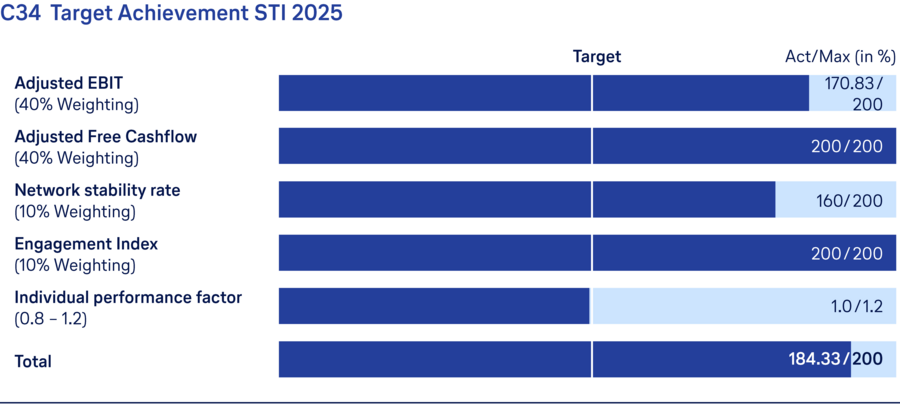
In the interests of value-based management, the financial targets are based on the Group’s key performance indicators; Adjusted EBIT and Adjusted free cash flow each account for 40% of the target achievement. For the 2025 financial year, as in prior years, the Supervisory Board defined “Customers” and “Employees” as focal points for the business and sustainability targets in the one-year variable remuneration, and thus took the interests of other key stakeholders into consideration.
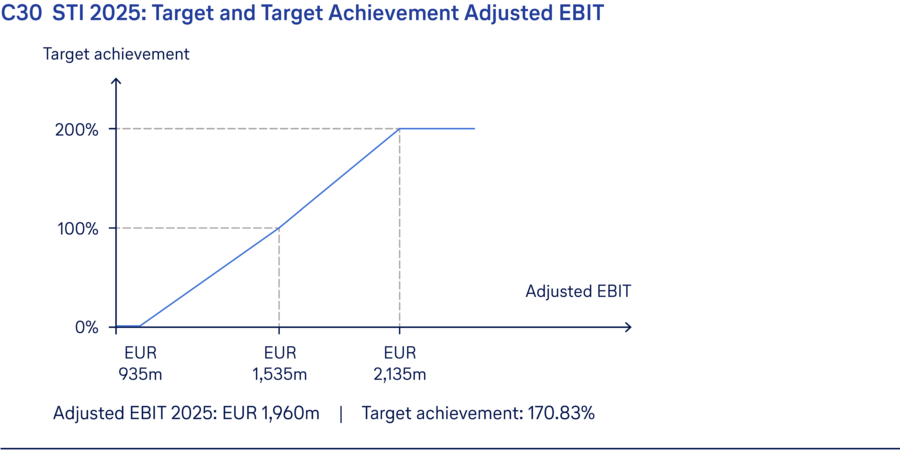
Financial targets are set by the Supervisory Board on the basis of the budget and the Group’s medium-term financial planning for the upcoming financial year. The target for Adjusted EBIT in the 2025 financial year was EUR 1,535m. For the performance criterion of Adjusted free cash flow, the target was EUR 225m. Interim figures are interpolated on a straight-line basis. The targets and performance against the financial targets in financial year 2025 are shown in the diagrams.
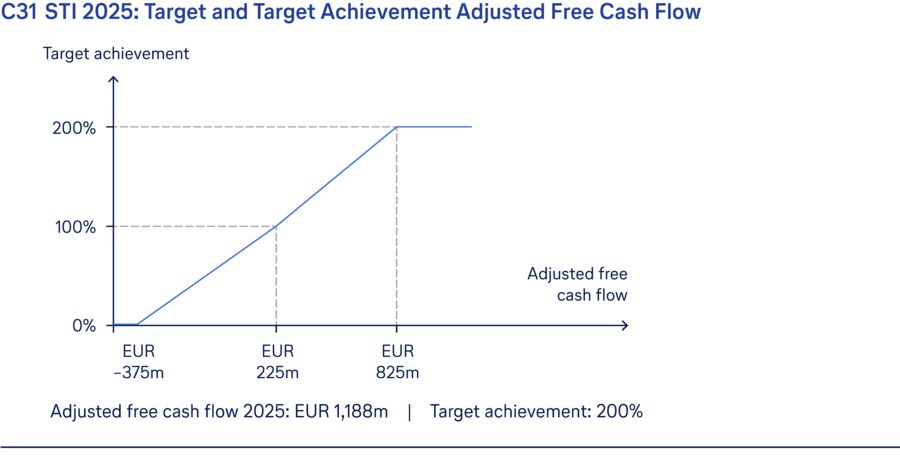
Overall, the level of target achievement for the financial targets for the STI 2025 is therefore 185.42%.
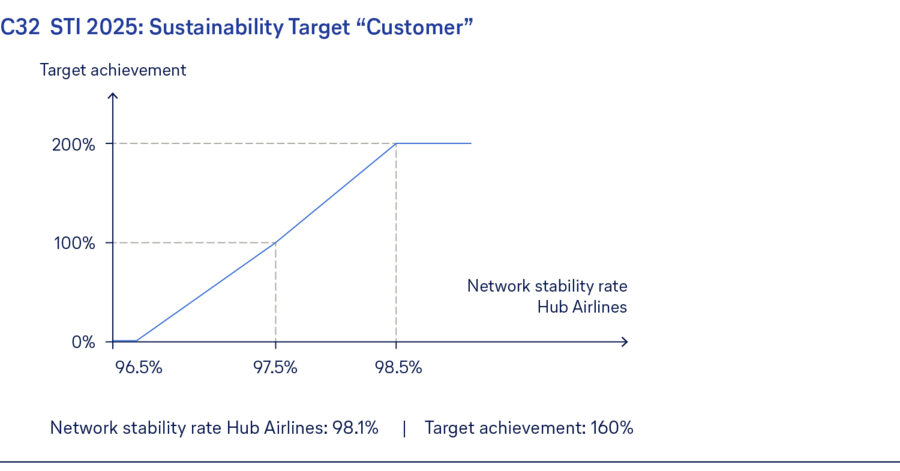
For the sustainability parameter “Customers”, the flight schedule stability rate of the hub airlines was used in the 2025 financial year. This measures the proportion of flights operated as planned, based on flight cancellations within 90 days prior to departure, by all Lufthansa Group hub airlines (Lufthansa Airlines, SWISS, Austrian Airlines, Brussels Airlines). Cancellations due to strikes or geopolitical events are excluded from this assessment in order to eliminate external effects. Interim figures are interpolated on a straight-line basis.
The Engagement Index is used for the parameter “Employees” (↗ Combined non-financial declaration). It measures the extent to which employees identify with the Company, as well as their commitment and willingness to recommend the Company to others as an employer. Each index score corresponds to a performance level. The 100% target is based on the average external benchmark. Following the change in the data collection scale during the financial year, “5” is now the best achievable score.
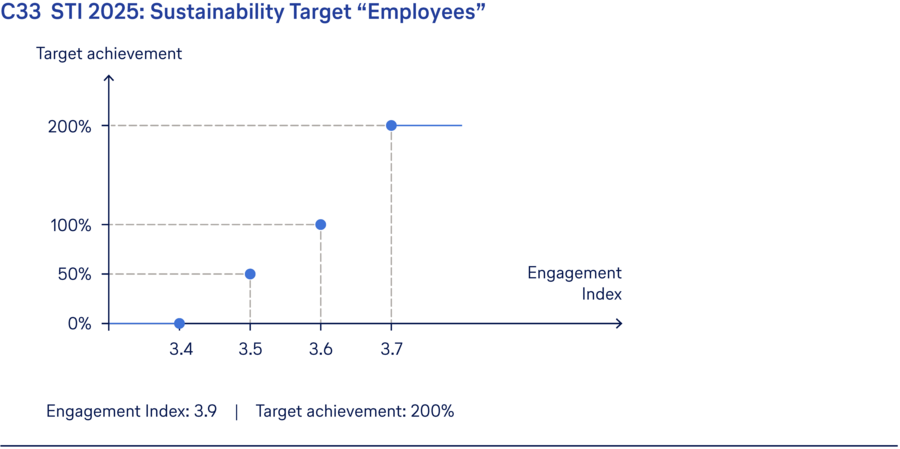
The “Customers” and “Employees” targets each account for 10% of the STI 2025.
Overall, the level of target achievement for the STI 2025 based on the weighted target achievement of the financial and sustainability targets is thus 184.33%.
In addition, the Supervisory Board can apply an individual performance factor (bonus/malus factor) of 0.8 to 1.2 when assessing the performance of each individual Executive Board member for the STI. This is based on the individual performance targets set annually by the Supervisory Board and the individual Executive Board members. In addition to the targets for individual Executive Board members, these comprise overarching targets for the entire Executive Board in order to reflect the collective responsibility of its members as a decision-making body.
The Steering and Remuneration Committee and Supervisory Board assessed performance against the established targets at the end of the 2025 financial year. The individual and collective targets for the 2025 financial year established by the Supervisory Board relate to the implementation of the Lufthansa Group strategy, in particular the multi-brand, multi-hub and multi-AOC strategy, the improvement of the customer experience and advancement of digitalisation, the implementation of ESG measures, in particular the continued modernisation of the fleet, the development of the organisational structure to improve efficiency and the long-term increase in profitability and value creation.
Including the collective performance and individual contributions of the Executive Board members, the Supervisory Board defined an individual performance factor of 1.0 for all Executive Board members for the 2025 financial year. In doing so, particular attention was paid to the rapid integration of ITA Airways, the operational implementation of the new Lufthansa Group umbrella brand, significant improvements to punctuality, the launch of Lufthansa Allegris and SWISS Senses as well as tailored services and the free use of messaging services on long-haul flights, the optimisation of fleet productivity and increase in “green fares”, the development of the new TOM2026 operating model, as well as significant improvements in results for the passenger airlines and Lufthansa Cargo, as well as the presentation of a clear strategy on the Capital Markets Day. For each Executive Board member, the performance factor was then multiplied by the overall target achievement in relation to financial, business and sustainability targets.
The following table shows the overall level of target achievement and the resulting amount paid for the STI 2025 for each individual member of the Executive Board.
| T211 | Overall level of target achievement and amounts paid for the STI 2025 | ||||
|---|---|---|---|---|---|
| Executive Board | Target amount in € thousands | Overall target achievement in % | Individual performance factor | Payment amount in € thousands | |
| Carsten Spohr | 1,408 | 184.33 | 1.0 | 2,595 | |
| Michael Niggemann | 640 | 184.33 | 1.0 | 1,180 | |
| Till Streichert | 832 | 184.33 | 1.0 | 1,534 | |
| Grazia Vittadini1) | 600 | 184.33 | 1.0 | 1,106 | |
| Dieter Vranckx1) | 600 | 184.33 | 1.0 | 1,106 | |
| 1) Target amount according to remuneration system 2023. | |||||
Long-term variable remuneration (LTI)
To promote the long-term, sustainable development of the Company, long-term variable remuneration (the greater part of variable remuneration) depends on the achievement of long-term targets. Taking absolute and relative share performance into account closely aligns the interests of Executive Board members with those of shareholders.
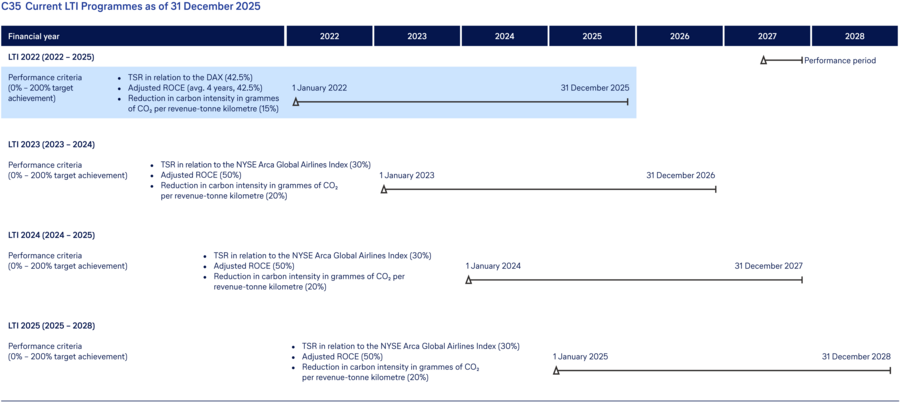
Current long-term variable remuneration includes ongoing programmes from several financial years, which are partly based on remuneration systems in effect before 1 January 2025. In particular, this includes long-term variable remuneration granted in the 2022 financial year (LTI 2022), for which the four-year programme ended on 31 December 2025. The following table provides an overview of current LTI programmes for the members of the Executive Board, including the performance criteria set by the Supervisory Board.
Long-term variable remuneration commitment 2025 (LTI 2025)
Since financial year 2020, the long-term variable remuneration commitment for Executive Board members has been share-based. At the beginning of the performance period, the Executive Board members receive a number of virtual shares corresponding to the value of each contractually granted target amount. The number of virtual shares is determined with reference to the average price of the Lufthansa share in the first 60 trading days after the four-year performance period begins. The average price for the LTI 2025 is EUR 6.62. The following table shows the number of virtual shares conditionally allocated to the individual Executive Board members as LTI 2025 in the reporting year.
| T212 | Conditionally allocated shares for LTI 2025 – allocation price: €6.62 | ||
|---|---|---|---|
| Executive Board | Target amount in € thousands | Number of conditionally committed shares | |
| Carsten Spohr | 2,750 | 415,408 | |
| Michael Niggemann | 1,250 | 188,822 | |
| Till Streichert | 1,625 | 245,468 | |
| Grazia Vittadini1) | 1,100 | 166,163 | |
| Dieter Vranckx1) | 1,100 | 166,163 | |
| 1) Target amount according to 2023 Executive Board remuneration system. | |||
The final number of virtual shares at the end of the four-year performance period depends on the achievement of the financial performance targets Adjusted ROCE (50%) and relative total shareholder return (30%), as well as the strategic and sustainability targets (20%). The Supervisory Board has specified “Environment” as a core area of focus for the strategic and sustainability targets in the LTI 2025. This provides a long-term incentive for the environmental policy goal of reducing CO2 emissions.
Performance against the target of Adjusted ROCE is measured by comparing the average Adjusted ROCE over the four-year performance period with a target set by the Supervisory Board at the beginning of the performance period for each year of the programme. The Supervisory Board aligns this target with the Group’s four-year operational planning, with the lower limit set to cover the weighted average cost of capital (WACC). This is in line with the strategic objective of earning a return on capital employed that exceeds the long-term cost of capital.
The Supervisory Board determines the target performance for each year based on the actual figures and the defined performance curve. Interim figures are interpolated on a straight-line basis. Overall target achievement is measured at the end of the four-year performance period as the average of the target achievements for the individual years. The following chart shows the targets for the LTI 2025.
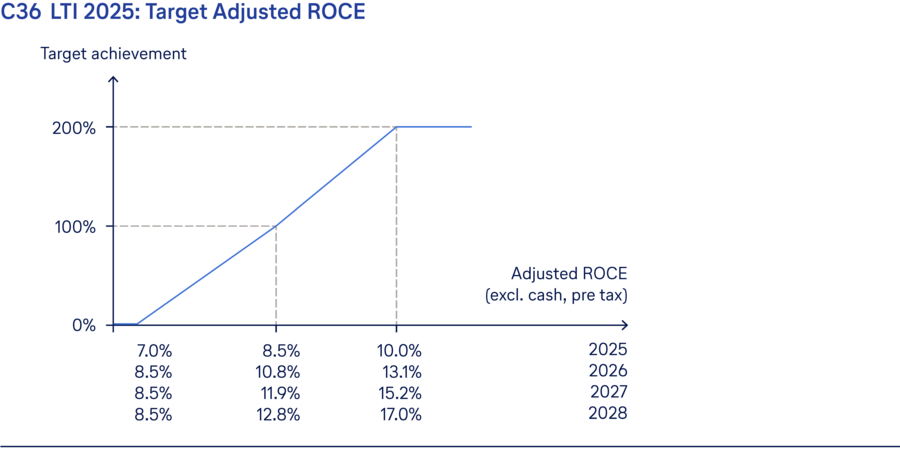
The actual average Adjusted ROCE reached in the financial years making up the four-year performance period and the resulting levels of target achievement are published in the remuneration report for the financial year at the end of the respective performance period.
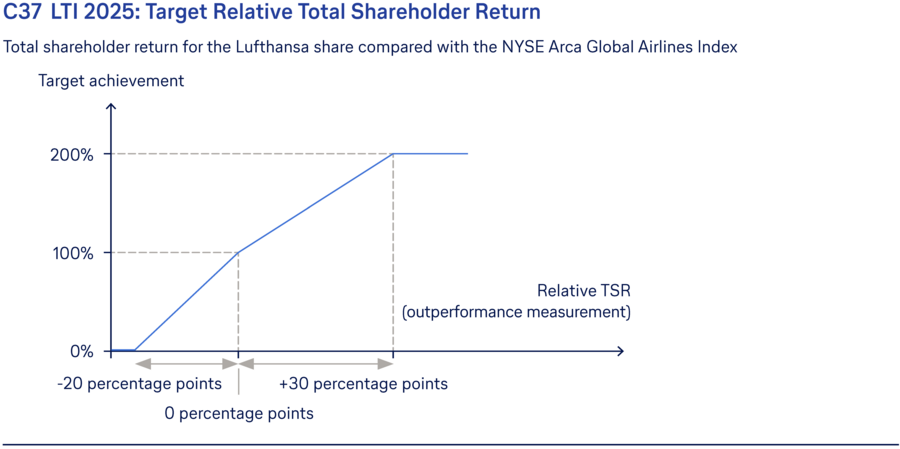
TSR performance for the LTI 2025 is calculated at the end of the four-year performance period by comparing the share return for Deutsche Lufthansa AG with the share return for the NYSE Arca Global Airlines Index. To calculate the TSR performance, the average price for the Deutsche Lufthansa AG share for the last 60 trading days before the start of the performance period is compared with the respective average share price before the end of the performance period. Notionally reinvested dividends are taken into consideration. TSR performance is measured in the same way for the NYSE Arca Global Airlines Index. The relative TSR is then measured as the difference between the TSR performance of Deutsche Lufthansa AG and of the NYSE Arca Global Airlines Index in percentage points (outperformance).
On this basis, the target achievement is calculated at the end of the four-year performance period using the defined performance curve. The design of the performance curve includes the standard market elements of share-based remuneration components on the European market. Target achievement is 100% if the TSR of Deutsche Lufthansa AG corresponds to the TSR for the peer group index. If the relative TSR for Deutsche Lufthansa AG is 20 percentage points or more below the comparative index, the target achievement is zero. If the relative TSR for Deutsche Lufthansa AG is 30 percentage points or more above the comparative index, the target achievement is 200%. Interim figures are interpolated on a straight-line basis.
The “Environment” sustainability target is based on the Lufthansa Group’s long-term strategy. Since 2022, the Lufthansa Group’s CO2 reduction targets have been based on the industry-wide and internationally acknowledged Science Based Targets initiative (SBTi), which are in line with the targets set by the Paris Agreement. The Lufthansa Group thus undertakes to achieve a scientifically based intensity target relating to its specific CO2 emissions, measured in terms of grammes per revenue tonne-kilometre. The reduction target for the LTI 2025 is based on the long-term target of a 30.6% reduction in specific carbon emissions by 2030 compared with the 2019 base year (↗ Combined non-financial declaration). The target for the LTI 2025 is a 15 percentage point reduction in CO2 intensity by the end of the performance period on 31 December 2028. The end points of the range are defined by a deviation of +/– 2 percentage points from the target. Interim figures are interpolated on a straight-line basis.
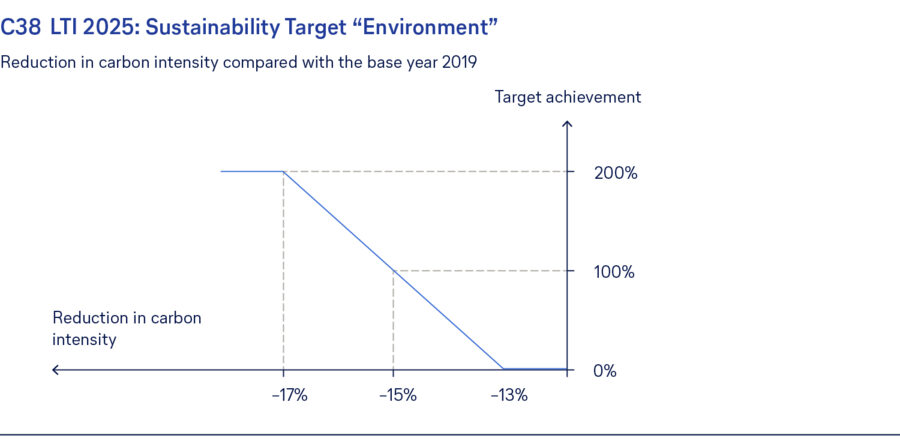
To calculate performance, the level of target achievement in terms of the relative improvement in CO2 intensity is determined at the end of the four-year performance period. This is then counted towards the overall level of target achievement for the LTI 2025 at the end of the performance period with a weighting of 20%.
To obtain the final number of virtual shares, the number of virtual shares granted conditionally is multiplied by the total target achievement, which comprises the weighted financial and sustainability performance targets, at the end of the performance period. To calculate the payment amount, the final number of virtual shares is multiplied by the average Lufthansa share price over the last 60 trading days before the end of the performance period, plus dividends paid during the performance period for the final number of shares. Payment is generally in cash.
Long-term variable remuneration 2022 (LTI 2022)
The long-term variable remuneration commitment for the financial year 2022 (LTI 2022) is also share-based. At the beginning of the performance period, Executive Board members received a number of virtual shares corresponding to the contractually agreed target amount.
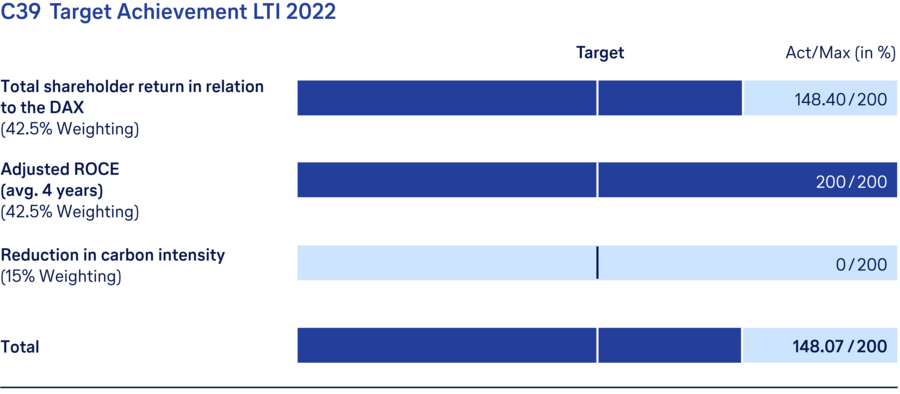
The number of virtual shares is determined with reference to the average price of the Lufthansa share in the first 60 trading days after the four-year performance period begins. The average price for the LTI 2022 is EUR 7.00. The final number of virtual shares for the LTI 2022 depends on the achievement of the financial performance targets Adjusted ROCE (42.5%) and relative total shareholder return (42.5%), as well as the strategic and sustainability targets (15%).
Unlike the LTI 2025, no annual target was set by the Supervisory Board for determining the target achievement of Adjusted ROCE for the LTI 2022. Instead, a strategic target was set for average Adjusted ROCE over the four-year performance period. For the LTI 2022, the strategic target ROCE was 6.3%.
Unlike for the LTI 2025, TSR performance for the LTI 2022 was calculated at the end of the four-year performance period using DAX-listed companies as a comparative index. This involved comparing the average share price for the last 60 trading days before the start of the performance period with the relevant share price before the end of the performance period. Dividends were taken into account as notionally reinvested. The TSR performance of all DAX companies was ranked and the relative performance of Deutsche Lufthansa AG determined by its percentile position. Target achievement is 100% if the TSR of Deutsche Lufthansa AG corresponds to the median (50th percentile) for the peer group. Interim figures were interpolated on a straight-line basis.
The Supervisory Board had specified “Environment” as a core area of focus for the strategic and sustainability targets in the LTI 2022. The underlying performance criteria were based on the long-term target of a 30.6% reduction in specific CO2 emissions by 2030 compared with the 2019 base year. The target for the LTI 2022 was a 13 percentage point reduction in carbon intensity by the end of the performance period on 31 December 2025.
The following table shows the target, lower and upper limits for the financial performance criteria and the sustainability target “Environment” set by the Supervisory Board for the LTI 2022, along with the target achievement for each.
| T213 | LTI 2022: financial targets – objective and target achievement | |||||
|---|---|---|---|---|---|---|
| Objective | Target achievement | |||||
| 0% | 100% | 200% | in % | |||
| Relative TSR compared with the DAX | 25th percentile | 50th percentile | 75th percentile | 62.1 percentile | 148.40 | |
| Adjusted ROCE | 5.0% | 6.3% | 7.6% | 8.9% | 200 | |
| Reduction in CO2 intensity compared with 2019 | -11.0% | -13.0% | -15.0% | -7.1% | 0 | |
Overall, the level of target achievement for the long-term variable remuneration for the 2022 financial year is thus 148.07%.
To calculate the payment amount from the LTI 2022, the number of virtual shares granted conditionally is first multiplied by the total target achievement, consisting of the weighted financial and sustainability performance targets, in order to obtain the final number of virtual shares. The final number of virtual shares is then multiplied by the average Lufthansa share price over the last 60 trading days before the end of the performance period, plus the dividends paid over the course of the programme. The average share price at the end of the programme is EUR 7.80 for the LTI 2022. Adding the dividend of EUR 0.30 per share paid to shareholders for financial years 2024 and 2025 means the payment amount for the LTI 2022 is obtained by multiplying the final number of virtual shares by EUR 8.40. No dividend was paid out in the 2022 and 2023 financial years. The following table shows the calculation of the individual payments for eligible Executive Board members.
| T214 | Payment amounts under LTI 2022 – overall level of target achievement 148.07% | ||||
|---|---|---|---|---|---|
| Executive Board | Target amount in € thousands |
Number of conditionally committed shares (start price: € 7.00) |
Final number of virtual shares |
Payment amount in € thousands (final price: €7.80, plus €0.60 dividend) |
|
| Carsten Spohr | 2,090 | 298,571 | 442,094 | 3,714 | |
| Christina Foerster (until 30 June 2024) |
1,100 | 157,143 | 232,682 | 1,955 | |
| Harry Hohmeister (until 30 June 2024) |
1,100 | 157,143 | 232,682 | 1,955 | |
| Detlef Kayser (until 30 June 2024) |
1,100 | 157,143 | 232,682 | 1,955 | |
| Michael Niggemann | 1,100 | 157,143 | 232,682 | 1,955 | |
| Remco Steenbergen (until 30 June 2024)1) |
1,100 | 157,143 | - | - | |
1) Under the severance agreement, Remco Steenbergen is not entitled to the LTI 2022.
Malus and clawback rule
In the event of an intentional or grossly negligent breach of statutory obligations or internal policies (compliance malus and clawback), or if variable remuneration components dependent on achieving certain targets are paid on the basis of false data (performance clawback), the Supervisory Board has the right to withhold or demand repayment of the one-year and long-term variable remuneration. Enforcement of the withholding or repayment claim is at the professional discretion of the Supervisory Board.
The Supervisory Board did not exercise the right to withhold or demand repayment of variable remuneration components in financial year 2025.
Share Ownership Guidelines
The Share Ownership Guidelines (SOG) have been an integral part of the remuneration system for the Executive Board since 2019. They oblige the CEO to acquire Lufthansa shares worth twice his basic salary and the ordinary Executive Board members to acquire shares worth one year’s gross basic salary and to hold them for their term of office and beyond. Executive Board members must demonstrate annually that they meet this obligation.
For the Executive Board members active before 1 January 2023, i.e. Carsten Spohr and Michael Niggemann, the minimum number of Lufthansa shares to be purchased was determined at the beginning of the term of office based on the average share price over the 125 trading days before the service contract begins. As of the 2023 financial year, newly appointed members of the Executive Board are obliged to purchase a number Lufthansa shares corresponding to the values of their respective basic salaries. This applies to the members of the Executive Board newly appointed in the 2024 financial year, Till Streichert, Grazia Vittadini and Dieter Vranckx.
To build up a share portfolio, shares are to be acquired by all Executive Board members over a four-year period. Shareholdings acquired beforehand can be included in the calculation. Since the 2023 financial year, to determine whether the SOG are met, these shares have been included at the average price of the Lufthansa share over the 60 trading days prior to the start of Executive Board mandates.
| T215 | Shareholdings of Executive Board members active in the 2025 financial year | ||
|---|---|---|---|
| Number of Lufthansa shares which must be held according to SOG |
Shareholdings under SOG as of 31 Dec 2025 | ||
| Carsten Spohr | 180,596 shares | 350,000 shares | |
| Michael Niggemann | 56,126 shares | 100,000 shares | |
| Till Streichert | €1,118,000 | €1,159,488 | |
| Grazia Vittadini | €860,000 | – | |
| Dieter Vranckx | €860,000 | €462,116 | |
The shares acquired in accordance with the SOG are to be held until the end of the service contract with the Executive Board member. After stepping down, Executive Board members may sell 25% of their SOG shares per year.
Retirement benefits
The members of the Executive Board receive retirement benefit commitments based on a defined contribution plan. Every Executive Board member receives, for the duration of their employment, a fixed annual amount which is credited to their personal pension account. With the new structure for the target total remuneration in the 2025 financial year, this amounts to EUR 572k for Carsten Spohr, the Chairman of the Executive Board, EUR 338k for Till Streichert, the Executive Board member determined by the Supervisory Board to be of particular importance and Chief Financial Officer, and to EUR 260k for Michael Niggemann as an ordinary Executive Board member. The other ordinary members of the Executive Board, Grazia Vittadini and Dieter Vranckx, who remained in the remuneration system in place prior to 1 January 2025, received EUR 450k.
The investment guidelines are based on the investment concept for the Lufthansa Pension Trust, which also applies to staff members of Deutsche Lufthansa AG.
Retirement benefits are paid when the beneficiary reaches the retirement age of 60 years (if they are no longer an Executive Board member) or in the event of disability or death. Where an employment relationship ends before retirement age is reached, the beneficiaries or their surviving dependants acquire a retirement benefit credit as defined in the investment concept. Deutsche Lufthansa AG guarantees the amounts paid into the retirement benefit account.
A supplementary risk capital sum will be added to the pension credit in the event of a claim for a disability pension or a pension for surviving dependants. This sum consists of the average contributions paid into the pension account over the past three years multiplied by the number of full years by which the claimant is short of the age of 60 from the time pension entitlement arises.
The pension credit is paid out in ten instalments. On application by the Executive Board member or their surviving dependants, a payment as a lump sum or in fewer than ten instalments may also be made, subject to approval by the company. The pension balance accumulated until 31 December 2018 by Carsten Spohr may also be paid as an annuity, on application and with the approval of the Company.
Under his contract as a pilot, which is currently not active, Carsten Spohr is entitled to a transitional pension in accordance with the collective bargaining agreement on “Transitional pensions for cockpit staff”. In the event that Carsten Spohr steps down from the Executive Board before reaching the age of 60 and resumes his employment as a pilot, he is entitled to draw a “Transitional pension for cockpit staff at Lufthansa” once he turns 60 or on request once he turns 55, in accordance with the provisions of the collective bargaining agreement. This additional benefit is paid if certain conditions of eligibility are met and provides for a monthly pension of up to 60% of the last modified salary until the beneficiary reaches the age of 63.
Pension entitlements in financial year 2025
The total amount of pension entitlements earned by active Executive Board members in the 2025 financial year was EUR 2.0m (previous year: EUR 2.1m) according to HGB and EUR 2.2m (previous year: EUR 2.2m) according to IFRS. This was recognised in staff costs (current service cost). The individual service costs and present values of pension entitlements are as follows:
| T216 | Pension entitlements according to HGB and IFRS | ||||||||
|---|---|---|---|---|---|---|---|---|---|
| HGB | HGB | IFRS | IFRS | ||||||
| Current service costs | Settlement amount of pension obligations | Current service costs | Defined-benefit obligations (DBO) | ||||||
| in € thousands | 2025 | 2024 | 31 Dec 2025 | 31 Dec 2024 | 2025 | 2024 | 31 Dec 2025 | 31 Dec 2024 | |
| Carsten Spohr | 535 | 942 | 14,184 | 12,150 | 573 | 993 | 14,184 | 12,147 | |
| Michael Niggemann | 176 | 414 | 3,259 | 2,684 | 264 | 460 | 3,248 | 2,664 | |
| Till Streichert (since 15 September 2024) | 332 | 234 | 619 | 234 | 405 | 228 | 612 | 228 | |
| Grazia Vittadini (since 1 July 2024) | 450 | 262 | 773 | 263 | 472 | 259 | 769 | 260 | |
| Dieter Vranckx (since 1 July 2024) | 468 | 280 | 816 | 281 | 492 | 275 | 808 | 276 | |
| Total | 1,961 | 2,132 | 19,651 | 15,612 | 2,206 | 2,215 | 19,621 | 15,575 | |
End-of-service benefits
Cap on severance pay
If a contract is terminated early for reasons other than good cause or a change of control, the Company will not remunerate more than the value of outstanding entitlements for the remainder of the contract, as recommended by the German Corporate Governance Code, whereby these payments may not exceed annual remuneration for two years (severance cap). The cap on severance pay is determined by the annual remuneration, which is made up of the basic salary and the target amounts of the one-year and long-term variable remuneration; in-kind benefits and ancillary benefits are not considered.
Remuneration awarded and due in financial year 2025 pursuant to Section 162 AktG
Pursuant to Section 162 AktG, the remuneration report must disclose the remuneration awarded and due to each current or former member of the Executive Board or Supervisory Board in the past financial year.
Remuneration will be deemed to have been awarded if it fell due in the reporting period and the individual Executive Board member has actually received it (“payment-based perspective”). According to the prevailing legal opinion regarding the interpretation of the term “award” in Section 162 AktG, remuneration components may, as an alternative, already be presented in the remuneration report for the reporting year in which the one-year or long-term activity constituting the basis for this remuneration has been performed in full (“accumulation-based perspective”). This perspective enables transparent reporting that is easy to understand, with the level of performance in the respective reporting year matching the level of remuneration. As in the previous year, the accumulation-based perspective is therefore applied to the term “award” in the present report within the meaning of Section 162 AktG.
Accordingly, the amounts paid out for the STI are shown in the following tables for the reporting year, even though they will be paid out only after the end of the reporting year in question. Similarly, the amounts paid out for the long-term variable remuneration components are indicated in the reporting year in which the performance period ends, even though the payment will, also in this case, only be made in the following year.
The following section shows the remuneration awarded and due to each individual active and former Executive Board member in financial year 2025, in accordance with Section 162 Paragraph 1 Sentence 1 AktG.
As well as the STI for the 2025 financial year, the variable remuneration components awarded in this sense in the financial year include the payment under the LTI 2022.
Executive Board members active in the financial year
Table T217 shows the remuneration awarded and due to Executive Board members active in the 2025 financial year as defined in Section 162 Paragraph 1 Sentence 1 AktG, as well as the relative proportions of individual fixed and variable remuneration components. Although the retirement benefit expenses are not classified as awarded or due remuneration within the meaning of Section 162 Paragraph 1 Sentence 1 AktG, they are also shown in the following tables for the sake of transparency. They correspond to the service cost for pensions and other contractually agreed retirement benefits in accordance with IAS 19.
| T217 | Remuneration awarded and due in accordance with Section 162 Paragraph 1 Sentence 1 AktG – Executive Board members active in the 2025 financial year | ||||||||||||
|---|---|---|---|---|---|---|---|---|---|---|---|---|---|
| Carsten Spohr, Chairman of the Executive Board since 01 May 2014; Member of the Executive Board since 01 Jan 2011 |
Michael Niggemann Member of the Executive Board since 01 Jan 2020 |
Till Streichert Member of the Executive Board since 15 Sept 20242) |
|||||||||||
| in € thousands | 2025 | 20251) | 2024 | 20241) | 2025 | 20251) | 2024 | 20241) | 2025 | 20251) | 2024 | 20241) | |
| Fixed remuneration | |||||||||||||
| Basic salary | 1,892 | 22.9% | 1,892 | 36.2% | 860 | 21.3% | 860 | 32.9% | 1,118 | 33.5% | 329 | 34.5% | |
| Ancillary benefits | 58 | 0.7% | 55 | 1.1% | 35 | 0.9% | 37 | 1.4% | 126 | 3.8% | 37 | 3.9% | |
| Total | 1,950 | 23.6% | 1,947 | 37.2% | 895 | 22.2% | 897 | 34.3% | 1,244 | 37.2% | 366 | 38.4% | |
| Variable remuneration | |||||||||||||
| One-year variable remuneration | 2,595 | 31.4% | 145 | 2.8% | 1,180 | 29.3% | 66 | 2.5% | 1,534 | 45.9% | 25 | 2.6% | |
| Long-term variable remuneration LTI 2022 (LTI 2021) | 3,714 | 45.0% | 3,140 | 60.0% | 1,955 | 48.5% | 1,652 | 63.2% | – | 0.0% | – | 0.0% | |
| Total | 6,309 | 76.4% | 3,285 | 62.8% | 3,135 | 77.8% | 1,718 | 65.7% | 1,534 | 45.9% | 25 | 2.6% | |
| Other | 0 | 0.0% | – | – | 0 | 0.0% | – | – | 563 | 16.9% | 563 | 59.0% | |
| Total remuneration as defined in Section 162 AktG | 8,259 | 100.0% | 5,232 | 100.0% | 4,030 | 100.0% | 2,615 | 100.0% | 3,341 | 100.0% | 954 | 100.0% | |
| Retirement benefit expenses | 573 | – | 993 | - | 264 | - | 460 | – | 405 | - | 228 | - | |
| Total remuneration | 8,832 | – | 6,225 | – | 4,294 | – | 3,075 | – | 3,746 | – | 1,182 | – | |
| 1) The relative proportions indicated here relate to the total remuneration shown in the table as defined in Section 162 AktG, excluding retirement benefit expenses. 2) The Supervisory Board agreed to pay Till Streichert one-off gross compensation of €1,690,000 for the loss of benefits from his previous employer. The compensation is paid in three instalments of EUR 563k each in 2024, 2025 and 2026, and is not offset against the maximum remuneration for those financial years as defined in Section 87a Paragraph 1 Sentence 2 No. 1 AktG. |
|||||||||||||
| T217 | Remuneration awarded and due in accordance with Section 162 Paragraph 1 Sentence 1 AktG – Executive Board members active in the 2025 financial year (continued) | ||||||||
|---|---|---|---|---|---|---|---|---|---|
| Grazia Vittadini Member of the Executive Board since 01 July 2024 |
Dieter Vranckx Member of the Executive Board since 01 July 2024 |
||||||||
| in € thousands | 2025 | 20251) | 2024 | 20241) | 2025 | 20251) | 2024 | 20241) | |
| Fixed remuneration | |||||||||
| Basic salary | 860 | 40.9% | 430 | 85.1% | 860 | 40.4% | 430 | 83.3% | |
| Ancillary benefits | 138 | 6.6% | 42 | 8.3% | 163 | 7.7% | 53 | 10.3% | |
| Total | 998 | 47.4% | 472 | 93.5% | 1,023 | 48.1% | 483 | 93.6% | |
| Variable remuneration | |||||||||
| One-year variable remuneration | 1,106 | 52.6% | 33 | 6.5% | 1,106 | 51.9% | 33 | 6.4% | |
| Long-term variable remuneration LTI 2022 (LTI 2021) | – | 0.0% | – | 0.0% | – | 0.0% | – | 0.0% | |
| Total | 1,106 | 52.6% | 33 | 6.5% | 1,106 | 51.9% | 33 | 6.4% | |
| Total remuneration as defined in Section 162 AktG | 2,104 | 100.0% | 505 | 100.0% | 2,129 | 100.0% | 516 | 100.0% | |
| Retirement benefit expenses | 472 | – | 259 | - | 492 | – | 275 | – | |
| Total remuneration | 2,576 | – | 764 | 0.0% | 2,621 | – | 791 | – | |
| 1) The relative proportions indicated here relate to the total remuneration shown in the table as defined in Section 162 AktG excluding retirement benefit expenses. | |||||||||
In financial year 2025, the members of the Executive Board received no benefits or promises of benefits from third parties relating to their work on the Executive Board.
Former Executive Board members
Table T218 shows the remuneration awarded and due to former Executive Board members in the 2025 financial year in accordance with Section 162 Paragraph 1 Sentence 1 AktG. In accordance with Section 162 Paragraph 5 AktG, no personal data was disclosed for former Executive Board members who left the Executive Board before 31 December 2015.
| T218 | Remuneration awarded and due in accordance with Section 162 Paragraph 1 Sentence 1 AktG – former Executive Board members | |||||
|---|---|---|---|---|---|---|
| in € thousands | Ancillary benefits |
Variable remuneration (LTI 2022) | Interim compensation |
Lump-sum pension payment |
Total | |
| Christina Foerster Member of the Executive Board until 30 June 2024 |
– | 1,955 | – | – | 1,955 | |
| Karl Ulrich Garnadt Member of the Executive Board until 30 April 2017 |
1 | – | 132 | 133 | ||
| Harry Hohmeister Member of the Executive Board until 30 June 2024 |
1 | 1,955 | 215 | – | 2,171 | |
| Detlef Kayser Member of the Executive Board until 30 June 2024 |
3 | 1,955 | – | 3,322 | 5,280 | |
| Simone Menne Member of the Executive Board until 31 August 2016 |
– | – | – | 2,846 | 2,846 | |
Total current payments and other benefits to former Executive Board members (including the individual payments shown in Table T218) and their surviving dependants came to EUR 17.1m in the reporting year (previous year: EUR 4.1m). This includes non-cash benefits and concessionary travel. Pension obligations toward former Executive Board members and their surviving dependants amount to EUR 43.8m (previous year: EUR 60.0m).