
Group strategy
Positioning as leading European airline group
The Lufthansa Group is the leading European airline group and one of the largest airline groups worldwide. The Lufthansa Group aspires to play its part in actively shaping the global airline market. It strives to connect people, cultures and economies in a sustainable way. In doing so, it aspires to set standards in terms of customer-friendliness and sustainability. The Lufthansa Group uses the potential of innovation and digitalisation to develop customer-focused products and increase efficiency. Its corporate strategy focuses on operational stability and reliability in all areas as well as strict cost management. The safety of flight operations is always of the highest priority.
At the core of the Lufthansa Group are its airlines with their home markets of Germany, Austria, Switzerland, Belgium and Italy and their extensive European and intercontinental route networks. It serves the relevant customer and market segments with its own independent brands, while the Lufthansa Group umbrella brand provides orientation for customers and represents a shared service promise. Service offerings are to be pooled under the Lufthansa Group brand to make them more easily distinguishable for customers. The passenger airline business is supplemented by the Logistics and MRO business segments which each have synergies with the airlines. ↗ Business segments.
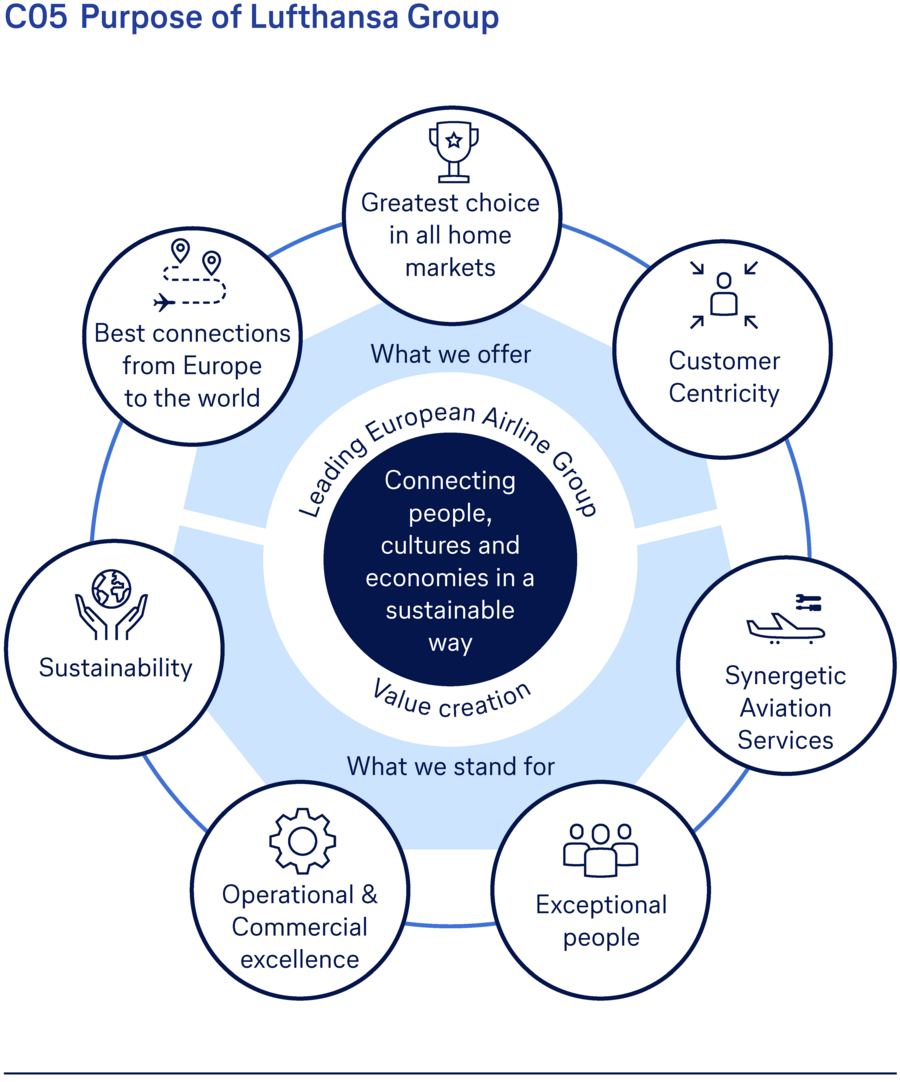
Structural transformation of the Lufthansa Group designed to boost long-term economic success
The Group’s strategy envisages structural transformation and modernisation of the Lufthansa Group. The Lufthansa Group is thus seeking to be optimally positioned in a changing, fast-paced geopolitical environment with significant impacts on demand as well as supply and value chains. It intends to systematically make use of the opportunities arising from trends and changes to the market. Services, business models and organisational structures are to be continuously aligned with the complex and dynamic market environment. The aim is to safeguard the Lufthansa Group’s leading market position and economic success. For this purpose, the Company is to become a more agile, flexible and competitive organisation. In particular, a stronger focus on its customers’ needs, accelerating innovation and digitalisation, responsibility and sustainability, modern forms of work organisation and value-based management will ensure that the Lufthansa Group is ready for the future.
The Lufthansa Group is continuing to pursue the transformation begun in recent years. For example, this includes the widening of its route network through its ITA Airways joint venture as well as the further expansion of Lufthansa City Airlines for competitive feeder services in European traffic at its Frankfurt and Munich hubs.
In addition, a structural increase in profitability is to be achieved via increased revenue and cost reductions. For this purpose, the airlines and business segments of the Lufthansa Group have initiated independent earnings improvement programmes such as Lufthansa Airlines’ turnaround programme. ↗ Lufthansa Airlines.
A group-wide transformation programme will integrate the various earnings improvement programmes and further develop the organisation and governance of the Lufthansa Group. The goal is to achieve closer and more networked cooperation between Group Functions and airlines to leverage synergies and achieve greater efficiency. ↗ Changes in business and organisation.
Customers are at the heart of things, maintaining our premium positioning is a core priority
An even greater focus on the customer is a core element of the Group strategy. The Lufthansa Group strives to consistently achieve its premium positioning, to expand its range of products and services in line with industry trends and customer feedback, and to continue to innovatively develop its loyalty programme. The focus here is, in particular, on aspects which influence repeat purchase decisions and a willingness to pay.
Through their refits with Lufthansa Allegris and SWISS Senses product generation seating, Lufthansa Airlines and SWISS offer a new travel experience in every class on long-haul routes. With the introduction of the Boeing 787 Dreamliner Austrian Airlines is also getting a new cabin layout, with high-quality service details for long-haul flights.
Progress is also being made on the automation of customer services. The digital customer portal enables customers to access all relevant information relating to their journey and resolve issues such as rebookings or refunds or purchase additional products quickly and intuitively. In addition, the continuous expansion of the Lufthansa Group Travel ID will make it possible to match services and offerings with passengers’ personal needs. ↗ Passenger Airlines.
Multi-airline business model is the basis for the Lufthansa Group’s success
The airlines form the core of the Lufthansa Group. They are positioned as high-quality carriers in their respective markets. Their nationwide presence in their home markets enables them to offer an attractive range of flights and route networks. The Lufthansa Group aims to maintain the leading market position of its airlines going forward. To this end, the Lufthansa Group’s traffic system is continuing to be developed into a multi-traffic system, consisting of hubs, point-to-point traffic and intermodal offerings.
With their wide range of destinations and frequent flights, Lufthansa Airlines and SWISS offer the greatest connectivity of all of the European airlines. Austrian Airlines, Brussels Airlines and ITA Airways offer a high-quality and attractive product which is primarily attuned to the needs of their local markets. With Eurowings, the Lufthansa Group has an innovative and competitive offering in point-to-point traffic, which addresses both price-sensitive and service-oriented customers with low-cost basic fares and additional service options that can be booked flexibly.
The Lufthansa Group will continue to pursue its fleet modernisation programme. Key targets are a reduction in fuel consumption and carbon emissions as well as costs for maintenance and operational irregularities. The number of aircraft models is to be trimmed by retiring and phasing out older, less efficient models. In the period up to 2030 the Lufthansa Group expects more than 230 new aircraft, of which 100 will be long-haul aircraft. This represents the largest fleet modernisation in the Company’s history and will play a key role in increasing its profitability and ensuring the Group’s future viability. ↗ Fleet.
In order to consistently exploit opportunities in the leisure travel market, the range of short-, medium- and long-haul routes from the hubs in Frankfurt and Munich targeting leisure travellers is being expanded. Discover Airlines supplements and strengthens the tourism portfolio of the Lufthansa Group. Passengers are thus able to benefit from the wide feeder network and the established ground processes of Lufthansa Group Network Airlines.
Cooperation with partner airlines is becoming increasingly important in order to strengthen market presence in key traffic regions and offer attractive connecting flights. The Lufthansa Group is therefore further developing its successful joint ventures and partnerships. It is also expanding its range of intermodal transport solutions.
The Lufthansa Group is also seeking to play an active role in the consolidation of the airline industry. Particular attention is being paid to the ITA Airways joint venture. Potential equity investments in other companies are always judged on the basis of their contribution to value creation.
Logistics and MRO business segments to be aligned with market needs
Lufthansa Cargo and Lufthansa Technik are global leaders in their respective sectors.
With its specialised solutions, Lufthansa Cargo focuses on goods segments with dynamic growth. The cargo airline is responding to the changing nature of globalisation with a broader geographical focus which includes a stronger presence in growth markets. In addition, Lufthansa Cargo is investing in the modernisation of its Frankfurt hub to achieve even greater freight handling efficiency. It aims to make it into the top 3 worldwide in the airfreight market.
Lufthansa Technik is a leading global provider of technical aircraft services. The company is strengthening its international presence by expanding its global production locations. At the same time, it is systematically pursuing the digitalisation and modularisation of its products and widening its portfolio to include adjacent business segments such as Defence.
Lufthansa Group to focus increasingly on sustainability and social responsibility
Responsibility is the foundation of business activities in the Lufthansa Group. It is therefore continuously expanding its environmental commitment, is dedicated to social issues and treats its employees and partners responsibly and fairly. ↗ Combined non-financial declaration.
In terms of environmental policy, the Lufthansa Group aims to cut its net CO2 emissions in half by 2030 compared with 2019 and supports the objective of making aviation carbon-neutral by 2050. By 2030, it aims to cut its CO2 emissions per revenue tonne-kilometre by 30.6% in comparison with 2019.
In order to achieve these objectives, the Lufthansa Group is investing continuously in fuel-efficient aircraft and initiating operational efficiency measures. It is also working with policymakers and partners in industry, technology and research to promote the increased use of sustainable aviation fuel (SAF).
Moreover, the Lufthansa Group includes sustainability aspects in the design of its products and services. It is helping its customers to contribute to a reduction in the climate impact of future flights through the use of SAF and support for climate change mitigation projects.
The Lufthansa Group attaches great importance to offering its staff an attractive working environment with transparent structures, efficient processes and a wide range of social benefits. It provides extensive opportunities for their ongoing development, thus contributing to employee satisfaction. Diversity and equal opportunity are seen as a strength.
In terms of social responsibility, the Company assists disadvantaged people worldwide through financial and personnel support for educational establishments and training provided by help alliance, the Group’s own charitable aid organisation.
Due to the crucial importance of sustainable action, sustainability matters are reflected in the remuneration of the Executive Board members and the management levels. The Lufthansa Group also actively supports its assessment by relevant international ESG ratings, such as MSCI, Sustainalytics and CDP, to ensure transparency regarding its activities and progress at all times.