
Financial strategy and value-based management
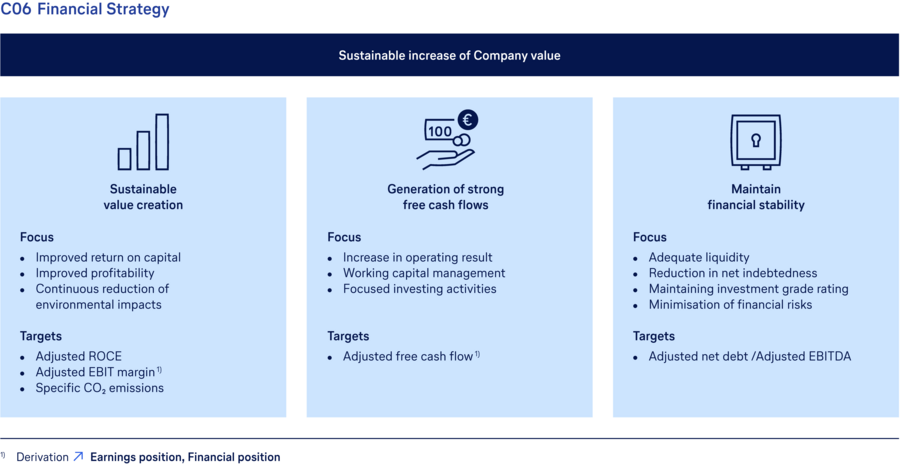
Financial strategy builds on three pillars
The financial strategy of the Lufthansa Group seeks to increase its company value in a sustainable manner. Three dimensions form the pillars for this: Sustainable value creation, Generation of strong free cash flows and Maintaining financial stability. In successfully implementing its financial strategy, the Lufthansa Group aims to contribute to the further strengthening of its balance sheet and the Group’s investment in profitable growth, enabling it to successfully overcome crises.
Finance Transformation Programme is intended to deliver improvements in the area of finance
The Lufthansa Group initiated a Finance Transformation Programme in the 2022 financial year to drive the structural development of the Group’s finance function and to strengthen it. The aim of this programme is to enhance the Company’s commercial performance and competitiveness. Its cornerstones are the improvement of financial steering, increased efficiency, the ongoing development of talent and other employees and, in particular, the modernisation of the finance IT landscape.
The Finance Transformation Programme is progressing successfully and on schedule. Significant progress was achieved in the 2025 financial year. A data model for harmonised financial data was developed, standardised financial processes were defined and a common, consolidated finance IT target architecture was approved. In addition, the Finance Academy was expanded with the addition of a broad-based, professional learning programme for the targeted ongoing development of employee skills. Since the middle of the reporting year, the focus has been on technical implementation with the goal of a successful first go-live for two Lufthansa Group airlines in January 2027. Following this pilot phase, the finance functions of all of the Group’s airlines are to be incorporated into the new system and into a new organisational structure in the course of three further rollout waves up to 2030.
Lufthansa Group announces new mid-term financial targets
At its Capital Markets Day, which took place in Munich on 29 September 2025, the Lufthansa Group set out its strategic orientation and published new mid-term financial targets.
The Company intends to maximise the synergies within the Group by consistently expanding its integrated and networked cooperation model. In addition, the existing transformation programmes, especially the turnaround programme at Lufthansa Airlines, and the extensive fleet modernisations are intended to pave the way to greater profitability for the Network Airlines.
This is intended to deliver attractive long-term returns for shareholders.
To this end, the Company aims to achieve the following financial targets in the period from 2028 to 2030:
- Adjusted EBIT margin of 8% to 10%
- Pre-tax Adjusted ROCE (return on capital employed) of 15% to 20%
- Adjusted free cash flow of over EUR 2.5bn
Maintaining a strong balance sheet will also form the basis for the realisation of financial targets. As is already the case, the Lufthansa Group will continue to strive for a solid investment grade rating from leading rating agencies in the future. To hedge against possible crises, the Lufthansa Group will continue to maintain a conservative minimum liquidity level of EUR 8bn to 10bn.
In addition, the Company will adhere to its current dividend policy which envisages the distribution of 20% to 40% of the Group’s net profit to its shareholders.
The Lufthansa Group further intends to expand the proportion of its fleet which is leased in the medium to long term. ↗ Fleet.
Sustainable value creation
Sustainable value creation requires adequate profitability
The Lufthansa Group applies a value-based system of management. At its core is the return on capital, measured as the adjusted return on capital employed (Adjusted ROCE). If Adjusted ROCE exceeds the weighted average cost of capital (WACC), this means that the Company is creating value. The underlying capital base is adjusted for the Group’s cash and cash equivalents. The system of calculating the Adjusted ROCE was revised in the 2025 financial year: in future, the Company’s value creation before tax will be shown, rather than after tax.
The Company’s value creation was positive in the 2025 financial year. Adjusted ROCE after tax was 10.3% (previous year: 9.6%), while WACC increased to 8.6% (previous year: 8.5%) in the 2025 financial year. According to the new mid-term targets, the pre-tax Adjusted ROCE is to amount to between 15% and 20% in the period from 2028 to 2030.
| T008 | Calculation of Adjusted ROCE | |||
|---|---|---|---|---|
| in €m | 2025 | 2024 | Change in % | |
| Total revenue | 39,597 | 37,581 | 5 | |
| Changes in inventories, other own work capitalised and other operating income | 3,062 | 3,186 | -4 | |
| Operating income | 42,659 | 40,767 | 5 | |
| Operating expenses | 40,890 | 39,225 | 4 | |
| Result from equity investments | 261 | 189 | 38 | |
| EBIT | 2,030 | 1,731 | 17 | |
| Adjusted EBIT | 1,960 | 1,645 | 19 | |
| ROCE1) in % | 10.7 | 10.1 | 0.6 pts | |
| Adjusted ROCE2) in % | 10.3 | 9.6 | 0.7 pts | |
| Total assets | 48,394 | 47,052 | 3 | |
| Non-interest bearing liabilities | 28,107 | 29,287 | -4 | |
| of which liabilities from unused flight documents | 5,389 | 5,183 | 4 | |
| of which trade payables, other current financial liabilities, other current provisions | 6,904 | 6,751 | 2 | |
| of which advance payments, deferred income, other non-financial liabilities | 3,932 | 3,714 | 6 | |
| of which other non-interest bearing liabilities | 3,734 | 5,151 | -28 | |
| of which liquid funds | 8,148 | 8,488 | -4 | |
| Capital employed | 20,287 | 17,765 | 14 | |
| Average capital employed | 19,026 | 17,114 | 11 | |
| WACC in %3) | 8.6 | 8.5 | 0.1 pts | |
| 1) EBIT/Average capital employed; previous year’s figures adjusted due to new calculation method (before tax). 2) Adjusted EBIT/Average capital employed; previous year’s figures adjusted due to new calculation method (before tax); Adjusted ROCE according to previous calculation method, i.e. after tax: 7.7% (previous year: 7.2%) 3) Internal management metric. |
||||
Sustainable value creation requires adequate profitability. This will in turn provide scope for entrepreneurial freedom and enable key stakeholders – investors in particular – to participate in the Company’s success.
The Company’s profitability is measured on the basis of its Adjusted EBIT margin, i.e. the ratio of Adjusted EBIT to revenue. Calculating the underlying Adjusted EBIT entails adjusting EBIT for write-downs and write-backs, earnings effects from disposals of non-current assets, effects of pension plan changes, restructuring expenses in the form of severance payments, significant costs of legal procedures and company transactions not arising in the normal course of business and other material non-recurring expenses caused directly by extraordinary external factors.
Adjustments were made in the reporting year, particularly due to book gains, especially from sales of aircraft and reversals of provisions recognised for extraordinary legal risks and restructuring, and offset by impairment losses, particularly for aircraft held for sale, and severance and restructuring expenses. ↗ T022 Reconciliation of results.
Adjusted EBIT came to EUR 1,960m in the 2025 financial year (previous year: EUR 1,645m). The Adjusted EBIT margin was therefore 4.9% (previous year: 4.4%). ↗ Earnings position.
The goal of safeguarding the Lufthansa Group’s future value creation underpins all of its investment and strategic decisions. The Group initiated comprehensive measures in the 2025 financial year in order to increase its future profitability. In particular, fleet renewal and fit-for-the-future programmes such as the turnaround programme at Lufthansa Airlines form part of a comprehensive process of change. This is intended to strengthen the Lufthansa Group in the long term and to boost its productivity and profitability. The Group also intends to leverage synergies and achieve greater efficiency through closer and more networked cooperation between Group Functions and airlines. For this purpose, the Lufthansa Group will also continue to pursue its process of digital transformation over the next few years.
The Lufthansa Group expects this to deliver significantly increased profitability by the end of the decade. According to new mid-term targets, an Adjusted EBIT margin of between 8% and 10% is to be realised in the period from 2028 to 2030. ↗ Forecast.
Furthermore, the Lufthansa Group incorporates the specific carbon emissions into its management system to lower the associated costs by reducing environmental impacts. This facilitates sustainable value creation, positively affects financing conditions and is also factored into management remuneration. Specific carbon emissions per passenger-kilometre were 85.4 grammes in 2025, 2% lower than in the previous year (previous year: 87.5 grammes). Information about the long-term goals for reducing carbon emissions can be found in the ↗ Combined non-financial declaration.
Cost and efficiency management safeguard future viability
In the next few years, the Lufthansa Group envisages significant cost increases, in particular due to sustainability-related expenses which will arise on regulatory reasons, such as the SAF quota and the discontinuation of free CO2 emissions certificates. Other cost items such as fees and charges and staff costs are also expected to increase. The Lufthansa Group therefore expects its unit costs to remain under pressure due to factors including ongoing cost inflation.
In response to unavoidable cost increases, it is focusing on increasing unit revenues through targeted revenue-increasing measures. The ongoing capacity restrictions in the market are expected to make an additional contribution to stabilising revenues across the market.
It is therefore necessary to carefully weigh up the different options of increasing market shares, boosting yields or allocating production capacity to different flight operations. The growth is intended to increasingly take place in flight operations with high productivity and low unit costs.
In order to preserve its competitiveness, the Company has also reviewed and implemented programmes to increase its cost-related efficiency and productivity as well as further cost-reduction measures. Operational units – from the Company’s fleet to its staff – and administrative functions must both contribute to this.
In response to cost pressure, efficiency improvement programmes were already launched for the Passenger Airlines in 2024. These target more efficient use of crews and the fleet. This involves, in particular, Lufthansa Airlines’ turnaround programme with a volume of measures planned to impact earnings with around EUR 1.5bn in 2026 and around EUR 2.5bn in 2028. In the reporting year, the Group-wide efficiency and earnings improvement programmes were combined and the Group Executive Board receives regular reports on them. ↗ Passenger Airlines.
Generation of strong free cash flows and effective capital allocation
Financial management aims for strong free cash flows
The generation of strong free cash flows is a clear focus of the Lufthansa Group’s financial strategy, with the aim of creating value for its shareholders and further reducing its volume of debt in the long term. In addition to increasing the operating result, the key levers for this are strict cash and working capital management as well as focused investing activities.
Free cash flow also plays a major role for the variable remuneration of many employees, particularly of managers, and in the performance dialogues with the business entities. With this, the organisation is continuously made aware of its influence on company value and incentives are established to increase the level of free cash flows.
According to the new mid-term targets, Adjusted free cash flow is to exceed EUR 2.5bn per year in the period from 2028 to 2030.
The Lufthansa Group achieved a positive Adjusted free cash flow of EUR 1,188m in the 2025 financial year (previous year: EUR 840m). ↗ Financial position.
Improvements in working capital management support cash flow generation
Working capital management is to be further intensified. This includes targeted measures such as strict receivables management, optimising payment terms with suppliers, improvements to procurement processes and maintenance of inventories, in particular at Lufthansa Technik.
Focused investments are intended to increase return on capital employed
The strategic goals of the Group and its business segments, and the portfolio roles of the different Group companies provide the framework for the allocation of capital and for investment decisions. All investment projects should contribute to sustainable value creation, i.e. profitability above and beyond the weighted average cost of capital (WACC).
The Lufthansa Group is extensively investing in the modernisation of its fleet, on-board and ground products, digitalisation and infrastructure. It is largely replacing older, less efficient aircraft with new models and thereby sustainably increasing its profitability through increased fuel efficiency and reduced maintenance costs, for example. The allocation of new aircraft to the different airlines and bases follows value-based criteria and is continuously optimised.
Sale-and-leaseback transactions to finance the modernisation of the fleet were completed in the reporting year: a total of 19 aircraft were sold to lessors and then leased back.
The Lufthansa Group increased its investment volume in the reporting year. Compared with the previous year, net capital expenditure (without acquisition and disposal of equity investments) declined by 9% to EUR 2,460m (previous year: EUR 2,698m). Advance and final payments for aircraft and aircraft components along with aircraft and engine overhauls account for most of this expenditure. ↗ G12 Primary, secondary and financial investments.
Continuous dividend distribution aimed for
The Company plans for its shareholders to regularly participate directly in its success with an attractive dividend. This is intended to make the Company more attractive, including for investors with a long-term investment horizon.
The Lufthansa Group’s dividend policy is to distribute to its shareholders 20% to 40% of the Group’s net profit, adjusted for non-recurring gains and losses. One condition for the payment of a dividend is that the net profit for the year as shown in the individual financial statements of Deutsche Lufthansa AG that are drawn up under German commercial law allows for a distribution of the relevant amount. The Group’s dividend policy has been confirmed in its new mid-term targets.
In line with the dividend policy, the Executive Board and Supervisory Board will table a proposal at the Annual General Meeting on 12 May 2026 to distribute a dividend of EUR 0.33 per share to shareholders for the 2025 financial year. This represents a total dividend payment of EUR 396m or 30% of net profit for 2025, which is a higher percentage than the previous year, when 26% of net profit was distributed. ↗ Earnings position.
Maintaining financial stability
Liquidity expected to amount to between EUR 8bn and EUR 10bn in future
The coronavirus pandemic demonstrated that a sufficient level of minimum liquidity is vital in the event of global crises, which generally have a particularly severe impact on airlines. To ensure the requisite volume of liquidity for an extreme crisis scenario, as well as to cover operational expenses, it is also necessary to safeguard capacity to repay working capital liabilities, in particular advance payments received from customers for flight documents not yet used. The Lufthansa Group aims to achieve minimum liquidity of between EUR 8bn and EUR 10bn to reduce liquidity risks and thus protect the Group against possible crises. This has been confirmed in its new mid-term targets. For capital efficiency reasons, part of the strategic liquidity reserve is held in the form of a revolving line of credit.
Including its freely available credit lines at year-end 2025, the Company’s available liquidity amounted to EUR 10.7bn (31 December 2024: EUR 11.0bn). ↗ Financial position.
Objective is to reduce gearing
The Lufthansa Group’s long-term financial strategy continues to focus on ensuring a low level of gearing, primarily by achieving strong free cash flows and optimising net indebtedness.
The gearing is measured as Adjusted net debt/Adjusted EBITDA; the ratio takes into account both net indebtedness (including the financial obligations arising from lease agreements, primarily for property and aircraft) and net pension obligations. These are actively managed. To limit any further increase in its liabilities, the Lufthansa Group has largely switched over to a defined contribution pension system. For its largest remaining defined benefit pension plans, the allocation of the pension assets has been adjusted in the context of the introduction of a liability driven investment (LDI) system. This is intended to align the sensitivity of plan assets to interest rates more closely to that of pension obligations in order to permanently reduce the level of volatility of pension provisions.
Net indebtedness stood at EUR 6,406m at the end of the 2025 financial year. Despite the positive free cash flow, net indebtedness was up by 12% on the previous year (previous year: EUR 5,744m) due to interest and dividend payments and additional lease liabilities, in particular from the sale and leaseback transactions. By contrast, due to interest rates, net pension obligations declined by 26% to EUR 1,902m in the reporting year (previous year: EUR 2,566m). In combination with the higher Adjusted EBITDA, the ratio of Adjusted net debt/Adjusted EBITDA fell to 1.8 (previous year: 2.0) as of year-end 2025. ↗ Assets.
| T009 | Adjusted Net Debt/Adjusted EBITDA | |||
|---|---|---|---|---|
| 2025 | 2024 | Change | ||
| in €m | in €m | in % | ||
| Net indebtedness 1) | 5,909 | 5,497 | 7 | |
| Net pension obligations | 1,902 | 2,566 | -26 | |
| Adjusted Net Debt | 7,811 | 8,063 | -3 | |
| Adjusted EBIT | 1,960 | 1,645 | 19 | |
| Depreciation, amortisation and impairment | 2,369 | 2,337 | 1 | |
| Adjusted EBITDA | 4,329 | 3,982 | 9 | |
| Adjusted Net Debt/Adjusted EBITDA | 1.8x | 2.0x | -0.2x | |
| 1) In order to calculate Adjusted net debt, 50% of the hybrid bond issued in 2015 (EUR 247m) and 50% of the hybrid bond issued in 2025 (EUR 250m) have been discounted here. Calculation of net indebtedness ↗ Financial position. | ||||
Securing the investment grade rating
Deutsche Lufthansa AG has received an investment grade rating from all the leading rating agencies.
Standard & Poor’s, Fitch Ratings and Scope Ratings have all given Deutsche Lufthansa AG an investment grade rating of BBB-, outlook stable. Moody’s rating is Baa3, which is likewise investment grade, with a stable outlook.
| T010 | Development of ratings | |||||
|---|---|---|---|---|---|---|
| Rating/outlook | 2025 | 2024 | 2023 | 2022 | 2021 | |
| Standard & Poor’s | BBB-/stable | BBB-/stable | BBB-/stable | BB/positive | BB-/stable | |
| Moody’s | Baa3/stable | Baa3/stable | Ba1/stable | Ba2/stable | Ba2/negative | |
| Scope Ratings | BBB-/stable | BBB-/positive | BBB-/positive | BBB-/stable | BBB-/negative | |
| Fitch Ratings | BBB-/stable | BBB-/stable | BBB-/stable | |||
The Group strives to be rated as investment grade on a lasting basis. Investment grade ratings for the Company’s debt ensure good access to the capital markets and low funding costs and thus financial flexibility. Conditions for an investment grade rating are good profitability and adequate gearing, among other aspects.
Lufthansa Group benefits from good capital market access and utilises diversified funding sources
The Lufthansa Group successfully raised new funds on the capital market again in the 2025 financial year, benefiting from attractive conditions associated with its investment grade rating. It has borrowed a total volume of EUR 2,266m through the placement of a hybrid bond, a convertible bond, eight borrower’s note loans and six aircraft financing transactions. The Lufthansa Group also made use of various other financing instruments, such as sale-and-leaseback transactions and Japanese operating leases. ↗ Financial position.
Future financing activities will likewise be based on the need for capital expenditure and will aim to minimise financing costs. Financing activities are mainly determined by the Lufthansa Group’s rating as well as market conditions. A broad financing mix, favourable financing costs, a balanced maturity profile and a diversified portfolio of lenders are achieved through the differentiation of financing instruments. ↗ C15 Maturity profile of financial liabilities.
New loans or bonds generally have either fixed or floating rates of interest. The Lufthansa Group pursues a net fix hedging strategy. This means the volume of floating-rate liabilities should not exceed the volume of funds invested at a floating interest rate. Net debt is thus subject to a fixed interest rate and market-wide interest-rate changes do not have any material impact on the Group’s interest burden. This strategy is managed primarily by means of derivatives.
Structured risk management minimises finance risks
The Group’s financial stability is also ensured through integrated risk management. Hedging fuel, exchange rate and interest rate risks minimises the short-term financial risks for the Lufthansa Group. The hedges smooth price fluctuations by means of rule-based processes. Changes in fuel costs can therefore be taken into account in pricing at an early stage. ↗ Opportunities and risk report, Notes to the consolidated financial statements, Note 45.