
Employees
Human resources management prepares the Company for the future and creates prospects for employees
The Lufthansa Group’s employees play an indispensable role in its success. In the 2025 financial year, human resources management was once again a key pillar on which the future of the Lufthansa Group will be built. At the heart of this is a corporate culture which combines economic success with commitment, well-being and sustainable employability. With its Cultural Journey programme, the Lufthansa Group is continuously strengthening this culture and adapting it in line with the changing needs of society as well as its workforce and stakeholders.
The Company-wide employee survey “involve me!” is providing important insights into strategic areas of action and leading to their integration within the Group’s HR strategy. The Lufthansa Group’s approach encompasses equal opportunities, diversity, flexible career paths, professional training and a work-life balance. The Company is creating modern work models which take account of employees’ individual life stages and promote a partnership-based, transparent culture. The Lufthansa Group is thus safeguarding its position as an attractive employer, retaining talent on a long-term basis and enabling employees’ personal and career development. ↗ Combined non-financial declaration.
Number of employees increases in the reporting year
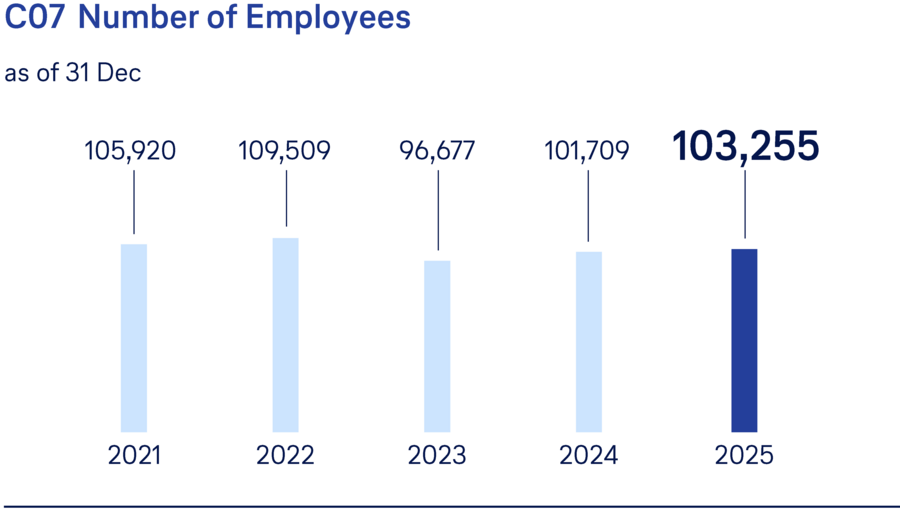
At year-end 2025, the Lufthansa Group had 103,255 employees worldwide (previous year: 101,709). Accordingly, the number of employees had risen by 1,546, or 2%, in the reporting year. This increase is mainly attributable to successful recruitment measures in operational areas in particular.
Translated into full-time positions, the Group had 86,610 employees at the end of 2025 (previous year: 84,215). This represents a year-on-year increase of 2,395 or 3%.
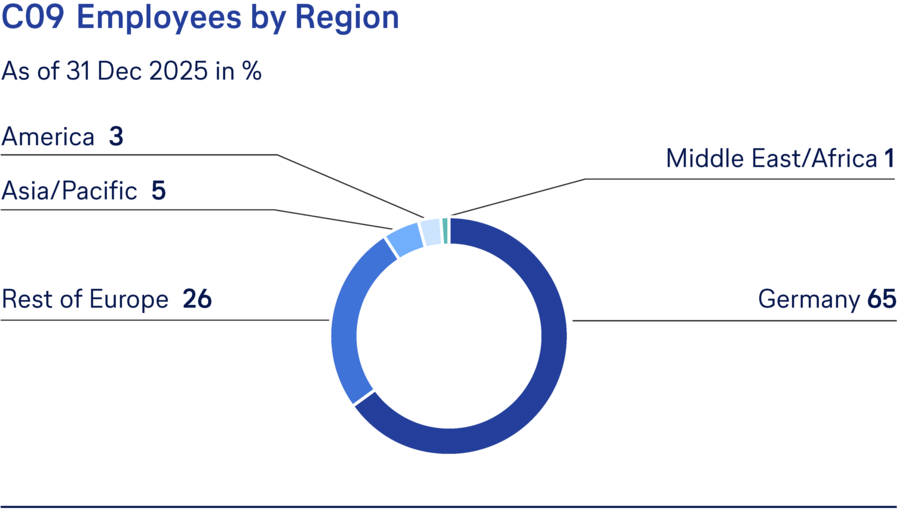
In Germany, the Group had 67,091 employees: 755, or 1%, more than in the previous year (previous year: 66,336). The Group’s employees in Germany therefore accounted for 65% of its overall workforce (previous year: 65%). The number of employees outside Germany increased by 791 or 2% to 36,164 (previous year: 35,373).
As of the reporting date, the average age of the workforce was 42.4 years (previous year: 42.1 years). Average seniority was 13.9 years (previous year: 13.7 years). 35% of employees worked part-time in the reporting year (previous year: 35%). The fluctuation rate remained at 6% (previous year: 6%).
At year-end, 1,685 apprentices were in training or on combined degree courses offered by the Lufthansa Group worldwide (previous year: 1,860).
Lufthansa Group intends to cut around 4,000 jobs by 2030
The Lufthansa Group’s strategic objectives envisage changes to the Group’s organisational and operational structure. The goal is to achieve closer and more networked cooperation between Group Functions and airlines to leverage synergies and for greater efficiency. ↗ Group strategy.
This more strongly integrated cooperation model will result in significant changes to processes and structures in terms of cooperation with the Group companies. On this basis, the Company is reviewing which activities will no longer be required in future, e.g. due to duplication. In particular, the far-reaching upheavals resulting from digitalisation and the increased use of artificial intelligence will deliver efficiency gains in many areas and processes.
Due to these developments and structural adjustments, the Lufthansa Group plans to cut around 4,000 jobs worldwide in the period up to 2030, mainly in Germany. These cuts will be implemented in consultation with Lufthansa’s labour union partners. The focus here is on administrative roles rather than operational roles.
Important agreements signed with collective bargaining partners
In the 2025 financial year, the Lufthansa Group, represented by the relevant industry associations or companies, reached the following new wage and collective agreements with its collective bargaining partners. ↗ Opportunities and risk report, Human resources.
The Employers’ Federation for Air Transport Companies (AGVL) and the cabin staff union Unabhängige Flugbegleiter Organisation e.V. (UFO) signed a new collective bargaining agreement on part-time work for Lufthansa Airlines’ roughly 19,000 cabin staff with effect from 1 January 2025. This collective bargaining agreement better reflects the seasonality of the airline business: in future, working time models will enable the balanced use of employees’ work capacity throughout the year while placing the leisure phases of partially retired employees mainly within low demand periods. The list of potential models has been significantly scaled back and rules have been incorporated to simplify the allocation process. This agreement has a minimum term which expires at the end of 2027.
Following the independent flight attendants’ union UFO’s termination of the framework collective bargaining agreement for the cabin crew in the autumn of 2024, since the start of 2025 this agreement has remained in force pending a new settlement.
The collective agreements on transitional and retirement benefits for the cockpit staff of Lufthansa Airlines and Lufthansa Cargo are still open. No wage settlement has been reached here. After the Vereinigung Cockpit pilots’ union (VC) declared that the negotiations on pension agreements had failed and initiated a strike ballot, a majority of the union’s members voted to take industrial action.
At SWISS, a capacity agreement was signed for cockpit crew in 2025 with the goal of relieving shortages through voluntary measures including a voluntary increase in the retirement age. This agreement applies until 31 October 2026. For ground staff, an agreement has been concluded for the permanent night shift at Lufthansa Technik. This move was prompted by the expiry of a special government scheme at the end of 2025 and the resulting need to negotiate a new maximum shift time for the permanent night shift. It remains in force up to the end of 2026 or until a new collective agreement is signed.
In April 2025, Edelweiss concluded a collective agreement with the cabin union Edelweiss Air Flight Attendant Association (EFA) with a minimum term running from May 2025 to April 2030. This collective agreement offers attractive work conditions and includes an absolute no-strike obligation. It thus guarantees stability and business planning certainty.
Eurowings GmbH has concluded a collective bargaining agreement with the trade union Vereinigte Dienstleistungsgewerkschaft (ver.di) for its roughly 1,800 cabin staff. The agreement provides for salary increases of 4% and 3% in February and August 2025 and 2.4% in August 2026. In addition, a profit-sharing scheme and a one-off payment of EUR 1,000 have been agreed. Two new collective wage agreements for roughly 700 ground staff at Eurowings Aviation GmbH have likewise been concluded with ver.di. These stipulate an increase in the remuneration tables of 3.7% (but at least EUR 180), 3.5% and 2.2% in January 2025, 2026 and 2027 respectively and a monthly increase of EUR 100 in the remuneration received by apprentices and students on combined degree programmes. These two collective agreements each have a minimum term of 30 months.
Developing a sustainable relationship between collective bargaining partners
Within the scope of its social and collective bargaining policies, the Lufthansa Group aims to define good working conditions and fair salary arrangements which strike a balance between the interests of the companies and employees in every part of the Group. Longer-term agreements establish planning certainty for both parties. The agreements concluded in the reporting year achieved this in some contexts.