
Strategy
SBM-1 – Strategy, business model and value chain
Core elements of the general corporate strategy have an impact on sustainability matters
The Lufthansa Group offers its customers short-haul, medium-haul and long-haul flights worldwide. These are primarily provided by its five biggest Passenger Airlines: Lufthansa Airlines, SWISS, Austrian Airlines, Brussels Airlines and Eurowings. Additional services are provided by the tourist airlines Discover Airlines and Edelweiss. The Lufthansa Group also expanded its portfolio of Passenger Airlines by acquiring a stake in ITA Airways. Customers can also use the services of Lufthansa Cargo to transport goods around the world. Finally, the Lufthansa Group portfolio includes the technical maintenance of aircraft by Lufthansa Technik, IT services delivered by Lufthansa Systems, and vocational and professional training for flight and technical personnel through Lufthansa Aviation Training. The Lufthansa Group continuously expands its product portfolio in order to address strategic topics. In 2023, it introduced the “Green Fares” product, which enables customers to contribute to reducing the climate impact of future flights by using SAF and supporting climate change mitigation projects to offset their estimated individual flight-related CO₂ emissions. This product underlines the Lufthansa Group’s commitment to greater energy and resource efficiency.
The Lufthansa Group offers its products and services to both private and corporate customers and is active around the globe. Its multi-hub strategy offers customers of its Passenger Airlines an extensive route network with the corresponding flexibility in travel. The Eurowings business, by contrast, is focused exclusively on point-to-point traffic on European short-haul and medium-haul routes.
Moreover, commercial joint ventures with leading international airlines extend the Passenger Airlines route network. Commercial joint ventures exist with United Airlines and Air Canada on routes between Europe and North America, and with All Nippon Airways (ANA), Singapore Airlines and Air China on routes between Europe and Japan as well as Singapore and China respectively. In addition, the Lufthansa Group maintains so-called code-share agreements, under which a flight is operated by one airline while several partner airlines market the same flight under their own flight numbers. The Lufthansa Group is also driving the expansion of its offering in the dynamically growing markets of Asia in order to strengthen its presence and leverage additional growth opportunities through expanded route networks and strategic partnerships.
The Lufthansa Group is a global company based in Europe, operating flights to Europe, North, Central and South America, the Asia/Pacific region, the Middle East and Africa from its five main hubs (Frankfurt, Munich, Zurich, Vienna, Brussels). Lufthansa Technik also provides MRO repair shops and carries out aircraft overhauls in the Asia/Pacific region, Europe, the Middle East, Africa and North, Central and South America.
| T051 | ESRS 2 SBM-1 | 40a Distribution of employees by region1) as of the reporting date 31 Dec 2025 | |||
|---|---|---|---|---|
| Region | 2025 | 2024 | ||
| Germany | Headcount | 67,091 | 66,290 | |
| North/Central America | Headcount | 2,723 | 2,616 | |
| South America | Headcount | 226 | 222 | |
| Europe, other | Headcount | 27,690 | 26,470 | |
| Asia/Pacific | Headcount | 4,760 | 5,061 | |
| Middle East/Africa | Headcount | 765 | 763 | |
| Total number | Headcount | 103,255 | 101,422 | |
| 1) Based on regions of deployment. | ||||
In certain circumstances, such as armed conflicts, the Lufthansa Group may decide to or may be obligated to temporarily halt flights to specific countries. For example, the airlines of the Lufthansa Group did not have access to Russian airspace during the reporting year.
In 2025, the Lufthansa Group was active in the following ESRS sectors and generated the following revenue:
| T052 | ESRS 2 SBM-1 I 40b Revenue by ESRS sector in 2025 | ||||
|---|---|---|---|---|---|
| Business segment | ESRS sector | Activity | Revenue in the ESRS sector in 2025 in €m |
Revenue in the ESRS sector in 2024 in €m | |
| Passenger Airlines | Other transport services (TTR) | Activity H.51.10 Passenger air traffic for the Passenger Airlines | 29,760 | 28,905 | |
| Logistics | Other transport services (TTR) | Activity H.51.21 Air cargo for Lufthansa Cargo | 3,355 | 3,213 | |
| MRO1) | Defence (MDE) | Activity C.33.16 Repair and maintenance of aircraft and spacecraft for Lufthansa Technik | 6,044 | 4,898 | |
| 1) Previous year’s figures adjusted due to reclassification of Lufthansa Industry Solutions. | |||||
The ESRS sectors listed were also taken into account in the Lufthansa Group’s double materiality assessment. Guided by this materiality assessment, the Lufthansa Group identified the most important topics on which to base its strategy.
In the area of the environment, the Lufthansa Group pursues the aim of minimising greenhouse gas emissions and waste on board. By 2030, the Company aims to achieve a net reduction in CO2 of 50% in comparison with 2019. This target applies to air operations worldwide and includes both passengers and cargo clients. Furthermore, the Lufthansa Group also plans to phase out single-use plastic and aluminium on board – an aim that covers global air passenger operations.
With regard to social topics, the Lufthansa Group pursues targets for boosting customer satisfaction and diversity. Customer satisfaction is a central aim for the Lufthansa Group and applies to all products and services globally, as well as to all customer groups for the Company’s individual segments. In the area of diversity, a target was set to achieve a 25% share of women in management positions by the end of 2025. To assess the attractiveness of its working conditions, the Lufthansa Group set itself the target of achieving an employee engagement index of 3.6 in 2025. Finally, in terms of governance, the Lufthansa Group strives to ensure ethical conduct in all of its business relationships and compliance with all legal and regulatory requirements.
The companies in the Lufthansa Group carry on their business activities from Europe, in particular from Germany, Austria, Switzerland and Belgium. As a result, most of the site-specific impacts, risks and opportunities can be attributed to one of these countries. Because flights are the main source of greenhouse emissions in flight operations, the climate change impacts cannot be limited to a specific place or market.
The biggest challenge is achieving the climate target by 2050. The Lufthansa Group is therefore investing in aircraft featuring new technologies with increased fuel efficiency along with other environmental projects, and is adapting to stricter environmental requirements.
The Lufthansa Group business model extends across several value creation stages
The Lufthansa Group business model includes passenger and cargo flights, MRO services as well as IT and logistics services in particular.
Some of the biggest production factors are fuel, aircraft, replacement parts, infrastructure services from third parties (for example, airport services and air traffic control) and qualified staff. These advance expenses are guaranteed through long-term agreements with reliable suppliers and investments in training programmes for the Company’s own staff.
The core activities (outputs) extend across the following areas:
- Procurement and operation of aircraft: purchase or leasing of aircraft, goods and services for their maintenance and operation, as well as the operation of flights
- Flight services: passenger and cargo services, including distribution, logistics services, flight planning, airport handling, flight operations, customer support and catering
- Additional services: maintenance, repair and overhaul of aircraft, including defence, provision of IT and digital transformation solutions and consultancy services, flight training and advanced training for cockpit crews, cabin crew and other airlines.
In 2025, the Lufthansa Group generated revenue by providing passenger and cargo flight services, MRO services and logistics and IT solutions. The current and expected benefits to customers include improved travel experiences, better punctuality and reduced CO2 emissions. Investors benefit from increased financial performance; other stakeholders benefit from the strong market position and sustainable business practices of the Lufthansa Group.
SBM-2 – Interests and views of stakeholders
The Lufthansa Group identified the following groups as their most important stakeholders:
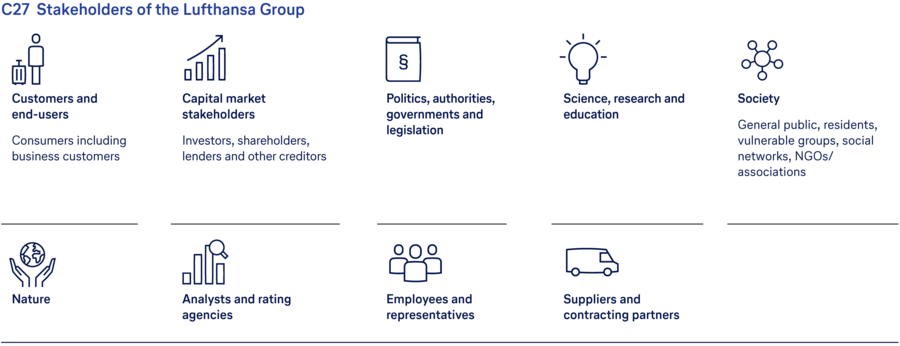
The Lufthansa Group places great emphasis on open, continuous and trusting dialogue with its internal and external stakeholder groups and engages with them through a range of different formats. In 2023, a comprehensive stakeholder survey was conducted in order to obtain more in-depth findings. By involving more than 10,000 external individuals, external perspectives were incorporated. The Company communicates with its investors via roadshows, investor conferences and direct dialogue, as well as, in the reporting year, as part of a Lufthansa Group Capital Markets Day. Customer engagement is supported through panels and customer surveys, as well as through an event held several times a year entitled “Customer Touch”, at which customers can share their experiences directly with a Lufthansa Group management panel. Interaction with employees takes place via established formats. These include “frankly speaking”, where the Chief Executive Officer and other members of the senior management answer questions from employees, and the “involve me!” annual employee survey. Residents in airport regions are integrated into the process through dialogue formats with local representatives at the Company’s key airports, as is the case with the ongoing dialogue in the Airport/Region forum in Frankfurt. Furthermore, the Lufthansa Group reports on its activities and progress in various formats, such as in the progress report on the UN Global Compact. In the annex to the management report, the Company also provides a TCFD (Task Force on Climate-related Financial Disclosures) Index that is relevant to the capital market in order to ensure transparency and the continuous involvement of stakeholders. ↗ T222 TCFD Index
| T053 | ESRS 2 SBM-2 | Stakeholder dialogue formats of the Lufthansa Group | |
|---|---|---|
| Stakeholder group | Stakeholder dialogue formats | |
| Employees and employee representatives | - Dialogue formats between the Executive Board and employees - Employee survey - Works council conference - Social partner dialogue within the Company - Complaint channels - Intranet | |
| Customers (B2B, B2C) | - Dialogue and exchange formats and events with selected top customers - Passenger surveys, for example after the flight or during the flight - Customer surveys - “Co-creation hub” for the submission of customer feedback and suggestions - Customer involvement in product development, for example through workshops - Complaint channels | |
| Investors Capital market stakeholders Analysts |
- Capital Markets Day - Bilateral dialogues - Investor roadshow - Conferences - Publications and reports on websites | |
| Politics & authorities | - Meetings and dialogue formats - Publications on websites - Position papers and public briefs, e.g. Policy Brief - Participation in industry initiatives | |
| Public/civil society | - Social media channels - Publications on websites - Participation in committees and expert working groups, for example in local aircraft noise committees - Media formats, for example interviews - Complaint channels | |
| Science & research | - Participation in committees and expert working groups | |
| Suppliers Business partners |
- Surveys - Direct dialogues - Supplier portal - Trade fairs - Participation in working groups - Participation in industry initiatives - Cross-industry dialogues - Complaint channels | |
The Lufthansa Group organises its stakeholder involvement via a coordinated structure that combines both centralised and decentralised efforts. The centralised coordination is managed by the relevant departments, such as Investor Relations and Corporate Communications, while the HR department manages the employee involvement initiatives, including employee surveys. The decentralised involvement is organised by the relevant local sites in order to ensure that the communication is tailored to the requirements of the communities and other local stakeholder groups.
Responsible corporate governance benefits from dialogue with the Company’s stakeholders. This continuous exchange aims to help the Lufthansa Group better understand its different interest groups’ needs, expectations and wishes, which permits their inclusion in business practices. Topics that can potentially impact long-term opportunities for creating value can thus be better identified. The materiality assessment conducted as part of the CSRD-compliant reporting also included the dialogue with various stakeholder groups and internal representatives.
The results of the stakeholder involvement were used in the Lufthansa Group’s materiality assessment and its validation in the 2025 reporting year. This serves as the basis for the strategic development of its corporate responsibility management and the selection of the aspects and issues addressed in the combined non-financial declaration. Beyond the materiality assessment itself, these results are also used for product development in order to ensure that the Company’s offering meets the expectations and requirements of its stakeholders.
The Lufthansa Group regards the interests and perspectives of its stakeholders as a contribution towards helping to shape its strategy and business model. These findings are collected systematically via various dialogue formats and through the materiality assessment. The stakeholder survey covered all ESRS topics and other relevant sustainability-related topics, such as social commitment. Internal experts also represented and incorporated the perspectives of stakeholders as part of the validation of the materiality assessment in 2025. All sustainability-related topics deemed material are integrated into the strategic initiatives and the Company’s business practices.
Some examples of how the business model is adapted to the interests and perspectives of stakeholders include the expansion of holiday routes as a response to customer demand and the introduction of products designed to contribute to future reductions in climate impact. The Company is also continuously improving intermodal travel options by reducing the dependence on short-haul flights by integrating train and bus connections, thus helping to achieve other sustainability targets. The route network is adapted while taking into account political and safety-relevant factors in order to guarantee passenger safety.
Furthermore, the Lufthansa Group continued to expand its offering for more sustainable flying. Green Fares were expanded from inner-European to intercontinental routes in December 2024, for instance. Green Fares combine the use of sustainable aviation fuels (SAF) with contributions to certified climate change mitigation projects at a ratio of 20% CO2 savings through SAF / 80% CO2 emissions avoided or removed through climate change mitigation projects in Europe and 10% CO2 savings through SAF / 90% CO2 emissions avoided or removed through climate change mitigation projects on intercontinental routes. Further incentives were also introduced in the reporting year to make more sustainable flying more attractive. Particularly noteworthy is the extension of Miles & More: as of September 2025, its members collect miles and points for voluntary contributions to SAF and climate change mitigation projects. Other options are available to customers through various digital services, in-flight media and post-flight contributions to climate change mitigation projects. Overall, the share of bookings with a more sustainable flying option rose in the reporting year from 4% to around 5%, which represents relative growth of 25%. The ongoing development of these offers is an explorative process with no fixed timetable. However, the Lufthansa Group does expect the expansion of more sustainable flying options to raise customer awareness of climate change mitigation and have a positive long-term impact on important stakeholder relationships. At the same time, it represents an incremental adaptation of the existing strategies and elements of the business model. Further information on Green Fares can be found at ↗ S4-4 – Taking action on material impacts on consumers and end-users, and approaches to managing material risks and pursuing material opportunities related to consumers and end-users, and effectiveness of those actions
The Lufthansa Group wishes to ensure that the perspectives and interests of relevant stakeholders are communicated effectively to the relevant decision-making bodies with regard to sustainability-related impacts of the Company. The results of the materiality assessment, which is also based on stakeholder assessments, are validated by the management and then presented to both the Executive Board and the Supervisory Board. Updates and more in-depth treatments of specific sustainability topics are also presented by the ESG Committee twice a year.
SBM-3 – Material impacts, risks and opportunities and their interaction with strategy and business model
| T054 | ESRS2 SBM-3 | 48 Material impacts, risks and opportunities in 2025 | ||||||||
|---|---|---|---|---|---|---|---|---|---|
| Aggregated aspects | IRO | Allocation of value chain | Time horizon | Impacts on people and the environment/financial risks and opportunities | Influence of material IROs on the business model, supply chain, strategy and decision-making of the Lufthansa Group | How the Company responded to this influence or intends to respond to it | Current financial effects | Material changes in comparison with 20241 | |
| E1 – Climate change | |||||||||
| Extreme weather events | Negative impact | Upstream, own, downstream |
Long-term | Adjusting to extreme weather events may require disruptive changes to processes or sites, which may have a negative impact on customers, suppliers, business partners or communities. This will affect flight routes or airport infrastructure (runways), among other areas, which could lead to an increase in fuel consumption and greenhouse gas emissions, as well as higher prices for customers. |
Influences and expenses caused by climate change adaptation are considered by the climate risk analysis. See also ↗ ESRS E1 Climate change – Climate-related risks and opportunities for the Lufthansa Group have been identified and ↗ ESRS E1 Climate change – Resilience analysis has been updated and resistance to climate change has been analysed. | Adaptation measures, particularly for heatwaves, are described in ↗ ESRS E1 Climate change – Measures to mitigate climate-related physical and transition risks are being continued. | No current financial effects | ||
| Risks | Upstream, own, downstream |
Medium- to long-term | Physical climate risks and changing customer preferences can lead to higher operational and maintenance costs, delay flights and cargo, place pressure on fuel procurement and reduce service reliability. This could potentially jeopardise the stability, brand and financial performance of the Lufthansa Group. | ||||||
| Opportunity | Own, downstream |
Medium-term | Use of the en-route weather display may improve climate and weather forecasts, allowing the Lufthansa Group to protect itself against higher insurance premiums and improve its reputation. | ||||||
| Regulatory and market risks | Risk | Upstream, own, downstream |
Medium- to long-term | Political/regulatory climate change mitigation measures in aviation, such as a CO2 tax or quotas for sustainable aviation fuel (SAF), could influence the adjustment of the Company’s own operating processes (increasing costs and refinancing requirements). Non-compliance could result in fines, reputational damage or the loss of operating licences. In addition, declining sales volumes are to be expected, as travel becomes less affordable and the Lufthansa Group faces higher fuel and emissions costs due to stricter emissions limits and a reduced allocation of free emissions certificates. Stricter EU climate change mitigation requirements may move long-haul connections to hubs outside the EU and thus distort the competition with airlines from the Middle East. |
Physical and transition risks are analysed in particular through the climate risk analysis. See also ↗ ESRS E1 Climate change – Climate-related risks and opportunities for the Lufthansa Group have been identified and ↗ ESRS E1 Climate change – Measures to mitigate climate-related physical and transition risks are being continued and ↗ ESRS E1 Climate change – Four-pillar climate change mitigation strategy addresses four areas for action. | Various measures to manage transition risks are planned and listed under ↗ ESRS E1 Climate change – Economic instruments represent the fourth pillar of the climate change mitigation strategy. | Higher costs due to expected price trend for ETS certificates. ↗ Financial position | ||
| Negative impact | Own, downstream |
Medium-term | Both the reduction of certificates under the Emissions Trading Scheme (ETS) and the potential adoption of new trading schemes could increase ticket prices, which would affect customers in Europe and beyond. | ||||||
| Impacts of CO2 emissions on climate change | Negative impact | Upstream, own, downstream |
Medium- to long-term | Direct CO₂ emissions from energy-intensive and polluting processes in ground and flight operations, as well as in the training of flight crews, have a negative impact on the climate. Emissions in the upstream and downstream value chain, such as those caused by airport services, the manufacture of kerosene, engine manufacturing and aircraft disposal, also contribute to climate change. | The four-pillar strategy details how climate change mitigation is enshrined in the corporate strategy and decision-making process. Additional information is available in chapter ↗ ESRS E1 Climate change – Four-pillar climate change mitigation strategy addresses four areas for action. | Various measures to reduce CO2 emissions and fuel consumption are described in detail in chapter ↗ ESRS E1 Climate change – Actions and resources in relation to climate change policies. | Higher costs due to expected price trend for ETS certificates. ↗ Financial position | ||
| Opportunity | Upstream, own, downstream |
Medium- to long-term | Climate change mitigation measures such as fleet modernisation, investments in fuel-efficient aircraft, the use of SAF and the expansion of intermodal transport reduce fuel consumption as well as operating and procurement costs. They also encourage innovation, strengthen the brand value and increase attractiveness for customers and investors. In addition, higher revenues and business growth can be achieved through the development of new markets, the expansion of the customer base and the development of internal climate change mitigation solutions. The Lufthansa Group’s AeroSHARK technology reduces fuel consumption and CO2 emissions across the long-haul fleet and for cargo customers, lowering operating costs and increasing sales volumes at Lufthansa Technik. Reducing specific CO2 emissions is a key sustainability target and is firmly embedded in remuneration targets. This supports cost savings, brand value, customer loyalty and investor confidence through improved access to capital, and strengthens the competitiveness of the Lufthansa Group. In addition, operating costs can be reduced through digital training, solutions and projects such as Volar (route optimisation) and STAM (reduction of traffic peaks). Investments in digital initiatives, for example Lufthansa Aviation Training, reduce resource consumption and increase revenues. |
||||||
| Impacts of contrails on climate change | Negative impact | Own, downstream |
Medium-term | Contrails from flights contribute to climate change by trapping the Earth’s heat, warming the air below, and reflecting incident sunlight back into space. This affects both the local climate in the regions involved and the global climate. | Various research projects are currently investigating what the impacts of contrails on climate change are. These are described in the resilience analysis. See ↗ ESRS E1 – Climate change – Resilience analysis has been updated and resistance to climate change has been analysed. The impact of contrails is not currently considered in the Lufthansa Group strategy or in its decision-making. | Initial measures relating to contrails are described in detail in chapter ↗ ESRS E1 Climate change – Measures to mitigate climate-related physical and transition risks are being continued. | No current financial effects | x | |
| Risk | Own, downstream |
Long-term | Public criticism of the climate impact of contrails by communities, governments, scientists and non-governmental organisations harbours the risk of lowering sales volumes. | ||||||
| Energy efficiency |
Negative impact | Upstream, own |
Medium-term | In order to provide flights, operate offices, process raw materials, ensure product deliveries and other services all over the world, energy is required. Inefficient use of this energy leads to the excessive depletion of natural resources and contributes to climate change. |
The four-pillar strategy, which is described in chapter ↗ ESRS E1 Climate change – Ground operations energy management focuses on energy efficiency and renewable energy sources addresses how climate change is enshrined in the corporate strategy and decision-making process. | Various measures to increase energy efficiency are described in detail in the chapter ↗ ESRS E1 Climate change – Ground operations energy management focuses on energy efficiency and renewable energy. | Higher costs due to expected price trend for ETS certificates. ↗ Financial position | ||
| Positive impact | Own, downstream |
Medium-term | Supporting customers in reducing their energy consumption with energy-efficient fuels, alternative and sustainable fuels and adapting infrastructure, ground processes and offsetting measures helps to create a more diverse energy mix, improve energy supply security and reduce global emissions. | ||||||
| Risk | Upstream, own, downstream |
Medium- to long-term | New or amended government regulations on energy consumption may require the Company to adapt its operational processes, such as new routes or limiting the use of resources, which could significantly increase operating costs. Inefficient energy use, such as improper isolation of buildings and poor operational planning, may also lead to additional costs. Furthermore, there is the risk of disruption to the supply chain, particularly in regions at risk of energy shortages that could potentially have negative impacts on the Lufthansa Group’s operations. | ||||||
| Opportunity | Upstream, own, downstream |
Medium- to long-term | Efficiency gains achieved by decoupling transport performance from fuel consumption, for example through the continuous modernisation of the fleet with more fuel-efficient aircraft, lead to lower fuel costs, reduced CO2 compliance costs under the EU ETS and the global CORSIA system, as well as savings in procurement costs. Global government initiatives and subsidies could accelerate business activities in the areas of energy efficiency and renewable energy sources, as well as innovative technologies in emerging industries such as hydrogen. These include tax reforms, research and development incentives and the expansion of digital projects, such as those implemented by Lufthansa Aviation Training. |
||||||
| E2 – Pollution | |||||||||
| Noise pollution | Negative impact | Own | Medium-term | Lufthansa Group Airlines air traffic leads to noise pollution that affects habitats, ecosystems and biodiversity, as well as local communities. | The five-pillar strategy, which is described in chapter ↗ ESRS E2 Pollution – Five-pillar strategy for active noise abatement aims to reduce noise pollution, explains how impacts, risks and opportunities associated with the topic of aircraft noise are enshrined in the corporate strategy and decision-making process. | Various measures relating to noise abatement are described in detail in chapter ↗ ESRS E2 Pollution – Actions and resources related to pollution. | No current financial effects | ||
| Risk | Own | Medium-term | Amendments or new regulations on noise abatement and environmental requirements, such as restoring depleted resources in certain regions, may result in significant financial strain for the Lufthansa Group. In the event of non-compliance with noise pollution and other pollution guidelines, residents and nature conservation organisations may also threaten legal action, with financial and reputational consequences for the Company. | ||||||
| Opportunity | Own | Medium-term | By investing in quieter aircraft, using noise-abatement technologies, taking part in noise research, optimising flight processes and routes, and engaging in dialogue with stakeholders, the Lufthansa Group may achieve a competitive and reputational advantage, and become more attractive for customers and investors. | ||||||
| E5 – Resource use and circular economy | |||||||||
| Resource inflows, including resource use | Negative impact | Upstream, own, downstream |
Long-term | The use of non-renewable raw materials (such as metals and rare materials) by suppliers in aircraft manufacturing contributes to the global depletion of natural resources and reduces their availability for local communities. The use of non-renewable raw materials in the Lufthansa Group’s own operations (such as fossil fuels, single-use plastic and packaging materials) in conjunction with business models that create incentives for consumption also impacts global resource depletion and may affect local communities. |
The policies outlined in chapter ↗ ESRS E5 Resource use and circular economy – Policies related to resource use and circular economy describe how the use of raw materials and other resources is included in the strategy and decision-making process of the Passenger Airlines, Lufthansa Cargo and Lufthansa Technik. | There are various measures for implementing the R strategies within the Passenger Airlines, Lufthansa Cargo and Lufthansa Technik. These are described in detail in chapter ↗ ESRS E5 Resource use and circular economy – Actions and resources related to resource use and circular economy. | No current financial effects | x | |
| Risks | Own, downstream |
Medium-term | A shifting regulatory landscape, such as EU directives on single-use plastics, electronic waste and extended producer responsibility, could tighten restrictions on non-renewable resources and certain packaging materials. A significant rise in current and production costs may occur due to new or amended global government regulations. Non-compliance with these regulations by the Lufthansa Group, suppliers and business partners may result in additional costs in the form of liabilities, penalties, fees, reputational damage or the loss of licences and approvals. |
||||||
| Opportunity | Upstream, own, downstream |
Medium-term | Investments in research and development for innovative technologies, processes and the circular economy may lead to new sources of income and price advantages. Global demand for solutions based on a circular economy is increasing, which may boost market and brand potential, as well as the Company’s reputation. Potential government initiatives and subsidies to reduce resource use or promote the circular economy, such as tax reforms, digital funding programmes and incentives for research and development, may support activities within the circular economy. |
||||||
| S1 – Own workforce | |||||||||
| Secure and attractive employment | Negative impact | Own | Medium-term | A lack of job security and social protection can lead to financial instability, mental health issues and a widening of global income inequality. This can trigger social unrest and undermine the foundations of fair and sustainable societies worldwide. Epidemics, endemics and pandemics caused by changing environmental and socio-economic conditions reduce working time for Lufthansa Group employees, resulting in financial instability, lower wages and potential redundancies, and jeopardising their economic security and well-being. |
This topic was identified as being material within the Lufthansa Group’s materiality assessment. The Lufthansa Group is addressing the topic and is attempting to work out the implications for its business model. |
The Lufthansa Group is engaging with employee retention and employer attractiveness actions that are described in more detail in chapter ↗ ESRS S1 Own workforce – Comprehensive measures implemented under the Human Resources strategy. | No current financial effects | x | |
| Risk | Own | Medium-term | Reduced travel activity due to travel restrictions in certain destinations or worldwide reduces the Lufthansa Group’s business volume and has a negative impact on revenue and sales. This reduction can also increase uncertainty regarding the recovery of the industry, weaken the Group’s market position compared with competitors and impair access to financing opportunities. | ||||||
| Opportunity | Own | Medium-term | The continuous improvement of measures to retain employees and enhance employer attractiveness increases job satisfaction, strengthens employment security and reduces recruitment costs. The Lufthansa Group promotes loyalty, efficiency and its reputation as an employer through support programmes, occupational health and safety training and development courses. Effective management of violence and harassment in the workplace can also improve reputation and increase work efficiency. |
||||||
| Flexible working time models | Positive impact | Own | Medium-term | A healthy work/life balance for employees is supported with flexible working hours, remote working, part-time hours, sabbaticals, parental leave, caregivers’ leave and partial retirement. In addition, agreed working hours, various flexitime models and family benefits, such as childcare and caregiver consulting, also have a positive effect on employees’ quality of life. | Flexible working arrangements are included in the Lufthansa Group HR strategy under the item “New forms of work”. See chapter ↗ ESRS S1 Own workforce – Policies related to own workforce. | Flexible working arrangements include various models and are covered under the item “New forms of work”. See chapter ↗ ESRS S1 Own workforce – Policies related to own workforce. | No current financial effects | x | |
| Opportunity | Own | Medium-term | Flexible working models such as mobile working, collectively agreed working hours and measures to support work-life balance have a positive impact on employees and on the Lufthansa Group. They help to avoid overtime, promote employee well-being and increase satisfaction, loyalty and productivity. At the same time, they reduce operating costs (e.g. building and energy costs), lower employee turnover and strengthen the Lufthansa Group’s reputation and competitiveness as an employer. |
||||||
| Overtime and non-regulated working hours | Negative impact | Own | Medium-term | High workloads, often intensified by cost-cutting measures, impair work-life balance and lead to stress, burnout, sleep disorders and other health problems worldwide. | Overtime and flexible working hours models are included in the Lufthansa Group HR strategy under the item “New forms of work”, where they are specified and described in detail. See chapter ↗ ESRS S1 Own workforce – Policies related to own workforce. | In order to address the topic from the perspective of demographic change and the skills shortage, it has been addressed under “New forms of work”. For more information, see chapter ↗ ESRS S1 Own workforce – Policies related to own workforce. | No current financial effects | ||
| Risk | Own | Medium-term | Non-compliance with regulations on restricted overtime and a lack of flexible working solutions could result in reputational damage for the Lufthansa Group, along with lower employee retention and higher recruitment costs. Furthermore, costs may increase due to strikes, fines and legal disputes. High workloads and a lack of flexibility can reduce the attractiveness of an employer, which may result in job vacancies and a higher number of sick days, leading to reduced efficiency. | ||||||
| Collective bargaining agreements and social dialogue / trade unions | Positive impact | Own | Medium-term | Safeguarding the freedom of association at the Lufthansa Group leads to fairer working conditions in terms of pay and social benefits. | The social dialogue and free association of employees is one of the six pillars of the HR strategy as part of a trust-based social partnership; see chapter ↗ ESRS S1 Own workforce – Policies related to own workforce. In order to keep personnel costs competitive and strengthen employee satisfaction and retention, collective bargaining agreements play an important role in remuneration. The Lufthansa Group is aware of this and it is also a core element of the HR strategy, as described in more detail in chapter ↗ ESRS S1 Own workforce – Material impacts, risks and opportunities and their interaction with strategy and business model. |
This topic of competitive personnel costs is particularly relevant for the Lufthansa Group in the context of collective bargaining. The pillar of the HR strategy, a trust-based social partnership, is based on a joint responsibility for the Company and its employees. As such, the Lufthansa Group intends to continue to develop expiring regulations with trade unions and employee representatives. This is described in more detail in chapter ↗ ESRS S1 Own workforce – Material impacts, risks and opportunities and their interaction with strategy and business model. | No current financial effects | x | |
| Risk | Own | Medium-term | Higher labour costs for the Lufthansa Group due to collective bargaining agreements, and non-compliance with these agreements, may result in reduced employer attractiveness and retention as well as additional costs in the form of liabilities, penalties, fines, reputational damage or the loss of licences and approvals. | ||||||
| Opportunity | Own | Medium-term | Employee involvement and platforms for raising issues, as well as unrestricted freedom of association can promote a cooperative working environment, boost employee satisfaction and morale, and lead to high employee retention and savings on recruitment costs. Attractive collective bargaining agreements, a high take-over rate and a family-friendly HR policy can make the Lufthansa Group an attractive employer and thus create a competitive advantage. |
||||||
| Health and safety at work | Negative impact | Own | Medium-term | Psychosocial stress factors increase the global risk of chronic illnesses and severe accidents in the workforce. Employees of the Lufthansa Group are exposed to potential health risks due to poor working conditions, including chronic illnesses caused by inadequate ergonomics, injuries during flight operations and exposure to hazardous substances. This can result in long-term impairments, respiratory diseases or, in severe cases, fatalities and can significantly impair the well-being and safety of employees. |
In order to ensure sustainable employability in the coming years, the Lufthansa Group has enshrined the topic of health and safety in both its HR strategy and in other Lufthansa Group policies. See chapter ↗ ESRS S1 Own workforce – Policies related to own workforce. | Sustainable employability involves the implementation of occupational safety policies, as well as the promotion of employee health, as described in chapter ↗ ESRS S1 Own workforce – Policies related to own workforce. | No current financial effects | x | |
| Risk | Own | Medium-term | Acute and chronic health problems may result in higher costs due to absences, lower productivity, increasing insurance premiums and the payment of damages. Furthermore, these operational disruptions could result in a risk of reputational damage and financial impacts, such as penalties or the loss of licences, due to breaches of safety regulations. | ||||||
| H&S management (hazard and security management) | Negative impact | Own | Medium-term | Security threats and terrorist attacks on airports and aircraft can have significant impacts on people and the environment. Employees may be particularly affected as such events may affect their mental well-being and, in extreme cases, may lead to injury or even the loss of life. | The security and safety of its workforce is also part of the Lufthansa Group’s further-reaching policies. The aim is to protect the workforce from external hazards in air transport, as well as in the other segments. This relates to the pillar of sustainable employability in the human resources strategy and is described in chapter ↗ ESRS S1 Own workforce – Comprehensive measures implemented under the Human Resources strategy. | This is actively managed by the Lufthansa Group with the area of security and safety as well as further-reaching policies relating to the management of security and hazard prevention. This is presented in chapter ↗ ESRS S1 Own workforce – The corporate occupational safety policy protects health. | No current financial effects | ||
| Positive impact | Own | Medium-term | By offering supplemental healthcare options, the Lufthansa Group makes a significant contribution to the health and safety of its crews and employees. | ||||||
| Risk | Own | Medium-term | Delays and disruptions due to airport closures, aircraft damage or security measures increase operating costs and cash outflows for employee health and safety measures. This is associated with a significant financial risk. | ||||||
| Opportunity | Own | Medium-term | Health check-ups can promote employee well-being, boost their loyalty to the Company and improve the Lufthansa Group’s reputation as an employer. This can lead to work being completed with greater punctuality and increased operational efficiency, which can open up financial opportunities for business activities. | ||||||
| Diversity, equality and inclusion | Positive impact | Own | Medium-term | An inclusive culture with clear communication and measurable outcomes promotes gender equality and the inclusion of persons with disabilities, reduces discrimination, improves access to services, and strengthens well-being and economic justice. | A modern leadership culture and active diversity policies at the Lufthansa Group encompass various strategic topics, and diversity, equality and inclusion are integral parts of this. The Lufthansa Group has set out specific targets for promoting diversity, which can be found in chapter ↗ ESRS S1 Own workforce – Targets related to managing material negative impacts, advancing positive impacts and managing material risks and opportunities. | The modern leadership culture and active diversity policies at the Lufthansa Group are reflected in the internationalisation of the workforce, the establishment of talent programmes for specific groups of employees and further-reaching targets. More information is provided in chapter ↗ ESRS S1 Own workforce – Comprehensive measures implemented under the Human Resources strategy. | No current financial effects | x | |
| Opportunity | Own | Medium-term | Establishing best-practice management of gender equality and equal pay, as well as family-friendly policies, can improve the image of the Lufthansa Group, expand the talent pool and boost innovation and productivity. By creating opportunities for all, the Lufthansa Group can access a broader pool of talent, including people with disabilities, which increases inclusivity and supports fair working conditions. This helps to attract talent, increase employee satisfaction and promote innovation through diversity, which in turn strengthens productivity, financial performance and competitiveness. |
||||||
| Training and development | Positive impact | Own | Medium-term | By providing training and further education and training for all employees, the Lufthansa Group supports well-trained, more resilient employees. This enables them to manage changes effectively and to maintain their relevance on the labour market. | The shortage of skilled workers and the sustainable transformation have a direct impact on the Lufthansa Group’s HR strategy as well as on policies for a future-ready organisation. A key focus in this context is the promotion of sustainable employability through lifelong learning, qualifications and modern working models. This is described in chapter ↗ ESRS S1 Own workforce – Comprehensive measures implemented under the Human Resources strategy. | In order to safeguard this employability, the Lufthansa Group offers its employees training and further education programmes. See chapter ↗ ESRS S1 Own workforce – Comprehensive measures implemented under the Human Resources strategy. | No current financial effects | ||
| Opportunity | Own | Medium-term | Development programmes, digital transformation solutions, flight training and professional training offered by the Lufthansa Group foster engaged, resilient and well-trained employees. These employees are more productive, remain with the Company for longer and accordingly have a positive impact on personnel costs for recruitment and replacement. |
||||||
| Data security | Negative impact | Own | Medium-term | Insufficient protection of privacy may breach the privacy rights of the Lufthansa Group's employees and constitute an intrusion into their private life. | Data security is enshrined in the Code of Conduct and thus in the Lufthansa Group’s corporate governance. This also applies to data security regarding the Company’s own employees. See chapter ↗ ESRS S1 Own workforce – The Lufthansa Group’s Code of Conduct supports ethical values. | The Lufthansa Group has enshrined data security in its Code of Conduct, where it sets out clear guidelines that the Company’s employees must also observe in terms of data security. | No current financial effects | x | |
| S2 – Workers in the value chain | |||||||||
| Human and labour rights in the value chain | Negative impact | Upstream, downstream |
Medium-term | Suppliers and downstream business partners can have a negative impact on human rights in the value chain with regard to secure jobs, working hours, adequate wages, freedom of association, collective bargaining, health and safety, gender equality and equal pay for equal work, measures to combat violence and harassment at work, child labour and forced labour. | Compliance with human rights and labour laws in the value chain is a key component of the due diligence processes and the Lufthansa Group’s supplier risk analysis and is described in more detail in chapter ↗ ESRS S2 Workers in the value chain – Human rights and environmental risk analysis aims to protect the Lufthansa Group and its suppliers. | Various measures relating to human rights and labour laws in the value chain are described in detail in chapter ↗ ESRS S2 Workers in the value chain – Taking action on material impacts on value chain workers, and approaches to managing material risks and pursuing material opportunities related to value chain workers, and effectiveness of those actions. | No current financial effects | x | |
| Positive impact | Upstream, own, downstream |
Medium-term | The effective implementation of sustainable supplier management can improve working conditions, skills development, health and safety, and the human rights situation for workers in the value chain. | ||||||
| Risk | Upstream, own, downstream |
Medium-term | Non-compliance with laws and guidelines may result in legal consequences, reputational damage and sanctions against the Lufthansa Group, its suppliers and business partners, and may lead to the loss of business licences and a weaker financial situation. In addition, social unrest could lead to delays, disruptions, productivity losses and rising operating costs. | ||||||
| Opportunity | Upstream, own, downstream |
Medium-term | Systematic management of working conditions in the supply chain, e.g. through clear guidelines for suppliers and business partners, can enhance supplier performance and thereby strengthen the Lufthansa Group’s reputation as well as customer trust through transparency regarding working conditions across the value chain. This can increase business efficiency and productivity, reduce operating costs and strengthen the resilience and efficiency of the Lufthansa Group’s value chain. |
||||||
| S4 – Consumers and end-users | |||||||||
| Privacy | Positive impact | Downstream | Medium-term | Comprehensive information about data privacy makes it possible for customers to make well-informed decisions and protect their personal data. | The privacy of customers and end users is reflected in the Lufthansa Group’s Code of Conduct and is an integral part of its corporate governance. See also chapter ↗ ESRS S4 Consumers and end-users – Policies related to consumers and end-users. | At the Lufthansa Group, the protection of customer data complies with the Code of Conduct and / or the data privacy guidelines. See chapter ↗ ESRS S4 Consumers and end-users – Policies related to consumers and end-users. | No current financial effects | ||
| Risk | Own, downstream |
Medium-term | Non-compliance with data privacy legislation (such as the General Data Protection Regulation, GDPR) may result in fines, sanctions and reputational damage, which could have a negative impact on the Lufthansa Group’s financial performance. | ||||||
| Opportunity | Own, downstream |
Medium-term | By opening up access to data protection practices, the Lufthansa Group maintains a trusting business relationship, which results in satisfied customers, increased customer loyalty and cost savings in customer service. | ||||||
| Access to high-quality information | Risk | Own, downstream |
Medium-term | Potential liability costs and regulatory fines for product and service-related accidents, as well as misleading information could reduce customer trust and loyalty, which could lead to loss of business and reputational damage. | The product design and associated customer safety is integrated into the Lufthansa Group business model. See also chapter ↗ ESRS S4 Consumers and end-users – Opportunities and risks in appropriate product design. | The Lufthansa Group is committed to ensuring that its product claims and product information are truthful and not misleading; see chapter ↗ ESRS S4 Consumers and end-users – The Lufthansa Group pursues responsible marketing practices and product information. Various Lufthansa Group products are tested and refined on the basis of feedback in the Co-Creation Hub. These are also brought to market in compliance with the relevant safety regulations and customer safety measures. For more details, see chapter ↗ ESRS S4 Consumers and end-users – The Passenger Airlines measure customer satisfaction through various tools. |
No current financial effects | ||
| Health and safety | Negative impact | Own, downstream |
Medium-term | The products and services of the Lufthansa Group may affect the health and safety of customers if their use and maintenance pose risks of injury or accidents (e.g. food poisoning, malfunctions). | The health and safety of our customers and end users are the prime focus of the Lufthansa Group’s products. For more detailed information, please see chapter ↗ ESRS S4 Consumers and end-users – Lufthansa Group committed to protecting customer health and safety. | The Lufthansa Group provides an internal procedures manual relating to health and safety, personal security and the protection of children. This is addressed in the chapter ↗ ESRS S4 Consumers and end-users – Material impacts, risks and opportunities and their interaction with strategy and business model. | No current financial effects | x | |
| Risk | Own, downstream |
Medium-term | A lack of comprehensive and effective safety management for customers may lead to lower customer loyalty and competitive disadvantages. Safety risks for customers may also lead to reputational damage and negative media coverage. |
||||||
| Child safety | Positive impact | Downstream | Short-term | The Lufthansa Group offers unaccompanied minors and families special services, such as check-in, early boarding, special meals, pushchairs, cots, on-board activities, free luggage allowance and childcare before and after the flight, which helps to protect children. | At the Lufthansa Group, children’s safety is documented in detail in internal procedural guidelines. For more detailed information, please see chapter ↗ ESRS S4 Consumers and end-users – The Lufthansa Group supports families and people with disabilities. | Supporting families and protecting child safety are extremely important to the Lufthansa Group and are described in chapter ↗ ESRS S4 Consumers and end-users – The Lufthansa Group supports families and people with disabilities. | No current financial effects | ||
| Appropriate product design and accessibility and anti-discrimination | Negative impact | Own, downstream | Medium-term | Inadequate design may lead to reputational damage and legal liability as a result of a lack of inclusiveness. High prices for Lufthansa Group flights and freight services may also make them unaffordable for disadvantaged persons and therefore exclude them. | The Lufthansa Group is aware of the different needs of its travellers and strives to meet them, as explained in chapter ↗ ESRS S4 Consumers and end-users – Processes for engaging with consumers and end-users about impacts. | The Lufthansa Group is committed to appropriate product design and a wide range of communication channels; see chapter ↗ ESRS S4 Consumers and end-users – Opportunities and risks in appropriate product design and ↗ ESRS S4 Consumers and end-users – Lufthansa Group strengthens customer loyalty through a range of communication channels. | No current financial effects | ||
| Risk | Own, downstream |
Medium-term | Inadequate and non-inclusive design can lead to reputational damage, legal liability and a decline in sales volumes as accessibility and affordability for customers decrease, ultimately resulting in the loss of customers. | ||||||
| Responsible marketing | Risk | Own, downstream |
Medium-term | Misleading or false statements (for example, about the sustainability of amenity kits) may lead to reputational damage and legal liability. | The Lufthansa Group is committed to providing responsible marketing and product information, as described in detail in chapter ↗ ESRS S4 Consumers and end-users – The Lufthansa Group pursues responsible marketing practices and product information. | The Lufthansa Group strives to provide truthful and non-misleading statements in its product promises and information. More detailed information on policies can be found in the chapter ↗ ESRS S4 Consumers and end-users – Policies related to consumers and end-users. | No current financial effects | x | |
| Opportunity | Own, downstream |
Medium-term | By providing advanced passenger information to the Data Insight Lab, the Lufthansa Group is able to improve the customer experience, secure competitive advantages and gain loyal customers. The API data analysis provides insights into passenger behaviour, trends and patterns, which may lead to optimised processes and increased revenue from targeted services and personalised recommendations. | ||||||
| G1 – Business conduct | |||||||||
| Corporate culture | Positive impact | Own | Medium-term | By creating an ethical environment, the Lufthansa Group promotes a responsible, socially aware society to the benefit of employees and the local community. | Responsible conduct in compliance with legislation is a key element of the Lufthansa Group’s corporate culture and is embedded in the Group strategy; see chapter ↗ ESRS G1 Business conduct – Business conduct policies and corporate culture. | The Lufthansa Group has enshrined this corporate culture in its Code of Conduct and other policies. See chapter ↗ ESRS G1 Business conduct – Business conduct policies and corporate culture. | No current financial effects | x | |
| Opportunity | Own | Medium-term | A positive ethical and compliance culture can improve employee loyalty and commitment, attract future talents and reduce the likelihood of misconduct, which can lead to positive financial and reputational results and make recruitment easier. | ||||||
| Protecting whistleblowers | Positive impact | Upstream, own, downstream |
Medium-term | The protection of whistleblowers makes it possible for the Lufthansa Group to detect misconduct, protect people and the environment, promote transparency and strengthen employees’ trust in the organisation. | The protection of whistleblowers is enshrined in the Lufthansa Group Code of Conduct and is explained in chapter ↗ ESRS G1 Business conduct – Lufthansa Group Code of Conduct defines the framework for ethical and responsible behaviour. | In order to protect whistleblowers, the Lufthansa Group has established special notification channels and a comprehensive range of protections. For more details, see chapter ↗ ESRS G1 Business conduct – Lufthansa Group Code of Conduct defines the framework for ethical and responsible behaviour. | No current financial effects | ||
| Risk | Upstream, own, downstream |
Medium-term | Breaches of the Whistleblower Protection Act and a lack of appropriate measures to protect whistleblowers may lead to fines, the publication of confidential information and significant reputational damage. | ||||||
| Opportunity | Upstream, own, downstream |
Medium-term | The protection of whistleblowers may strengthen stakeholders’ trust in the compliance system and the corporate culture, and reduce unethical behaviour and associated remediation costs. A modern, transparent system may increase credibility, prioritise employee safety, boost trust and employee retention, improve the Company’s reputation and save on recruitment costs. | ||||||
| Animal welfare | Opportunity | Upstream, own |
Medium-term | The procurement and use of animal products in accordance with animal welfare standards across the supply chain and for customers can strengthen brand integrity and customer trust. Cooperation with certified suppliers and the enforcement of species-appropriate practices throughout the value chain promote customer loyalty and provide a competitive advantage. | The Lufthansa Group has integrated animal welfare in its business model and conducted an analysis of the associated risks. A more detailed analysis can be found in chapter ↗ ESRS G1 Business conduct – Lufthansa Cargo and the Passenger Airlines specifically address animal welfare. | Lufthansa Cargo complies with requirements for animal transport. There are various initiatives in the Passenger Airlines segment, which are described in chapter ↗ ESRS G1 Business conduct – Lufthansa Cargo and the Passenger Airlines specifically address animal welfare. | No current financial effects | x | |
| Management of relationships with suppliers including payment practices |
Positive impact | Upstream, own, downstream |
Medium-term | A close, direct partnership with suppliers or through initiatives (for example, in the field of research and development) may lead to more environmentally friendly or socially responsible products. Clear selection criteria in the Supplier Code of Conduct and corresponding performance assessments that require compliance with social and environmental standards aim to ensure responsible practices. Sustainability is advanced throughout the global supply chains by protecting communities and the environment. Transparent payment and business solutions boost the trust of employees, customers and business partners. |
The Lufthansa Group strives to ensure that its suppliers comply in full with the relevant laws, guidelines and regulations on fair competition, integrity and responsible business practice. See chapter ↗ ESRS G1 Business conduct – Management of relationships with suppliers. | This is implemented in the Lufthansa Group’s procurement processes and is addressed in chapter ↗ ESRS G1 Business conduct – Management of relationships with suppliers. | No current financial effects | x | |
| Risk | Upstream, own, downstream |
Medium-term | Non-compliance with the regulatory requirements for supply chain due diligence by suppliers and the Lufthansa Group may lead to loss of business, delays and disruptions due to penalties, liabilities, reputational damage and exclusion from the procurement process. | ||||||
| Opportunity | Upstream, own, downstream |
Medium-term | Clear selection processes and good supplier relationship management can boost the reputation of and trust in the Lufthansa Group, attract new customers, and increase market share and the Company’s financial performance. Strategic management of the Company’s own supply chain may boost efficiency and resilience, which may be associated with lower costs. Partnerships in the area of research and development, as well as knowledge sharing with external suppliers, facilitate new business solutions and may improve the Company’s financial performance. Secure, transparent and innovative payment systems also have the potential to increase the trust and loyalty of customers, business partners and employees. | ||||||
| Political engagement | Positive impact | Own | Medium-term | By engaging with members of parliament and political decision-makers, the Lufthansa Group can contribute its industry expertise, which may lead to more effective sustainability policies and better conditions for fair competition. | The Lufthansa Group champions integrity, which is in keeping with the corporate culture and includes responsible political engagement. More details can be found in chapter ↗ ESRS G1 Business conduct – Business conduct policies and corporate culture. | The Lufthansa Group has enshrined these principles in its Code of Conduct and is committed to complying with them. More details can be found in chapter ↗ ESRS G1 Business conduct – Business conduct policies and corporate culture. | No current financial effects | ||
| Risk | Own | Medium-term | The ongoing political and social discussion about interest groups may lead to media reports that question the Lufthansa Group’s lobbying practices and their influence and transparency in the shaping of policies and regulatory decision-making. | ||||||
| Opportunity | Own | Medium-term | Participation in political dialogue enables the Lufthansa Group to represent its interests in national and international regulations, which also contributes to creating favourable market conditions, expanding potential markets and increasing demand for the Group’s products and services. | ||||||
| Prevention and detection of corruption and bribery, including training | Negative impact | Own | Medium-term | A lack of guidelines on standards concerning corruption and bribery may increase the likelihood of unethical employee behaviour and reduce awareness of corruption, which could facilitate unfair competition and business practices. | Responsible and compliant behaviours form the basis for preventing and identifying corruption, which is something to which the Lufthansa Group is committed. The relevant details and guidelines can be found in chapter ↗ ESRS G1 Business conduct – Business conduct policies and corporate culture. | To aid the prevention and detection of corruption and bribery, the Lufthansa Group has established a comprehensive compliance management system. Supplementary measures and details of these are explained in chapter ↗ ESRS G1 Business conduct – Business conduct policies and corporate culture. | No current financial effects | ||
| Opportunity | Own | Medium-term | By clearly communicating its core values (for example, in the Code of Conduct) as well as through training on corruption prevention, the Lufthansa Group intends to raise its employees’ awareness of their responsibility and prevent cases of corruption, which can damage the Company’s reputation and may result in lost business. The prevention and identification of corruption may increase the appeal of the Company for employees, investors, customers and political actors, which could increase revenue, improve access to financing and strengthen long-term relationships that support continuous growth and success. | ||||||
| Cases of corruption and bribery | Negative impact | Own | Medium-term | The Lufthansa Group’s global business activities may lead to frequent contact with public officials. A high level of direct contacts with public officials and extensive cash outflows for customer incentives may undermine fair market conditions, restrict development and innovation and slow economic growth. They could also weaken democratic institutions, erode public trust and amplify inequality, poverty, social division, security concerns and the environmental crisis. | Responsible and compliant behaviours form the basis for preventing and identifying corruption, which is something to which the Lufthansa Group is committed. The relevant details and guidelines can be found in chapter ↗ ESRS G1 Business conduct – Business conduct policies and corporate culture. | To aid the prevention and detection of corruption and bribery, the Lufthansa Group has established a comprehensive compliance management system. Supplementary measures and details of these are explained in chapter ↗ ESRS G1 Business conduct – Business conduct policies and corporate culture. | No current financial effects | ||
| 1) Material changes compared with the 2024 reporting year are explained in the running text below the table. | |||||||||
As part of the validation of the double materiality assessment, the descriptions of the material impacts, risks and opportunities were further refined, sharpened and subjected to a critical reassessment. Where necessary, appropriate adjustments were made. The underlying standards for the Lufthansa Group remain unchanged, and targeted changes were made only to individual sub-topics. The aggregated aspects were updated accordingly. The adjustments made are marked in T054 and are explained below:
- E1: The impacts, risks and opportunities were restructured. Both material risks and material impacts are now reported under the aggregated aspect “Regulatory and market-based effects”. No material opportunity was identified in the reporting year with regard to the aspect of “Impacts of contrails on climate change”.
- E5: The impacts, risks and opportunities relating to resource inflows and outflows for products and services were consolidated under the aggregated aspect “Resource inflows, including resource use”. The basic content remains largely unchanged, but it has been summarised and the language has been made more precise. The sub-topic “Resource outflows in connection with products and services” was classified as not material.
- S1: The sub-sub-topic “Adequate wages” was reassessed as part of the validation and is no longer material. Several sub-sub-topics were combined under the aggregated aspect “Collective bargaining agreements and social dialogue / trade unions”. The newly added aggregated aspect “Secure and attractive employment” combines impacts, risks and opportunities from the former aspect “Social protection” with additional material impacts, risks and opportunities. No material risks were identified in the aggregated aspects “Flexible working time models”, “Diversity, equality and inclusion” and “Data security”. A material opportunity was no longer identified in the aggregated aspect “Health and safety at work”.
- S2: The material sub-sub-topics were combined and are now reported as the aggregated aspect “Human and labour rights in the value chain”.
- S4: A material opportunity was moved from the aspect “Health and safety” to the aspect “Responsible marketing”.
- G1: No material risks were identified for the aspect “Corporate culture”. In the area of “Animal welfare”, neither material risks nor material impacts were identified. No material negative impacts were identified under the aggregated aspect “Management of relationships with suppliers including payment practices”. No material negative impacts were identified under the aggregated aspect “Management of relationships with suppliers including payment practices”.
Resilience of the strategy and business model with regard to material impacts, risks and opportunities
The Lufthansa Group assesses the resilience of its strategy and business model to material impacts, risks and opportunities using an integrated, Group-wide approach. The analysis is based on the net risk view provided by risk management, which takes both current and planned measures into account. This ensures that the resilience assessment is consistent with the Group-wide risk management processes. As part of the resilience analysis, risks and opportunities are categorised by the responsible departments. A risk is considered manageable – and the Company therefore resilient – if an acceptable residual risk remains after appropriate measures have been implemented. Opportunities are assessed based on the measures required for their realisation and the Lufthansa Group’s overall ability to finance them. If both the measures and the financing capability are in place, the Lufthansa Group is well positioned to take full advantage of the relevant opportunity.
The resilience approach is applied across all material risks and opportunities and enables a uniform assessment of resilience from both a strategic and an operational perspective. Short-, medium- and long-term risks and opportunities are identified on the basis of the double materiality assessment. The resilience analysis is conducted annually, with a focus on the reporting period in question. Both current measures (within the next twelve months) and planned measures (beyond this period) are taken into account. Net risks are assessed in the short term based on the current status of implementation.
In the area of environment, the Lufthansa Group addresses key topics such as climate change (E1), pollution (E2) and circular economy (E5).
E1 – Climate change:
Climate-related risks and opportunities are key drivers influencing the Lufthansa Group’s strategy and business model. In addition to the resilience analysis, an in-depth climate risk analysis was conducted, taking into account both physical risks – for example from increasing extreme weather events – and transition risks resulting from regulatory and market-related developments. This analysis expands the basis for assessing the Lufthansa Group’s resilience and supports the evaluation of the extent to which the strategy and business model are resilient to climate-related risks and opportunities. Building on the findings of the double materiality assessment and the climate risk analysis, the Lufthansa Group carried out a resilience analysis. Following the analysis of current and planned measures and the assessment of short-term net risks and opportunities in the area of climate change, the Lufthansa Group can be assessed as resilient to the risks. In addition, the Lufthansa Group has the ability to seize the opportunities identified. ↗ E1 – ESRS 2 IRO-1 – Description of the processes to identify and assess material climate-related impacts, risks and opportunities
E2 – Pollution:
Noise pollution is a relevant environmental issue for the Lufthansa Group. The impacts, risks and opportunities associated with aircraft noise are continuously analysed and assessed in dialogue with relevant stakeholders. In order to minimise the burden on residents living near airports and to reduce possible future risks in advance, the Lufthansa Group continuously invests in quieter aircraft and optimises flight routes in cooperation with air traffic control and the responsible public authorities within the scope of operational possibilities. The Lufthansa Group also strives to comply with applicable noise regulations and closely monitors regulatory developments. Following the analysis of current and planned measures and the assessment of short-term net risks and opportunities in the area of aircraft noise, the Lufthansa Group can be assessed as resilient to the risks. It is also in a position to seize the identified opportunities in relation to environmental pollution. ↗ E2 – ESRS 2 IRO-1 – Description of the processes to identify and assess material climate-related impacts, risks and opportunities
E5 – Circular economy and resources:
The efficient use of resources and the promotion of circular processes are key areas of action for the Lufthansa Group. Material impacts, risks and opportunities in the area of circular economy – in particular with regard to resource use, waste prevention and material cycles – are analysed and assessed in order to identify levers for greater resource efficiency and closed material cycles. To reduce resource consumption and waste volumes, the Lufthansa Group implements a broad package of measures, including the replacement of single-use materials, the use of recycled and reusable products, the introduction of closed material cycles and upcycling initiatives. In addition, the Passenger Airlines are actively preparing for the implementation of the planned EU regulations on single-use plastics, which are currently expected to enter into force in 2030. Following the analysis of current and planned measures and the assessment of short-term net risks and opportunities in the area of circular economy and resources, the Lufthansa Group can be classified as resilient to the risks. In addition, the Lufthansa Group is in a position to seize the opportunities identified. ↗ E5 – ESRS 2 IRO-1 – Description of the processes to identify and assess material climate-related impacts, risks and opportunities
The Lufthansa Group is also strengthening its resilience in the area of social matters by focussing on employee rights (S1), human rights (S2) and customer satisfaction (S4).
S1 – Own workforce
Ensuring employee safety, wellbeing and development is a top priority for the Lufthansa Group. As part of the HR strategy, the material impacts, risks and opportunities are analysed and assessed within the overarching resilience approach. To strengthen resilience, the Lufthansa Group relies on a wide range of measures – from improved working conditions and leadership and development programmes to initiatives to support work-life balance and comprehensive health and safety measures. In addition, training, audits and ongoing dialogue with labour union partners are implemented with the objective of complying with labour and human rights standards. Following the analysis of current and planned measures and the assessment of short-term net risks and opportunities, the Lufthansa Group can be assessed as resilient to the risks in the area of own workforce. It also meets the conditions for making successful use of the opportunities identified. ↗ S1 – ESRS 2 SBM-3 – Material impacts, risks and opportunities and their interaction with strategy and business model
S2 – Workers in the value chain:
Resilience to risks relating to human rights and labour laws is strengthened through the integration of the requirements under the German Supply Chain Due Diligence Act (LkSG) into business processes, as well as with various other established processes. In order to address human rights impacts, extensive analyses are conducted that measure both the impacts and the risks and opportunities along the supply chain. These analyses include the systematic identification of human rights and labour impacts at various stages of the value chain, and weighting them by severity and likelihood of occurrence, as well as the Lufthansa Group’s role in causing them. Based on these results, measures have been defined in order to minimise the risks identified and to proactively prevent any potential negative impacts. Following the analysis of current and planned measures and the assessment of short-term net risks and opportunities in the area of workers in the value chain, the Lufthansa Group can be classified as resilient to the risks. The Lufthansa Group is also positioned to seize the opportunities identified in this field. ↗ S2 – ESRS 2 SBM-3 – Material impacts, risks and opportunities and their interaction with strategy and business model
S4 – Customers and end-users:
The Lufthansa Group places great importance on the safety and satisfaction of its customers. Measures to optimise the customer experience and the use of modern technologies strengthen the resilience of the business model in the face of changing customer requirements. Based on feedback and customer experiences, working groups and the departments conduct analyses of the material impacts, risks and opportunities. To do this, customer surveys, one-to-one conversations and other methods are used in order to garner relevant findings. Following the analysis of current and planned measures and the assessment of short-term net risks and opportunities, the Lufthansa Group can be assessed as resilient to the risks in the area of consumers and end-users, while also being in a position to realise the topic-specific opportunities. ↗ S4 – ESRS 2 SBM-3 – Material impacts, risks and opportunities and their interaction with strategy and business model
G1 – Business conduct:
In terms of corporate management, resilience is strengthened through responsible business conduct. The Lufthansa Group has established a governance system that aims to ensure ethical behaviour and compliance with regulatory requirements. This governance and compliance system analyses and evaluates the impacts, risks and opportunities of the Lufthansa Group. This evaluation and analysis result, for example, in measures for fighting corruption as well as data privacy policies. Conducting external and internal audits several times a year helps the Lufthansa Group to safeguard the long-term resilience of the Company. In terms of business conduct, policies have been implemented that address material topics and that are controlled via guidelines and management systems. Following the analysis of current and planned measures and the assessment of short-term net risks and opportunities in the area of business conduct, the Lufthansa Group can be assessed as resilient to the risks. The Lufthansa Group is also capable of taking advantage of the opportunities identified. ↗ ESRS G1 Business conduct – Business conduct policies and corporate culture
Company-specific reporting obligations
The material topics for the Lufthansa Group are addressed in detail in the sustainability report through the binding reporting requirements for ESRS. Furthermore, the Lufthansa Group also reports on two topics by means of additional company-specific figures. These figures refer to noise pollution and single-use plastic.