
Basis for preparing this statement
BP-1 – General basis for the preparation of sustainability statements
The 2025 combined non-financial declaration for Deutsche Lufthansa AG has been prepared for all consolidated legal entities with operating activities. As such, the consolidated quantitative and qualitative data on the topics of environment, social matters and corporate governance include the parent company Deutsche Lufthansa AG and the subsidiaries controlled by the Lufthansa Group. Associated companies and joint ventures are considered part of the value chain.
Generally speaking, the scope of reporting fulfils the same requirements as for financial reporting. However, there are two differences: firstly, the reporting scope of the EU’s Corporate Sustainability Reporting Directive (CSRD) is limited to all subsidiaries with operating activities because these are the relevant legal entities for reporting on material impacts, risks and opportunities. Secondly, the Lufthansa Group has reviewed whether financially non-consolidated subsidiaries contribute to the material impacts, risks and opportunities. This was not the case for the 2025 financial year.
At the start of the 2025 financial year, Lufthansa Industry Solutions, which previously formed part of the MRO business segment, was allocated to Additional Businesses and Group Functions. Lufthansa AirPlus Servicekarten GmbH was sold in July 2024. For reasons of materiality, the figures for the previous year have not been adjusted.
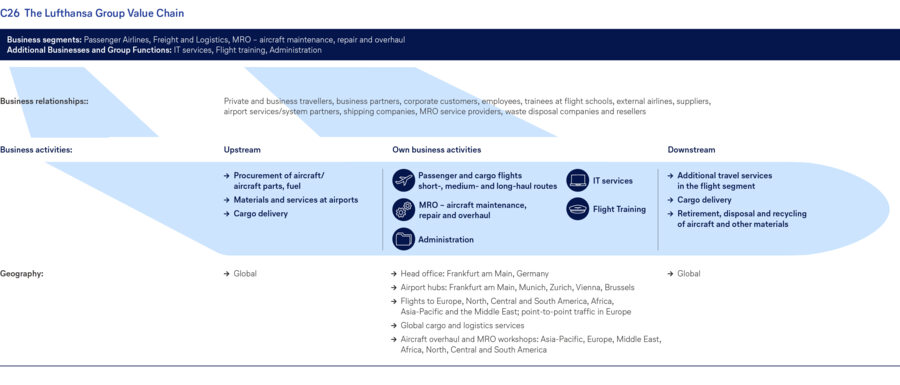
The operating segments of the Lufthansa Group conduct different business activities, which lead to differences in their value chains. The value chains for the three business segments of the Lufthansa Group are described below, as well as for Additional Businesses and Group Functions.
Passenger Airlines and Logistics business segments
Upstream value chain:
- Procurement and leasing of aircraft, fuel and other goods and services for ground and in-flight service, freight transport and logistics services
Downstream value chain:
- Use of products and services, aircraft sales
- Disposal of materials, such as waste on board, and their feeding into external recycling systems
- Transport, handling and delivery of products
Business segment MRO – aircraft maintenance, repair and overhaul
Upstream value chain:
- Procurement of components, engines, replacement parts, consumables and tools
- Procurement of used components, such as from the disassembly of aircraft, for obtaining replacement parts, unusable material for overhauls for reuse, procurement of MRO services (Maintenance, Repair & Overhaul)
Downstream value chain:
- Use of other products and services, such as commercial, government and special operations, e.g. VIP aircraft
- Contribution of non-repairable aircraft components and materials, including rare-earth elements, to external recycling systems; disposal of hazardous substances, chemicals, industrial waste and wastewater
Additional Businesses and Group Functions
Digital business and IT solutions
Upstream value chain:
- Procurement of hardware and supplies
- Procurement of IT infrastructure and software (for example servers, databases and standard software)
- Strategic IT consulting and system design
- Development and integration of customised software solutions
Downstream value chain:
- Use and operation of IT solutions, including managed services
- Training and support for users
- Optimisation of existing systems and processes
- Disposal or recycling of decommissioned hardware and resources
Flight schools
Upstream value chain:
- Procurement of hardware, simulators and supplies
- Purchase of computer programs and IT infrastructure services
- Procurement and leasing of aircraft, fuel and other goods and services for training purposes
Downstream value chain:
- Use of digital solutions and various devices and training
- Disposal or resale of decommissioned hardware, simulators, training aircraft, waste and water
Business relationships
Upstream value chain:
- Suppliers
- MRO service providers for aircraft maintenance, repair and overhaul; shipping companies
- Airport services / system partners
Downstream value chain:
- Private and business travellers
- Business partners and corporate customers
- External airlines
- Airport services / system partners
- Waste disposal services and resellers
The Lufthansa Group exercises the option to omit from its reports specific information that relates to intellectual property, expertise or the results of innovations. The Company also invokes the relevant exemption and exercises the option not to provide any information about upcoming developments or matters that are the subject of ongoing negotiations.
BP-2 – Disclosures in relation to specific circumstances
Time horizons are based on the Lufthansa Group’s risk management
The time horizons for the management of material impacts, risks and opportunities are based on the Lufthansa Group’s risk management. The short-term time horizon corresponds to one calendar year. The medium-term horizon deviates from the definition in the European Sustainability Reporting Standards (ESRS) and comprises more than one year, but less than four years. Time horizons beyond four years are defined as long-term horizons. The Lufthansa Group uses its own definitions of time horizons in order to ensure consistency across the Group in all risk assessments – regardless of the type of risk.
Estimates and sources relating to the value chain vary for some metrics
For some metrics, the Lufthansa Group uses indirect sources in order to estimate data relating to the value chain. A list of all data points where estimates are used to approximate information relating to the value chain can be found in the calculation methods. No data points with a high measurement or outcome uncertainty for the reporting year were identified in the course of the data collection and calculation processes. The methods and corresponding degree of accuracy are described in the topic-specific chapters under the relevant calculation methods as are details about the sources of valuation and measurement uncertainty, as well as assumptions, approximations and discretionary decisions.
Changes in the preparation or presentation of sustainability information
Corporate Accounting is responsible for any changes to the financial data of the Lufthansa Group. Any changes to these figures are not described separately in the combined non-financial declaration. Whether or not figures relating to sustainability data need to be adjusted is decided on a case-by-case basis. The decisions are based on the cost/benefit analysis between low comparability with previous periods and higher accuracy with more information. If figures have been adjusted, this is stated in the report at the relevant point. Revised comparative figures and the relevant differences between earlier and current figures, or the explanation that the preparation of comparative figures is not feasible, are described in the topic-specific chapters.
Reporting errors in prior periods
Should the Lufthansa Group determine that there are measurement or calculation errors in its reporting, such cases are mentioned in the subsequent report. As part of the ongoing reporting and audit processes, no errors from the prior period were identified for the current period. The comparative information therefore remains unchanged.