
Impact, risk and opportunity management
ESRS 2 IRO-1 – Description of the processes to identify and assess material impacts, risks and opportunities
The general methodology for identifying impacts, risks and opportunities is described under ↗ ESRS 2 General disclosures – Description of the process to identify and assess material impacts, risks and opportunities.
E2-1 – Policies related to pollution
Five-pillar strategy for active noise abatement aims to reduce noise pollution
Since 2001, the Lufthansa Group has played a role in research projects and implements noise abatement measures which are coordinated with relevant stakeholders. This research and development work is the basis for the Lufthansa Group’s active noise abatement. It contributes significantly to optimising both fleet and flight operations. Such measures reduce noise emissions at the source and help relieve local residents in airport regions by better distributing the remaining noise. Active noise abatement measures at the Lufthansa Group cover the following five pillars:
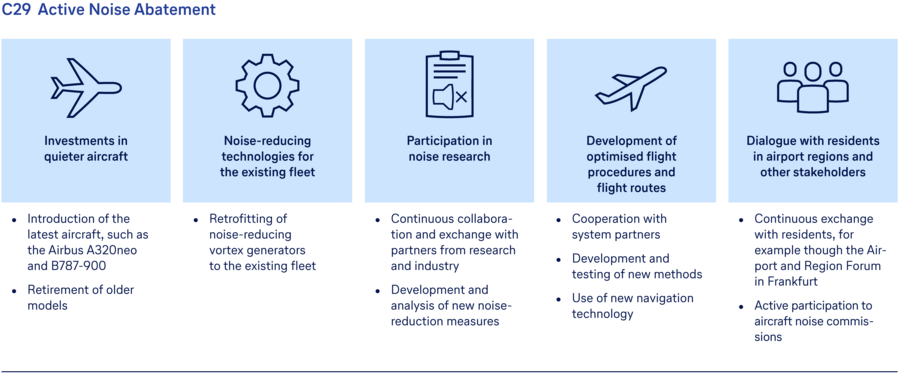
With this five-pillar strategy, the Lufthansa Group focuses on reducing the negative impacts of noise on local communities and other stakeholders. At the same time, the strategy serves as a basis for managing identified risks, such as costs arising from necessary adjustments to noise abatement regulations or from the avoidance of local limit value exceedances that could result in fines. It also supports the development of opportunities, such as reputational gains, through investments in noise-reducing technologies and procedures.
The five-pillar strategy includes both general initiatives and local activities – such as maintaining dialogue with stakeholders at key airports for the Lufthansa Group. Affected stakeholders include system partners such as airports, air traffic control organisations, local municipalities, other airlines, and researchers in this field. Participation in various local aircraft noise committees, dialogue platforms and other expert committees (such as expert working groups) forms an integral part of the five-pillar strategy. In this context, the interests of local residents are represented by elected municipal representatives as well as by other institutional interest groups. This concept aligns with the international framework of the so-called Balanced Approach of the International Civil Aviation Organization (ICAO), which is applied at selected airports and is part of EU Regulation 598/2014 on the establishment of rules and procedures with regard to the introduction of noise-related operating restrictions at EU airports within a balanced approach.
The Lufthansa Group has a multi-airline expert committee under the direction of the Regulatory Affairs Infrastructure department, which meets to discuss current operational and technical developments on the topic of active noise abatement. This committee, which also met several times during the reporting year, works for the Infrastructure & System Partnerships department, which has central responsibility for managing infrastructure and system partnerships. The department is the central point of contact and representative for the Human Resources & Infrastructure Executive Board function in relation to airports, air traffic control, handling agents, regulatory and political institutions (e.g. ministries) and industry associations. As the central coordinating unit within the Group on the issue of aircraft noise, it represents the Lufthansa Group in the committees of the Airport and Region Forum in Frankfurt and supports the Lufthansa Group’s participation in various aircraft noise committees.
E2-2 – Actions and resources related to pollution
Measures to reduce aircraft noise aim to reduce the noise generated directly by the aircraft. Additionally, the Lufthansa Group seeks to better understand which activities can contribute to reducing noise pollution. Some measures affect every flight globally, while others are specifically tailored to individual sites. Dialogues with stakeholders occur particularly at the Lufthansa Group’s hubs. The measures described below are implemented continuously. Accordingly, no fixed time horizons have been set for them, except for research and development projects. Here the time horizons typically span between one and five years.
The Lufthansa Group invests in modern and thus quieter aircraft
The highest priority measure for reducing aircraft noise at source is fleet modernisation. The Lufthansa Group updates its fleet continuously. Aircraft that went into service in 2025, including Airbus A320neos, A321neos, A350-900s and Boeing 787-9s, have modern engines and are much quieter than comparable older aircraft types. The Lufthansa Group’s newly commissioned aircraft meet the noise requirements stipulated by the ICAO. For more details on fleet modernisation, please see ↗ E1-3 Climate change – Driving continuous investment in technological advancement.
The existing fleet is being retrofitted with noise-reducing technologies
In addition to modernising the fleet, retrofitting existing aircraft also results in measurable noise reduction. At the beginning of 2014, Lufthansa Airlines became the first airline worldwide to start operations with a new Airbus A320 equipped with noise-reducing vortex generators, thus setting an industry standard. Aircraft with vortex generators are up to four decibels quieter on their approach, so the Company pays lower noise fees in Frankfurt than for comparable aircraft without these components. All aircraft in the A320 family operated by Lufthansa Airlines, SWISS, Eurowings and Austrian Airlines, for which the retrofit programme was completed by the end of 2024, are now equipped with this modification. The modification was carried out in the course of routine technical maintenance cycles. No retrofitting of the existing fleet was carried out in 2025.
The Lufthansa Group participates in noise research to optimise approaches and take-offs
In the reporting year, the Lufthansa Group once again worked with the German Aerospace Center in the ongoing development of its Low Noise Augmentation System (LNAS) for optimising approaches and take-offs. The LNAS uses aircraft data to recommend optimal configuration and speed. The German Aerospace Center is examining how approaches and take-offs can be made quieter and more efficient while observing safety regulations. Lufthansa Airlines supported the German Aerospace Center in developing the new LNAS departure functionality by conducting practical tests of this functionality on its A330 fleet in summer 2025. For the evaluation of these test flights, Lufthansa Airlines provided the German Aerospace Center with the relevant flight data.
Optimised flight procedures and flight routes are developed in cooperation with system partners
Optimising the vertical flight profile (flight procedures) and horizontal flight management (flight routes) contributes to reducing noise. The Lufthansa Group is active in this area, for instance with German air traffic control (DFS) and international partners. The following example tends to affect fuel consumption and is therefore relevant for climate change mitigation purposes.
The modern, satellite-based Required Navigation Performance (RNP) technology, which the ICAO has used to define the navigation performance required of an aircraft, plays an important role in the introduction of new flight procedures at European airports. Using this technology, trial operations for a segmented approach (known as RNP X) were launched at Frankfurt Airport in 2025. At Berlin Airport, a departure route was refined during the reporting year with the involvement of Lufthansa Airlines and tested in a simulator. The new route was implemented by DFS in September 2025 and is available to all airlines.
The Lufthansa Group engages in dialogue with residents near airports and other stakeholders on noise reduction measures
In addition to technical and operational improvements, the Lufthansa Group has for many years been involved in various dialogue forums with residents near airports, including in Frankfurt, Hamburg and Vienna. The experts from the Lufthansa Group contribute to the development of active noise abatement measures in these multilateral working groups. At Frankfurt Airport, Lufthansa Airlines (representing the Lufthansa Group) participates in the Noise Abatement Alliance together with the Hesse state government, Fraport AG, the Airport and Region Forum, DFS and the airline association BARIG. The airline is an influential member of the Active Noise Abatement expert panel and its sub-working groups. The focus of these activities is on optimising flight procedures and reducing noise at source. In order to avoid populated areas in the north of the city of Darmstadt, trial operations using a modified departure route (referred to as “CINDY-S”) were launched in July 2025. This route was developed within an expert committee and its trial phase is being monitored by that body.
Furthermore, through its cooperation with stakeholders such as airport operators, authorities and municipalities, the Lufthansa Group participates in several flight noise committees required for major airports under the German Aviation Control Act and in the working group of German flight noise committees.
At airports where the Lufthansa Group pays noise charges, these are based either on the aircraft certification data or on airport-specific noise measurements of individual flight movements.