
Impact, risk and opportunity management
ESRS 2 IRO-1 – Description of the processes to identify and assess material climate-related impacts, risks and opportunities
The Lufthansa Group’s climate-related risks and opportunities have been identified
Within the framework of its climate risk analysis presented below, the Lufthansa Group has identified the following key climate-related risks and opportunities:
Material transition risks:
- Higher current costs due to an increasing CO2 price within the European and international CO2 trading systems such as the EU Emissions Trading System (ETS) and the Carbon Offsetting and Reduction Scheme for International Aviation (CORSIA)
- Higher current costs due to rising kerosene prices as a result of upcoming legislation on the use of fuels for aviation
- Lack of availability and high prices for SAF, accompanied by mandatory, continuously rising blending quota from 2025 onwards for flights taking off from European airports
- Price fluctuations for conventional fuels as a result of stricter regulations and market trends to promote a low-carbon economy
In addition, the following climate-related physical risk has been identified:
- Disruptions in operations and consequently higher current costs as a result of heatwaves
Opportunities:
- Increase and acceleration of the development of new sustainable aircraft technologies
The climate risk analysis has been validated for the 2025 financial year
The qualitative scenario analysis for identifying and assessing climate-related risks and opportunities and their impacts on the Lufthansa Group’s business has been validated for the year 2025. The analysis was carried out both on the basis of its own operations and along the upstream and downstream value chain and took into account physical and transition risks. Changes primarily concerned the selection of sites, reflecting the changing relevance of individual airports over time. For the Passenger Airlines and Logistics segments, relevance is determined based on two criteria: passenger numbers and revenue generated from passenger and cargo transport at each site. Based on these criteria, the top ten airports are selected each year. To improve comparability, the time horizons were additionally aligned with those used in the double materiality assessment. A long-term time horizon extending to 2050 is nevertheless still considered, as climate-related risks in particular are expected to have long-term impacts. Physical climate risks were not reflected in the financial reporting in the reporting year. The climate transition risks identified as material are consistent with those considered in the financial reporting. The impacts of the Lufthansa Group on the climate have been validated and described as part of the double materiality assessment.
↗ ESRS 2 General disclosures – Material impacts, risks and opportunities and their interaction with strategy and business model. In addition, the approach to the double materiality assessment is presented under ↗ ESRS 2 General disclosures – Description of the processes to identify and assess material impacts, risks and opportunities.
Physical scenario analysis considers two emission pathways
The Lufthansa Group validated the list of possible climate scenarios from the previous year and confirmed that it was complete and up to date. Two climate scenarios from the Intergovernmental Panel on Climate Change (IPCC) were again selected: one pathway with low emissions (SSP1-2.6, sustainable development scenario) and one pathway with high emissions (SSP5-8.5, fossil-fuelled development scenario). By using these two climate scenarios, the Lufthansa Group seeks to ensure that all relevant physical risks are covered in the analysis. In addition, in both scenarios for flight operations, important drivers with regional and/or local impact such as heatwaves, storms, changes in the jet stream, an increase in turbulence and severe thunderstorms were taken into account. Data sources for the assessment included Fathom Global 3.0 for flood risks, ISIMIP3b CMIP6 models for heat waves, and academic publications such as those from the journal “Nature” to analyse changes in the jet stream, increased turbulence and severe thunderstorms. Nevertheless, uncertainties remain, particularly in the evaluation of flight routes as detailed data was not available for all route segments.
In the next step, the selection of climate-related risks and opportunities was validated for its relevance to the Lufthansa Group by an interdisciplinary team from various departments. This included experts from Corporate Strategy, Group Sustainability and Risk Management as well as representatives from the Flight Operations, MRO and Logistics business segments.
The mapping of the value chain was also reviewed to clearly identify upstream and downstream activities as well as activities that are part of the Lufthansa Group’s own operations. It is still assumed that physical climate risks affect the business areas in different ways. The value chain was therefore again divided into the business segments Passenger Airlines, Logistics and MRO. In line with the EU Taxonomy, a list of 28 climate risks was evaluated, of which 18 (previous year: 15) were selected for the scenario analysis. In addition, three further physical, aviation-specific climate risks (previous year: three) were assessed in the scenario analysis. To assess the relevance of climate risks, factors such as local conditions at the respective sites and their relevance for operational processes were taken into account. In total, 33 regions and sites (previous year: 25) were identified for the scenario analysis: 28 local physical sites (previous year: 20), including airports, hubs, supplier facilities and maintenance facilities, as well as five regions (previous year: five) covering key flight routes. In the scenario analysis, data from a climate scenario with low emissions (SSP1-2.6) and from a climate scenario with high emissions (SSP5-8.5) were used to assess the potential changes in physical risks over time, namely for the time horizons 2025, 2030 for a medium-term and 2050 for a long-term view. The exposure assessments for each facility type were also validated to ensure they were complete and up to date. Finally, where changes were identified, the exposure assessments and normalised climate data were combined, in line with the previous year, to calculate the risk values for each individual hazard and each site. The risk values were categorised on a five-point scale ranging from minimal to very high. This enables comparability across different hazards and facility locations.
Transition scenario analysis considers two climate scenarios
The qualitative scenario analysis for transition risks and opportunities aimed to evaluate the performance of the Lufthansa Group’s business strategy under different climate scenarios and to determine the materiality of the identified risks and opportunities. By incorporating various scenarios and risk factors, the Lufthansa Group seeks to strengthen its resilience to climate-related challenges and to identify opportunities for sustainable business development.
For the analysis of transition climate-related risks and opportunities, the scenarios used were validated for their suitability. The “Stated Policies Scenario” and the “Net Zero Scenario 1.5°C” of the International Energy Agency (IEA) were again selected this reporting year. From the perspective of the Lufthansa Group, these scenarios are suitable for identifying and analysing all relevant transition risks and opportunities, particularly in connection with climate policy and technological developments in the energy sector. As with the physical scenario analysis, important drivers for the aviation industry were once again taken into account in the transition scenario analysis, such as the development of the CO2 price, passenger-kilometres flown, fuel prices and other energy and carbon intensity indicators.
In the next step, the mapping of the value chain was validated to confirm upstream and downstream activities as well as activities that are part of the Lufthansa Group’s own operations. Since it was assumed that the risks and opportunities of climate change may affect different business areas in various ways, a distinction was made between the business areas Lufthansa Airlines, Lufthansa Cargo and Lufthansa Technik. In addition, the list of potential transition risks and opportunities developed by an interdisciplinary team in the previous year was reviewed to ensure it was still relevant, complete and up to date. In total, ten transition risks and opportunities were shortlisted for the scenario analysis. This represents a change of one additional risk compared with the previous year. The additional risk was included due to new regulatory requirements. Each risk and each opportunity were validated for a separate business area and the risks were weighted accordingly. Finally, the results of the scenario analysis were aggregated at Group level and the impacts on the value chain were described. For the evaluation of transition risks, the year 2025 was defined as the short-term, 2030 as the medium-term and 2050 as the long-term time horizon.
ESRS 2 SBM-3 – Material impacts, risks and opportunities and their interaction with strategy and business model
Resilience analysis has been updated and resistance to climate change has been analysed
The climate resilience analysis was reviewed and, where necessary, updated on the basis of the results of the climate scenario analysis for the 2025 financial year. The aim was to validate the resistance of the Lufthansa Group’s strategy, including its business model, to climate change while taking into account the related uncertainties.
As in the previous financial year, the scope of the climate resilience analysis relates to activities that are part of the Lufthansa Group’s own operations as well as upstream and downstream activities in the value chain. It covers passenger and freight air transport, as well as maintenance and repair. All risk-bearing assets and business activities that are used in the Company’s strategic decision-making, investment decisions, and the Lufthansa Group’s ongoing and planned climate change mitigation measures were considered. Furthermore, different sites that are significant for the Lufthansa Group’s operations were identified. These include the Lufthansa Group’s hub airports, production, maintenance, storage and office facilities, as well as facilities involved in the value chain.
To determine resilience, key stakeholders were involved in the previous year, including representatives from affected sites, employees and suppliers, in order to compile and assess existing measures and resilience strategies. The review for the current financial year was carried out by the Corporate Responsibility department. The climate resilience analysis is based on various critical assumptions. It is assumed that demand for air travel will continue to increase in the future, especially in the leisure travel segment, and that the global economy and macroeconomic trends will remain stable. Further assumptions considered include the development of emissions and fuel prices, as well as transport performance and CO2 intensity. To further reduce any uncertainties regarding the climate resilience analysis that may still exist, such as whether political actions will have as much impact as assumed, a financial evaluation of the identified qualitative climate risks will be carried out in the long term.
Measures to mitigate climate-related physical and transition risks are being continued
The climate resilience analysis is crucial for managing the growing risks posed by climate change.
Heatwaves, as the most significant physical risk, may represent a challenge for the Lufthansa Group’s business operations. In response to the challenges posed by heatwaves, central strategies have been developed and implemented to minimise exposure to adverse conditions while maintaining productivity at affected sites. These strategies include, among others, improved climate control for infrastructure and buildings, prioritising the maintenance of cooling systems, and training employees to prepare them for potential risks and to promote a high level of safety. These measures continue to be considered sufficient to address the impacts of heatwaves in the short, medium and long term.
Several key mitigation measures have been identified for the identified transition risks over the last few years. These risks, resulting from evolving regulatory frameworks and market dynamics, require proactive strategies to achieve the climate change mitigation targets of the Lufthansa Group. These include the continuous renewal of the fleet and the optimised use of SAF in order to benefit from incentives under the emissions trading systems while also meeting the Company’s self-imposed targets, thereby also improving operational efficiency.
The research and development of innovative, more climate-friendly technologies also form part of the measures that the Lufthansa Group is driving forward in order to take advantage of the opportunities offered by new, more sustainable aircraft technologies. For example, Lufthansa Technik initiated the Hydrogen Aviation Lab in 2021, a project funded by the City of Hamburg and the German Federal Ministry for Economic Affairs and Energy (BMWE) that focuses on technologies and extensive maintenance and ground processes for future aircraft generations using liquid hydrogen as a primary energy source. Since the end of 2024, the stationary laboratory has been in operation and has tested process flows ranging from the delivery of liquid hydrogen to refuelling and storage, through to energy generation in the fuel cell. Based on this research, Lufthansa Technik aims to contribute its operational expertise in maintaining and modifying commercial aircraft and gain insights by testing the real-world operation of these emerging technologies. The Company is also able to incorporate the perspective of airlines thanks to its close relationships with airlines around the world. In this context, the Lufthansa Group also strengthens its interaction with industry associations to develop effective policy proposals that support a sustainable and more climate-friendly aviation industry.
Alongside the Hydrogen Aviation Lab, the Lufthansa Group is also active in the field of climate research. Since 1994, the Company has actively supported various national and international atmospheric and climate research projects. This helps scientists better understand atmospheric processes and improve the reliability of climate models. Through this collaboration, the Lufthansa Group seeks to detect potential impacts of climate change early and enhance climate resilience. As part of the European research infrastructure IAGOS (In-service Aircraft for a Global Observing System), the Lufthansa Group works with its research partners from the Karlsruhe Institute of Technology and the Jülich Research Centre to equip selected passenger aircraft with measuring instruments that collect data about the condition of the atmosphere on scheduled flights. This data is freely accessible and is used by around 400 organisations worldwide. Between 1994 to October 2025, almost 76,000 measurement flights were conducted by all airlines participating in IAGOS, around half of which were operated by Lufthansa Airlines and Discover Airlines.
In addition, in its research on the non-CO2 effects of aviation, the Lufthansa Group works closely with various scientific partners and system partners, such as in the research projects D-KULT and CICONIA. Both aim to better understand why and when climate-damaging contrails occur and how they can be avoided. In the reporting year, Lufthansa Airlines conducted an extensive simulation study in cooperation with Lufthansa Systems, comparing climate-optimised flight plans with standard flight plans (D-KULT).
During the reporting year, SWISS analysed the non-CO2 effects of various optimised flight plan variants for individual long-haul flights (CICONIA).
With this bundle of implemented and planned resilience measures to minimise climate transition risks, the Lufthansa Group currently considers itself sufficiently capable of adapting to transition risks in the short-, medium- and long-term and of counteracting evolving regulatory frameworks and market dynamics.
E1-2 – Policies related to climate change mitigation and adaptation
Currently, the Lufthansa Group is focused on limiting the negative impacts of climate change. At present, there are therefore no specific policies relating to climate change adaptation.
Four-pillar climate change mitigation strategy addresses four areas for action
Progress in climate change mitigation in the aviation sector can only be made through cooperation and by combining various skill sets of different players, such as manufacturers, airports, air traffic control, airlines and policymakers. In this respect, the Lufthansa Group draws on targeted political support and financial support mechanisms to develop new technologies. One example is the acceleration of the market introduction of SAF. To this end, the Lufthansa Group is involved in a wide range of private and government-funded collaboration, research and development initiatives in order to develop new measures together with relevant partners. Working with the scientific community, the Lufthansa Group also funds atmospheric research to contribute to a better understanding of the global climate.
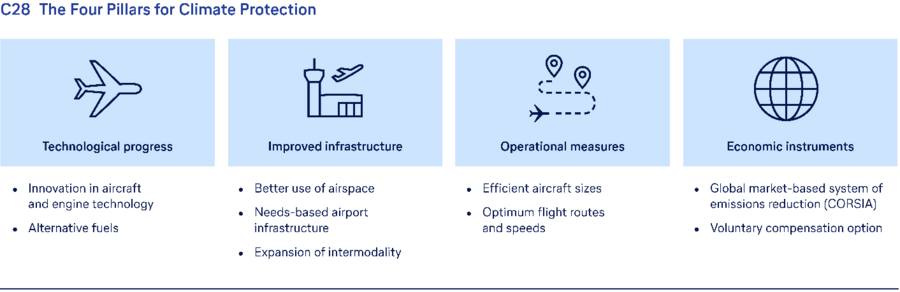
In 2007, the International Air Transport Association (IATA) defined emission reduction measures in four areas of action as part of the four-pillar climate change mitigation strategy of the aviation industry, to which the Lufthansa Group’s climate change mitigation strategy is aligned:
- technological progress,
- improved infrastructure,
- operational measures and
- economic instruments.
At the Lufthansa Group, the use of renewable energy as well as energy and fuel efficiency form the basis of the conceptual approach to climate change mitigation. Within the four-pillar strategy, the use of renewable energy is addressed under the area of technological progress, while energy efficiency is addressed under technological progress, improved infrastructure and operational measures.
The strategy applies to all the consolidated airlines in the Lufthansa Group. It is communicated to all relevant stakeholders both internally and externally. The monitoring to assess the success of the strategy consists of an annual measurement of greenhouse gas emissions compared with the reduction target by comparing the emissions model with the actual performance figures on fuel consumption and revenue tonne-kilometres (RTK), the sale of climate change mitigation projects through CO2 credits (offsetting) and the use of SAF. In addition to further climate-relevant effects beyond CO2, an annual report on a per-flight basis regarding climate impacts is legally mandated from 2025. The Executive Board of the Lufthansa Group bears ultimate responsibility for implementing the strategy within the Company.
Ground operations energy management focuses on energy efficiency and renewable energy
In 2024, the Lufthansa Group introduced a new energy management system for ground energy consumption. With it, the Lufthansa Group aims to change its approach to energy procurement and energy consumption, comply with current legislation, adjust its energy mix and decarbonise its vehicle fleet in the long term. Particular focus is placed on four areas: energy efficiency, renewable energy, energy procurement and ground mobility.
The interests of the Lufthansa Group’s stakeholders are taken into account through working groups in the definition and implementation of measures. The measures include increased transparency through annual reports and other communication initiatives, the reduction of environmental impacts through the introduction of an EMAS-certified environmental management system and a reduction in energy consumption in the properties. In addition to lower energy consumption, these measures also lead to a saving in greenhouse gas emissions in Scopes 1 and 2. In developing this commitment, the external standards EMAS (environment in general) and ISO 50001 (energy) as well as relevant German and EU-wide regulations are taken into account. Progress is monitored annually as part of the respective certification processes. Responsibility lies with the environmental and energy management officers.
E1-3 – Actions and resources in relation to climate change policies
As part of its four-pillar climate change mitigation strategy, the Lufthansa Group implements a broad range of measures across the four action areas to contribute continuously to advancing climate change mitigation in the aviation industry. In the reporting year, activities were continued across all four areas of action.
Driving continuous investment in technological advancement
The Lufthansa Group invests continuously in modern, fuel-efficient aircraft and engine technologies, which represent the most important element in reducing CO2 from flight operations in the first action area of its climate change mitigation strategy. Measures to technically modify the existing fleet are also examined on an ongoing basis and implemented in cooperation with partners from research and industry. In the past decade, the Lufthansa Group has been engaged in the research, testing and use of SAF. Through targeted partnerships, the Lufthansa Group has since advanced key technologies for the production of SAF and secured access to the required SAF volumes.
Even though many projects are still far from being ready for large-scale production, there has been a lot of momentum driving research into new, sustainable technologies in the aviation sector and their development for several years now from the perspective of the Lufthansa Group. Established manufacturers such as Airbus and Boeing and many young companies are seeking to bring new ideas and concepts to the aviation market. Alternative fuels, new propulsion systems based on hydrogen and electricity, and new aircraft designs associated with these all play a role in these developments from the perspective of the Lufthansa Group. The Lufthansa Group is monitoring these developments closely and analysing them on an ongoing basis with respect to their future viability and relevance.
Fleet renewal is the most important lever for reducing CO2 emissions
Fleet renewal remains the key driver for reducing CO₂ in the short and medium term. The Lufthansa Group fleet was expanded by 23 (previous year: 18) new aircraft in 2025, including Airbus A320neos, A321neos, A350-900s and Boeing 787-9s, which are powered by modern engines. The A320neo is one of the world’s newest and most environmentally friendly aircraft. A total of 21 (previous year: 4) aircraft have been removed from the Group fleet in exchange.
Since 2019, the Lufthansa Group has more than doubled the proportion of its fleet fitted with the latest technology to 25% (181 aircraft). In 2026, the Lufthansa Group expects the delivery of approximately 45 modern aircraft, including the Airbus A220-300, A320neo, A321neo, A350-900, A350-1000, Boeing 787-9 and 777-9 models. The order backlog comprises around 220 aircraft featuring the latest technology.
In total, EUR 4,666m (previous year: EUR 3,912m) was invested in fleet renewal in 2025. This capital expenditure is taxonomy-eligible and is reported under Activity 6.19 Passenger and freight air transport within Environmental Objective 1 – Climate change mitigation. See also ↗ Applicability and disclosures in accordance with EU Taxonomy Regulation (EU) 2020/852 – 6.19 Passenger and Freight Air Transport.
Technical measures for the existing fleet complement the commitment to greater fuel efficiency
Measures to retrofit the existing fleet are also constantly being examined and implemented where appropriate. The AeroSHARK fuel-saving surface technology developed by Lufthansa Technik together with an industrial partner is one example of the successful implementation of a technical measure. Their so-called “riblet films”, named after their microscopically small ribs modelled on shark skin, are currently already capable of reducing the air resistance of large commercial aircraft, and thus their kerosene consumption by around 0.8%.
At the end of 2025, the Lufthansa Group fleet had a total of 21 (previous year: 17) Boeing 777s fitted with AeroSHARK in service, including twelve Boeing 777-300ERs at SWISS and five Boeing 777Fs at Lufthansa Cargo and, newly added in 2025, four 777-200ERs at Austrian Airlines. In addition, Lufthansa Technik has commenced the certification process for the Airbus A330 aircraft model in order to offer this product both within the Lufthansa Group and on the external market.
Expansion of sustainable aviation fuels to support climate-friendly air travel of the future
The market roll-out of SAF is a key measure for making air travel more climate-friendly in the future. Global SAF production capacity, and therefore availability, is still limited. Overall global production capacity would only be sufficient for a small fraction of worldwide aviation fuel consumption. In order to safeguard its own supply of SAF over the long term, the Lufthansa Group uses continuous procurement on the spot market for short-term transactions. In the medium term, options for long-term supply commitments are under consideration. Over the long term, the Lufthansa Group supports innovative production concepts through a global SAF partner network. The use of SAF also enables compliance with additional technical screening criteria for economic activity 6.19 Passenger and Freight Air Transport ↗ Applicability and disclosures in accordance with EU Taxonomy Regulation (EU) 2020/852 – 6.19 Passenger and Freight Air Transport.
At the political level, the Lufthansa Group supports a global strategy for the supply of SAF. As well as a competition-neutral approach to SAF blending quotas, this includes, for instance, defining quantifiable goals and ambitious sustainability criteria for the use of SAF at the level of the International Civil Aviation Organization (ICAO). The Lufthansa Group has supported this process since 2023 through its membership of the ICAO Fuel Task Group. In the European Union, the Lufthansa Group advocates a simplification of compliance for SAF-related regulation and has put forward widely noted proposals, which were updated and expanded in 2025. The Lufthansa Group is a member of the Aviation Initiative for Renewable Energy in Germany (aireg), the eFuel Alliance and certification organisation ISCC.
The Lufthansa Group is committed to the harmonisation of European airspace
The ambitious targets for reducing CO2 emissions by 2050, together with the expected increase in operational complexity, require a significant improvement in the efficiency of European airspace. In addition to the fundamental modernisation and harmonisation of technologies, processes and standards, increasing attention must also be given to the resilience and security of data communication. As part of the adoption of the European Commission’s Single European Sky (SES2+) Regulation, the Lufthansa Group continues to support harmonisation and progress within the European airspace system. The Lufthansa Group and other European airlines, such as those in the Airlines for Europe (A4E) alliance, have the necessary expertise in this area and have been actively promoting the creation of an efficient EU airspace for many years through their participation in committees such as Network Directors of Operations (NDOP) and Network Directors of Technology (NDTECH), as well as various steering committees and projects. Furthermore, the Lufthansa Group seeks to persuade as many passengers who travel via its hubs as possible to use intermodal modes of feeder transportation to open up additional potential for further reducing the number of particularly short flights. By offering expanded intermodal services, arriving and departing by train or long-distance bus should become just as natural as using connecting flights.
Efficiency gains through a unified European airspace expected to reduce emissions
The purpose of the European Commission’s Single European Sky (SES2+) Regulation is to drive the standardisation and optimisation of European air traffic management systems. The technological basis for this is the results of Europe’s SESAR programme. The European Commission’s target of increasing efficiency by up to 10% through shorter flight paths, improved capacity management and fewer delays is to be achieved through the SESAR programme in terms of research and implementation. Capacity-boosting measures in the airspace play a significant role in efficient flight operations and are of vital importance for ensuring a stable flight plan and fewer delays. The Lufthansa Group provided various support measures in this area, including investing in modern communication technologies. In 2025, for example, the rollout of ADS-C EPP technology across Lufthansa Group aircraft was initiated. The retrofit of the existing aircraft is expected to be completed by the end of 2027. Due to the major relevance of the development of the European airspace for the Lufthansa Group, it also continues to participate in the SESAR Deployment Manager (SDM) industry consortium as a member and with the active support of experts. The Lufthansa Group received funding from the European Union for research and development projects and for its active participation in the SDM.
In 2025, the Lufthansa Group also participated in the governance bodies of the future SESAR programme. In addition, the implementation of these technologies, processes and standards in daily operations is coordinated within the scope of the SDM’s activities. Across Europe, the SDM coordinated 359 projects in the reporting year. The Lufthansa Group participated in three of these implementation projects and was also actively involved in SESAR research and demonstration projects (SESAR 3), collaborating with several of its airlines and Lufthansa Systems as an IT provider. The goal is to be able to implement even short-term efficiency gains at pace. In addition to the two projects listed above, once again during the financial year SWISS participated in three projects launched in 2023 which relate to optimised flight management and arrival time management in Zurich, as part of the Horizon Europe funding programme.
Operational measures aligned with the Lufthansa Group’s climate change mitigation strategy are in place
The Lufthansa Group’s operational measures for climate change mitigation comprise the more fuel-efficient use of aircraft and the optimisation of load factors, as well as reviewing and introducing new flight procedures and navigation technologies, determining optimal routes and speeds, and developing many concepts to save fuel in flight operations management.
These measures and their effects are managed together with technical measures, such as AeroSHARK, and infrastructure measures within the framework of the OPS Sustainability Program. The programme presented below integrates measures from the first three areas of action of the climate change mitigation strategy.
The OPS Sustainability Program is an integral approach for the areas of action of the climate change mitigation strategy
The OPS Sustainability Program integrates measures from the three areas of action (technological progress, improved infrastructure and operational measures) of the Lufthansa Group’s climate change mitigation strategy and is intended to ensure uniform reporting of the emissions reductions achieved. In addition, the programme implements accompanying communication and training measures to foster a culture of efficient resource use.
In the reporting year, 81 (previous year: 91) emission-reduction projects were pursued across the Group. These projects comprise activities relating to performance and procedures, weight reduction, flight route optimisation and technical development. In addition to the reductions achieved in recent years, they made it possible to permanently avoid another 67.8 thousand (previous year: 37 thousand) tonnes of CO₂ emissions in the reporting year. The quantity of kerosene saved amounted to approximately 21.7 thousand (previous year: 12 thousand) tonnes – this is equivalent to approximately 258 return flights between Munich and New York with an Airbus A350-900 aircraft.
To continue building on these positive results, the OPS Sustainability Program was extended until 2028 in order to further exploit remaining potential.
Emission reductions are to be achieved through process and weight optimisations
In this reporting year, pilots are once again using Green Procedures to promote the use of fuel-saving processes in flight operations, for example, through measures such as Single Engine Taxi In, in which only one engine is used for taxiing to the parking position after landing. Equally important is the optimised use of airspace through new, more efficient arrival and departure procedures with satellite-based navigation as well as structural adjustments to airspace boundaries and flight planning. Last but not least, significant weight savings on aircraft are targeted through the use of innovative materials and by reducing the material requirements in service and handling processes.
Economic instruments represent the fourth pillar of the climate change mitigation strategy
The European Emissions Trading System (EU ETS), the mandatory CORSIA scheme and voluntary CO2 offsets play an important role. Through CO2 offsetting, the aviation sector finances emission reduction projects in other sectors and credits the resulting reductions against its own net emissions targets. In addition to supporting climate change mitigation projects in line with the estimated flight-related CO2 emissions from the Company’s business travel, the Lufthansa Group is also continuously expanding its service portfolio to enable customers to finance projects that remove or avoid CO2 emissions.
Mandatory CO2 offsets
The CORSIA, which was agreed with the ICAO in October 2016 and in which the Lufthansa Group participates, has been offsetting growth-related CO2 emissions in international aviation through the purchase of certificates since 2021. CORSIA is designed to compensate for all emissions from the aviation sector that exceed the baseline CO2 emissions defined by the ICAO. This is based on the 2019 emissions for the pilot phase (2021 to 2023) and, for the years 2024 to 2035, on 85% of the emissions from 2019.
Trading in market-based climate change mitigation instruments
Under the EU Emissions Trading System (EU ETS), CO2 emissions have been recorded and reduced across industries through certificate trading since 2012. All flights carried out by the Lufthansa Group within the European Economic Area (EEA) are subject to this system. In addition, following the revision of the Emissions Trading Directive from 1 January 2025, data on so-called non-CO2 effects has also been mandatory for all Lufthansa Group flights. In the first step, the necessary data was recorded and reported per flight. Non-CO2 effects are not part of the pricing mechanism under the Emissions Trading Directive. Additional obligations to surrender emission certificates arise from the Swiss Emissions Trading Scheme (CH ETS) and the UK Emissions Trading Scheme (UK ETS) for flights between the EEA, Switzerland and the UK. Since 2024, the EU ETS has included an incentive mechanism for SAF that compensates for part of the additional costs, depending on the type of SAF and the refuelling location. In combination with the mandatory SAF blending quota, however, this may lead to competitive distortions. The Lufthansa Group is following the political revision process of the EU Emissions Trading Directive together with the relevant associations. The aim is to avoid overlaps between CORSIA and the EU ETS and to better align SAF blending rules with the EU ETS in order to ensure a level playing field.
Contributions to climate change mitigation projects in line with CO2 emissions from employee business travel
Since 2019, the Lufthansa Group has been voluntarily contributing to climate change mitigation projects worldwide in line with the estimated CO2 emissions from all of its employees’ business flights globally. In the 2025 reporting year, 87 thousand (previous year: 84 thousand) tonnes of CO2 were offset through the climate protection organisations myclimate, Climate Partner, Squake, Ceezer and Climate Austria.
More sustainable flight offerings are being expanded
The Lufthansa Group continues to expand its services and offerings for more sustainable flight options. These typically combine the use of SAF with support for certified climate change mitigation projects, for example through Green Fares. In the reporting year, particular emphasis should be placed on the introduction of new incentives through Miles & More, the Lufthansa Group’s loyalty programme: since September 2025, members have been able to earn miles and points for voluntary contributions towards SAF, supporting future reductions in CO2 emissions. In addition, the share of bookings including an option for more sustainable flying increased from 4% in the previous year to around 5%. This corresponds to relative growth of 25% and underlines both rising demand and increasing awareness of these offerings. ↗ S4-4 Consumers and end-users - Lufthansa Group offers sustainability initiatives and services for its customers.
Actions in the areas of technological progress and operational measures contribute to reducing fuel consumption and strengthen resilience and adaptability to climate change impacts. Examples include optimising flight times with regard to weather-dependent conditions, continuously adjusting payload depending on temperature and air pressure during the flight, and equipping airports with fixed air-conditioning systems to reduce the operating time of kerosene-powered auxiliary units and to compensate for extreme temperatures through targeted cooling or heating of aircraft.
Reduction of CO2 emissions from ground-based business activities continues
Climate change mitigation on the ground is also a key priority for the Lufthansa Group. The measures implemented in the reporting year focus on reducing energy consumption in buildings and transforming the ground-based vehicle fleet to reduce emissions.
To improve energy data capture, implementation of a Group-wide energy database was initiated during the reporting year, alongside energy efficiency measures such as demand-based adjustments to technical systems and LED installations. In July 2025, several Group companies, including Deutsche Lufthansa AG and Lufthansa Technik AG, were certified in accordance with ISO 50001. Within the audited management systems, specific targets are set and key performance indicators are defined and monitored. This represents an important milestone and forms the basis for systematic and continuous improvement in energy efficiency across the Group.
These measures are intended to achieve an increase in energy efficiency, a higher share of renewable energy and a reduction in Scope 1 and Scope 2 greenhouse gas emissions attributable to ground-based activities. The time horizon for these actions is long term and extends until 2045.