
Passenger Airlines business segment
| T026 | Key figures Passenger Airlines | ||||
|---|---|---|---|---|---|
| 2025 | 2024 | Change in % | |||
| Revenue | in €m | 30,576 | 29,690 | 3 | |
| of which traffic revenue | in €m | 28,623 | 27,869 | 3 | |
| Operating income | in €m | 31,651 | 30,682 | 3 | |
| Operating expenses | in €m | 30,688 | 29,722 | 3 | |
| Adjusted EBITDA | in €m | 2,959 | 2,882 | 3 | |
| Adjusted EBIT | in €m | 1,087 | 1,046 | 4 | |
| EBIT | in €m | 1,160 | 1,116 | 4 | |
| Adjusted EBIT margin | % | 3.6 | 3.5 | 0.1 pts | |
| Adjusted ROCE1) | % | 9.6 | 11.1 | -1.5 pts | |
| Segment capital expenditure | in €m | 4,047 | 3,275 | 24 | |
| Employees as of 31 Dec | number | 66,128 | 65,172 | 1 | |
| Average number of employees | number | 66,364 | 63,952 | 4 | |
| 1) Last year’s figure adjusted in line with new calculation method. ↗ Financial strategy. | |||||
Business activities
Passenger Airlines offers their customers a differentiated and high-quality product
The Passenger Airlines segment includes Lufthansa Airlines, SWISS, Austrian Airlines, Brussels Airlines and Eurowings, whose results are also reported individually.
The Network Airlines Lufthansa Airlines, SWISS, Austrian Airlines and Brussels Airlines offer their customers a premium experience, with high-quality products and services. The multi-hub strategy offers passengers a comprehensive route network along with the greatest possible flexibility for their journey. Lufthansa Airlines also includes the regional airlines Lufthansa CityLine, Lufthansa City Airlines and Air Dolomiti as well as Discover Airlines, the Lufthansa Group’s German holiday airline. Edelweiss, the leading Swiss holiday airline, is part of SWISS. Eurowings is positioned as a value carrier with an exclusive focus on point-to-point traffic on short- and medium-haul routes. Eurowings includes the equity investment in SunExpress, a joint venture with Turkish Airlines.
Moreover, commercial joint ventures with leading international airlines extend the Passenger Airlines route network. These exist with United Airlines and Air Canada on routes between Europe and North America, and with All Nippon Airways (ANA), Singapore Airlines and Air China on routes between Europe and Japan, Singapore and China respectively. In addition, numerous code-share agreements are in place.
In January 2025, the Lufthansa Group acquired a 41% stake in the Italian airline ITA Airways. The proportionate result is reported in the result from equity investments and included in the Adjusted EBIT of the Passenger Airlines segment. Options exist for the acquisition of the remaining shares in ITA Airways.
Course of business
Fleet modernisation continues
The Passenger Airlines are continuing to advance the modernising and harmonisation of their fleets. Older aircraft models are being retired and new, efficient aircraft with lower fuel needs and less carbon emissions are joining the fleet. Capital expenditure in modern and particularly fuel-efficient aircraft and engine technologies form the basis for the planned earnings improvement at Passenger Airlines. They are currently also the most important lever for reducing carbon emissions in flight operations. ↗ Combined non-financial declaration.
The Passenger Airlines added 23 new aircraft to its fleets in financial year 2025. They include seven Boeing 787-9 Dreamliners and one A350-900 at Lufthansa Airlines, which are fitted with the new Allegris cabin, and the first A350-900 at SWISS, which is fitted with SWISS Senses, the new travel experience from SWISS. 21 older aircraft were retired from the Passenger Airlines fleets. At the end of the 2025 financial year, the Passenger Airlines fleet had a total of 715 aircraft (previous year: 713 aircraft). Fixed orders for 212 aircraft are due for delivery in the period up to 2032. In the reporting year, numerous and persistent problems at the manufacturers relating to production, supply chains and certification caused further delays in the delivery of ordered aircraft.
With the purchase of convertible bonds from its wet-lease partner airBaltic, the Lufthansa Group also strengthened its strategic partnership with airBaltic in the 2025 financial year. The Passenger Airlines segment of the Lufthansa Group operated a total of 66 aircraft on wet leases in 2025. ↗ Fleet.
Further expansion of product and services planned
Lufthansa Group Passenger Airlines again expanded their product and service range in line with customer expectations. Passengers will thus be offered a wider choice of relevant individually selectable product components as well as an improved travel experience on board and on the ground, in the premium segment in particular. This includes fitting Lufthansa Airlines and SWISS aircraft with Allegris and SWISS Senses product generation seating which will offer a new travel experience in every class on long-haul routes.
The Lufthansa Group is also expanding and improving its digital services. At their centre is the award-winning Lufthansa Group app.
The culinary range will also be upgraded in the spirit of a premium service. There is also a focus on improvements to customer service, e.g. the enhanced accessibility of call centres, and expanded digital service channels.
Improvements in operational stability
The Lufthansa Group’s Passenger Airlines improved their operational stability significantly in the reporting year. Targeted measures increased punctuality and reliability significantly and made it possible to ensure stable flight operations, particularly during periods of strong demand in the summer months. This also reduced costs due to irregularities in flight operations.
Among the steps taken was the start of in-house ground handling at Munich Airport. Since October 2025, Lufthansa Ground Services GmbH & Co. KG (LGS) has been responsible for handling all flights by Lufthansa Group Airlines, with the exception of Lufthansa Airlines and Discover Airlines. In addition, the Lufthansa Group purchased Swissport Losch GmbH & Co. KG from its previous shareholders Swissport Cargo Services Deutschland GmbH and Losch Airport Service München GmbH for a low single-figure million euro amount.
In future, the Network Airlines will operate in an even more integrated manner.
The Lufthansa Group is reorganising collaboration across the Group These changes not only affect the organisational structure, but even more so the processes, the financial steering framework and collaboration across the Group. This means the Network Airlines in the Group in particular are moving closer together and will operate in an even more integrated manner in the future. The aim is to strengthen and expand their market position, particularly for the Network Airlines Lufthansa Airlines, SWISS, Austrian Airlines and Brussels Airlines. Efficiency and profitability are also expected improve at the same time. ↗ Changes in business and organisation.
Sustainability activities advanced
The Lufthansa Group’s Passenger Airlines are driving forward their sustainability activities. The airlines are investing in fuel-efficient aircraft and implementing efficiency measures to achieve their targets in this area. In addition, the spread of sustainable fuels is being promoted alongside industry, technology and research partners, and intermodal traffic expanded systematically in all domestic markets. The airlines are also strengthening their sustainability management by introducing or confirming certified environmental management systems.
Operating performance
Operating performance defined by high demand and falling yields
The Lufthansa Group’s Passenger Airlines further increased their traffic in the 2025 financial year due to continued high demand for air travel. Traffic was adversely affected by the situation in the Middle East, temporarily slower demand in the third quarter, particularly on North Atlantic routes, but also in Europe, and ongoing delays in the delivery of new aircraft.
The Passenger Airlines significantly improved their level of operational stability. Overall, in the reporting year the Lufthansa Group’s Passenger Airlines achieved significantly better punctuality than in the previous year and posted their highest levels of regularity since the start of the coronavirus pandemic.
In the reporting period, the Passenger Airlines’ capacity (available seat-kilometres) was 4% higher than in the previous year. The number of flights increased by 2% year-on-year. Sales (revenue seat-kilometres) grew by 4%. The Passenger Airlines transported 135.0 million passengers in the 2025 financial year, 3% more than in the previous year (previous year: 131.3 million). The passenger load factor was 0.1 percentage points higher year-on-year, at 83.2% (previous year: 83.1%). Yields fell by 2.0% on the previous year, however.
Traffic revenue generated by the Passenger Airlines segment increased by 3% to EUR 28,623m, driven by increased traffic and higher ancillary revenues (previous year: EUR 27,869m).
| T027 | Traffic figures Passenger Airlines | ||||
|---|---|---|---|---|---|
| 2025 | 2024 | Change in % | |||
| Number of flights | number | 1,002,935 | 980,423 | 2 | |
| Passengers | thousands | 135,035 | 131,300 | 3 | |
| Available seat-kilometres | millions | 338,552 | 326,176 | 4 | |
| Revenue seat-kilometres | millions | 281,765 | 271,038 | 4 | |
| Passenger load factor | % | 83.2 | 83.1 | 0.1 pts | |
| T028 | Operating figures Passenger Airlines | ||||
|---|---|---|---|---|---|
| 2025 in € cents |
2024 in € cents |
Change in % | Exchange-rate adjusted change in % | ||
| Yields1) | 10.0 | 10.2 | -2.0 | -1.3 | |
| Unit revenue (RASK)1) | 8.3 | 8.5 | -1.9 | -1.1 | |
| Unit cost (CASK) without fuel and emissions trading expenses |
6.7 | 6.6 | 1.9 | 2.0 | |
| 1) Previous year’s figures adjusted due a change in the definition of the performance indicators. These now include additional flight and ticket-related income. | |||||
| T029 | Trends in traffic regions Passenger Airlines | ||||||||||
|---|---|---|---|---|---|---|---|---|---|---|---|
| Net traffic revenue external revenue |
Passengers | Available seat-kilometres |
Revenue seat-kilometres |
Passenger load factor | |||||||
| 2025 | Change | 2025 | Change | 2025 | Change | 2025 | Change | 2025 | Change | ||
| in €m | in % | in thousands | in % | in millions | in % | in millions | in % | in % | in pts | ||
| Europe | 13,0071) | 0 | 109,323 | 2 | 134,389 | 5 | 109,422 | 4 | 81.4 | -0.5 | |
| Americas | 8,6731) | 3 | 12,715 | 4 | 113,333 | 4 | 95,447 | 4 | 84.2 | -0.5 | |
| Asia/Pacific | 3,8561) | 1 | 5,733 | 2 | 52,970 | -2 | 45,658 | 2 | 86.2 | 3.0 | |
| Middle East/Africa | 2,6121) | 6 | 7,265 | 10 | 37,859 | 8 | 31,238 | 8 | 82.5 | 0.0 | |
| Not assignable | 475 | 104 | |||||||||
| Total traffic | 28,623 | 3 | 135,035 | 3 | 338,552 | 4 | 281,765 | 4 | 83.2 | 0.1 | |
| 1) Figures were adjusted and now include additional flight and ticket-related income. | |||||||||||
Financial performance
Revenue up on previous year by 3%
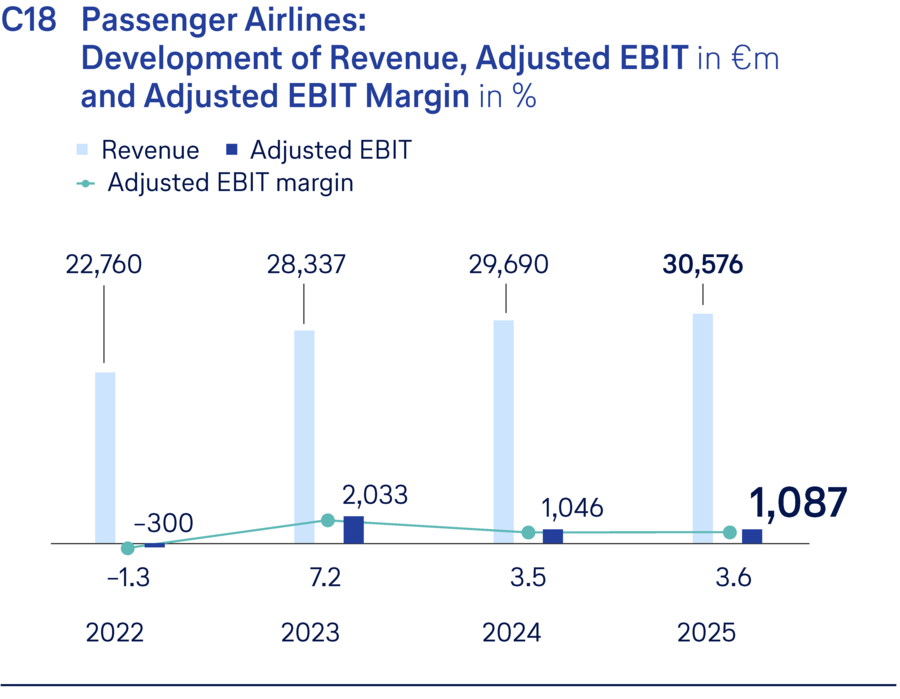
Revenue in the Passenger Airlines business segment was up by 3% in the reporting year to EUR 30,576m due to higher traffic revenue compared with the previous year (previous year: EUR 29,690m). Other operating income increased by 8% to EUR 1,075m (previous year: EUR 992m) as a result of higher exchange rate gains. Total operating income thus increased by 3% in the 2025 financial year to EUR 31,651m (previous year: EUR 30,682m).
Unit revenues (RASK) decreased by 1.9% year-on-year, due in particular to reduced unit revenues across the North Atlantic in the third quarter and partly also in the fourth quarter of 2025. These revenues were adversely affected by a drop in demand for travel to the USA as well as a weak US dollar exchange rate. The tense political situation in the Middle East also had a negative impact on demand in the region. In the European business there was price pressure due to strong competition among airlines, which had a negative impact on unit revenues. The passenger load factor remained stable year-on-year, however, whereby it was slightly lower than in 2024 on European routes and slightly higher on intercontinental routes.
Expenses up by 3%
Operating expenses of EUR 30,688m were 3% higher than in the previous year (previous year: EUR 29,722m).
Unit costs (CASK) excluding fuel and emissions trading expenses increased by 1.9% year-on-year, above all due to the strong rise in non-flight-related costs, fees and charges (such as for air safety, +18%) as well as higher staff costs.
The cost of materials and services of EUR 18,199m was EUR 438m or 2% up on the previous year (previous year: EUR 17,761m). Within the cost of materials and services, expenses for fees and charges increased due to prices by 10% (EUR +487m), charter expenses by 22% (EUR +126m) and expenses for in-flight services by 8% (EUR +97m). Due to lower prices, fuel expenses of EUR 6,922m were 7% (EUR -500m) lower than in the previous year (previous year: EUR 7,422m) despite increased flight operations.
Staff costs increased by 7% to EUR 6,441m (previous year: EUR 5,997m) due to a 4% rise in the average number of employees as well as collectively negotiated salary increases.
Expenses for passenger assistance in connection with flight irregularities due to strikes and operational difficulties at German airports fell by 37% to EUR 228m (previous year: EUR 362m). Direct compensation payments to passengers for flight delays and cancellations are recognised as reductions in revenue and totalled EUR 244m, a fall of 49% on the previous year (previous year: EUR 479m).
Depreciation and amortisation increased by 2% to EUR 1,872m (previous year: EUR 1,836m).
Other operating expenses increased by 1% to EUR 4,176m (previous year: EUR 4,128m) due to higher exchange rate losses and the expansion of flight operations.
| T030 | Operating expenses Passenger Airlines | |||
|---|---|---|---|---|
| 2025 | 2024 | Change | ||
| in €m | in €m | in % | ||
| Cost of materials and services | 18,199 | 17,761 | 2 | |
| of which fuel | 6,922 | 7,422 | -7 | |
| of which fees and charges | 5,157 | 4,670 | 10 | |
| of which charter expenses | 688 | 562 | 22 | |
| of which MRO services | 2,273 | 2,213 | 3 | |
| Staff costs1) | 6,441 | 5,997 | 7 | |
| Depreciation and amortisation2) | 1,872 | 1,836 | 2 | |
| Other operating expenses3) | 4,176 | 4,128 | 1 | |
| Total operating expenses | 30,688 | 29,722 | 3 | |
| 1) Without past service expenses/plan settlement. 2) Without impairment loss. 3) Without book losses. | ||||
Adjusted EBIT at EUR 1.1bn
The result from equity investments at Passenger Airlines came to EUR 124m (previous year: EUR 86m) in the reporting period. The ITA Airways joint venture, in particular due to currency effects, together with the SunExpress joint venture and the joint venture Terminal 2 at Munich Airport positively affected the result.
Adjusted EBIT at Passenger Airlines in the 2025 financial year increased by 4% to EUR 1,087m (previous year: EUR 1,046m). This trend is mainly attributable to lower fuel costs and the improved result from equity investments in the current financial year. Furthermore, the steps already taken as part of the turnaround programme had a positive impact on earnings, in particular the improvements to operational stability. The Adjusted EBIT margin improved by 0.1 percentage points to 3.6% (previous year: 3.5%).
EBIT rose by 4% to EUR 1,160m (previous year: EUR 1,116m). The difference to Adjusted EBIT mainly resulted from disposal gains on aircraft sales, particularly in the course of sale-and-leaseback transactions. ↗ Earnings position.
Segment capital expenditure up 24% on the previous year
Segment capital expenditure increased in the reporting year by 24% to EUR 4,047m (previous year: EUR 3,275m). This was primarily attributable to the delivery of 23 new aircraft, major maintenance events and advance payments as well as the acquisition of the Group’s stake in ITA Airways.
Number of employees up by 1% year-on-year
The number of employees came to 66,128 on 31 December 2025 (previous year: 65,172). This represents a 1% increase compared with year-end 2024, primarily driven by new employee hires in the operational areas as a result of expanding business operations.