
MRO business segment
| T040 | Key figures MRO1) | ||||
|---|---|---|---|---|---|
| 2025 | 2024 | Change in % | |||
| Revenue | in €m | 8,049 | 7,183 | 12 | |
| of which with companies of the Lufthansa Group | in €m | 2,005 | 2,285 | -12 | |
| Operating income | in €m | 8,705 | 7,653 | 14 | |
| Operating expenses | in €m | 8,124 | 7,055 | 15 | |
| Adjusted EBITDA | in €m | 755 | 757 | -0 | |
| Adjusted EBIT | in €m | 603 | 607 | -1 | |
| EBIT | in €m | 609 | 555 | 10 | |
| Adjusted EBIT margin | % | 7.5 | 8.5 | -1.0 pts | |
| Adjusted ROCE2) | % | 12.8 | 13.8 | -1.0 pts | |
| Segment capital expenditure | in €m | 230 | 206 | 12 | |
| Employees as of 31 Dec | number | 22,989 | 22,313 | 3 | |
| Average number of employees | number | 22,580 | 21,618 | 4 | |
| Fully consolidated companies | number | 23 | 22 | 5 | |
| 1) Previous year’s figures adjusted due to reclassification of Lufthansa Industry Solutions. 2) Previous year’s figure adjusted in line with new calculation method. ↗ Financial strategy. | |||||
Business activities
Lufthansa Technik is the world’s leading MRO provider
Lufthansa Technik is the world’s leading manufacturer-independent provider of maintenance, repair and overhaul services (MRO) for civilian, commercially operated aircraft. The company is also increasingly targeting military and sovereign operators and focusing on this field as a strategic growth area. Lufthansa Technik is divided up into five different areas, three of which are traditional MRO areas (Engine Services, Aircraft Component Services, Aircraft Maintenance Services) and two of which represent fields of the future (Digital Fleet Services and Original Equipment & Special Aircraft Services).
The Lufthansa Technik group comprises 34 facilities worldwide (previous year: 33 plants) offering technical aviation services. The company also holds direct and indirect stakes in 56 companies (previous year: 57 companies). Lufthansa Technik serves more than 800 customers worldwide, including OEMs, aircraft leasing companies, VIP jet operators, governments and armed forces as well as airlines. Around one quarter of its business comes from entities in the Lufthansa Group and three quarters from customers outside of the Lufthansa Group.
Lufthansa Technik is certified worldwide for maintenance, design and production, and holds a comprehensive range of approvals as a maintenance company which it has been issued by the European aviation authorities as well as the authorities in over 50 other countries. Its design organisation approvals (DOA) mean that Lufthansa Technik is able, among other things, to carry out aircraft modifications or repairs even if it lacks the type certificates for this. Moreover, due to corresponding production approvals the company is authorised to manufacture aircraft components, including spare parts. These comprehensive regulatory requirements illustrate the high market entry barriers in the MRO market. These arise, above all, from the requisite technical expertise as well as the high air safety and quality requirements. In addition, an extensive range of official certifications and licences from OEMs are needed. Market entry also requires considerable capital expenditure and investments in order to be able to provide MRO services with the necessary depth and level of quality.
Clear strategic roles for MRO areas
Lufthansa Technik’s five MRO areas have clear strategic roles and realise synergies.
Its Engine Services unit offers a comprehensive range of engine services worldwide. Its product offering encompasses the entire range of services for modern engines, such as overhaul, repair, mobile and auxiliary power unit (APU) services for virtually all manufacturers. It generates almost half of Lufthansa Technik’s revenue and is set to be a strong growth driver over the next few years, in particular through its maintenance of the new generation of engines.
Lufthansa Technik’s Aircraft Component Services unit realises more than one third of the company’s revenue. It serves as an integrator which pools the repair of a wide range of components of OEMs and aircraft manufacturers at Lufthansa Technik’s workshops. Its Total Component Support (TCS) product combines Lufthansa Technik’s component pool (the world’s largest) with integrated in-house logistics and AI-supported materials management in real time, in order to maximise the availability of components for all of its customers.
Lufthansa Technik’s Aircraft Maintenance Services provide standardised and efficient overhaul services for civilian, commercially operated aircraft, in particular within the scope of major maintenance inspections over the course of the flight operations life cycle (base maintenance). These services also include complex aircraft modifications as well as mobile services that are offered worldwide.
The Digital Fleet Services unit develops the Digital Tech Ops Ecosystem and offers customers digital products to implement and optimise technical aircraft operations. The use of modern technologies such as artificial intelligence and the availability of an ever-growing data pool play a key role. The unit relies on cloud-based IT solutions that are also offered under SaaS (software-as-a-service) contracts.
The Original Equipment & Special Aircraft Services unit serves a broad range of customers that includes VIP customers, aircraft manufacturers and governments. Its portfolio ranges from specialised engineering services through to the mass production of products developed internally. This represents the core of Lufthansa Technik’s growing Defence business.
At the start of the 2025 financial year, Lufthansa Industry Solutions, which previously formed part of the MRO business segment, was allocated to Additional Businesses and Group Functions for strategic reasons relating to the Lufthansa Group’s IT operations. The figures for the previous year have been adjusted accordingly.
Course of business and operating performance
Strong demand for MRO services
Lufthansa Technik once again reported a positive course of business in the reporting year. Continued strong demand for flights led to an increase in demand for maintenance and repair services as well as other Lufthansa Technik products and services, which had a positive impact on revenue. On the other hand, its earnings performance was impacted by the weaker US dollar as well as negative effects resulting from punitive US tariffs. In the medium term, the additional costs resulting from these punitive tariffs are to be passed on to customers as far as possible.
The ongoing shortage of materials and staff continued to constitute an operational challenge. The shortage of materials resulted, in particular, from delays in deliveries by the manufacturers and suppliers of aircraft, engines and aircraft components. The staff shortage in production areas continued to reflect the multiple-year training and skill-building programmes in the MRO field. Despite these operational pressures and the weaker US dollar, Lufthansa Technik once again achieved record revenue in the reporting year. However, the above-mentioned negative factors (above all, the weaker US dollar and the punitive US tariffs) resulted in a declining operating margin and an Adjusted EBIT which remained the same as in the previous year.
Lufthansa Technik continues to pursue its Ambition 2030 growth programme
Lufthansa Technik is continuing to pursue its Ambition 2030 growth programme. This programme aims to expand Lufthansa Technik’s leading global position in the field of technical servicing for aircraft fleets. In the engine business in particular, a permanently increased level of demand for repair and overhaul services is expected, since the number of older engines in global flight operations remains high due to delays in deliveries of the newly developed engine types, while these new engine types require a higher level of maintenance intensity.
The Ambition 2030 programme therefore envisages wide-ranging capital expenditure over the next few years for the expansion of core business, the extension of sites and an increased international presence (which may also be achieved through acquisitions) as well as the expansion of digital business models. The goal is to increase the company’s revenue to more than EUR 10bn and to achieve an Adjusted EBIT margin in excess of 10% by 2030.
Measures implemented to cushion the margin pressure resulting from US tariffs and the weaker US dollar
The company is continuing to pursue clearly defined strategic initiatives in order to achieve its goal of an Adjusted EBIT margin of more than 10% by 2030. In particular, these initiatives comprise measures to optimise the cost of materials, the development of new repair procedures and the increased use of alternative spare parts. In addition, Lufthansa Technik is continuing to optimise its site and service portfolio, moving forward with Digitize the Core digital initiatives and ramping up growth in selected areas such as Engine Parts Repair and Mobile Engine Services. Despite Lufthansa Technik’s world-leading market position and the measures which it implemented in the reporting year to boost its profitability, the pressure on its operating margin has increased. Continuing cost inflation, the considerable weakening of the US dollar and additional pressures resulting from punitive US tariffs were significant negative factors.
In the reporting year, the company increased its level of cash flow hedging in order to further limit the impact of Lufthansa Technik’s US dollar exposure on its earnings. The company also stepped up its capital expenditure on US locations, so as to further strengthen its natural currency hedging.
It made extensive changes to its logistics policy in the context of the punitive US tariffs. At the same time, it began to gradually pass on to its customers the remaining additional costs arising from these tariffs.
Investing in the future
Lufthansa Technik’s Ambition 2030 programme envisages capital expenditure in all three world regions – the Americas, APAC (Asia/Pacific) and EMEA (Europe, the Middle East and Africa). Three new construction projects are currently underway at the Hamburg headquarters of Lufthansa Technik. These include additional workshop buildings for its Aircraft Component Services and Special Aircraft Services and a hydraulics workshop where test operation began in November 2025.
In Alzey, a new storage and logistics centre for aircraft engines and their spare parts has gone into operation at Lufthansa Technik AERO Alzey. At Lufthansa Technik Portugal’s future location in Santa Maria da Feira, around 35 kilometres south of Porto, the construction of a new production facility for Engine Services and Aircraft Component Services is on schedule. This plant for the repair of aircraft components and engine parts is due to be completed by the end of 2027. It will be fitted out with modern MRO sector technologies to expand Lufthansa Technik’s repair capacities in Europe. The training centre was already opened in June 2025 and employees have started skill-building courses.
In the APAC region, Lufthansa Technik is reviewing options to strengthen its existing base maintenance capacities in the field of Aircraft Maintenance Services. It is further expanding its MRO capacity in the Americas region. In the reporting year, the groundbreaking ceremony took place for a new engine centre of Lufthansa Technik Canada Inc. at Calgary Airport. The repair workshop which is planned there and the integrated test stand are intended to provide additional repair capacities for Engine Services in the North American MRO market for the new generation of engine types especially. Additional component repair capacities are being established at Lufthansa Technik Component Services LLC’s site in Tulsa, USA. In the reporting year, the company expanded the total area of its plant there in order to enable additional growth and supplemented its portfolio of services with additional repair services.
Continued focus on recruitment of qualified professionals
The high level of demand for qualified professionals continued in the reporting year in operational areas in particular, but also in administrative areas. The company is addressing this demand through various national and international recruitment initiatives. Lufthansa Technik is also continuing to hire a large number of apprentices and students on combined degree programmes. At its German locations, overall in the reporting year 375 junior employees started an apprenticeship or combined degree programme at Lufthansa Technik. Accordingly, at the end of 2025 Lufthansa Technik and its equity investments had a total of more than 1,000 employees in Germany who were pursuing an apprenticeship or combined degree programme.
Future business safeguarded by a large number of new contracts as well as fleet growth
Lufthansa Technik serviced some 5,100 aircraft under long-term component contracts at the end of the 2025 financial year and thus 6% more than in the previous year. This increase is being driven by the growth of aircraft fleets for which Lufthansa Technik already has long-term contracts and by the signing of new contracts. Sixteen new customers were acquired over the course of the reporting year and 1,149 new contracts were signed with a volume of EUR 8.8bn, EUR 0.9bn of which was with companies in the Lufthansa Group.
New long-term contracts and exclusive contract extensions for the supply of components were signed with a number of airlines in the reporting year. Over the next few years, Lufthansa Technik will continue to be responsible for the comprehensive supply of components for Air Europa’s entire Boeing 737 fleet. As well as its existing 737 next generation fleet, the new contract also includes the 737 MAX aircraft which have already been added to its fleet and those which will be added in future. In addition, Lufthansa Technik expanded its existing component supply contract with Royal Jordanian Airlines. As well as this airline’s A320ceo fleet, this contract now also covers its future A320neo and A321neo fleets. Moreover, Lufthansa Technik will be responsible for supplying components for the B747 and B777 fleets of Cathay Pacific, which has its head office in Hong Kong, PRC. The agreement covers a total of 72 aircraft and is the largest ever component supply agreement concluded between the two companies.
Lufthansa Technik also signed new contracts in the field of engine maintenance in the reporting year. They include maintenance agreements for the CFM56-5B engines of the A320ceo fleets of Air Canada, SriLankan Airlines and Air Arabia. At the same time at its Hamburg site, the company recorded the hundredth induction of a CFM LEAP engine of the latest engine generation in the reporting year. With the rising proportion of new-generation engine types being inducted for overhaul, Lufthansa Technik’s Hamburg site reflects the structural transition from engine overhaul for previous generation engine types to the latest generation engine types. Moreover, Lufthansa Technik AERO Alzey has renewed its partnership with Pratt & Whitney Canada for the maintenance, repair and overhaul of PW100 and PW150 engines deployed in regional aircraft.
Digitalisation is progressing
In its MRO core business segment, Lufthansa Technik is moving forward with digitalisation and product modularisation as part of its Digitize the Core initiative, in order to achieve its Ambition 2030 goal of becoming a fully digitalised MRO provider by 2030. Lufthansa Technik is bringing together the operational and digital skills for technical aircraft operations in its Digital Tech Ops Ecosystem. This consists of AVIATAR as a platform for data-based analytics solutions, flydocs as a digital records and asset solution and AMOS, a product of Swiss Aviation Software AG, the world market leader in the field of maintenance and engineering/MRO software.
At the end of 2025, around 11,300 aircraft were connected up to the various Digital Tech Ops Ecosystem products via service contracts. Lufthansa Technik further expanded its digital services in the reporting year. The Technical Repetitives Examination application was introduced within the AVIATAR Reliability Suite. This enables customers to use artificial intelligence to analyse entries in electronic and conventional logbooks and identify repeat errors more efficiently.
Expansion of Defence business
Alongside MRO services and digital services for civil and commercial aircraft operators, Lufthansa Technik is continuing to expand its new Defence business. In the reporting year, for this purpose Lufthansa Technik signed an agreement with Sierra Nevada Corporation, a company which is globally active in the aerospace, security and defence fields. Lufthansa Technik is contributing its expertise in aircraft maintenance, repair, overhaul and modification to this partnership. The company is also gradually extending the aircraft servicing relationship it has maintained with the Special Air Mission Wing at the German Federal Ministry of Defence for more than 60 years to new fields, including the latter’s “grey fleet” and additional aircraft types of the German armed forces. In this context, the German Air Force’s Airbus A321LRs modified by Lufthansa Technik completed their first MedEvac (medical evacuation) training missions in the reporting year.
Moreover, the company reached another milestone in its partnership with the German Air Force and HENSOLDT in relation to the Pegasus (Persistent German Airborne Surveillance System) programme. In December, the first Bombardier Global aircraft arrived at Lufthansa Technik for system integration and aircraft certification for Germany’s next generation of signals intelligence aircraft. In addition, Lufthansa Technik signed a multi-year contract with Boeing relating to the addition of the new maritime reconnaissance aircraft P-8A Poseidon to the German Navy’s fleet. This contract covers almost all product segments, from aircraft maintenance, engine support and the supply of components to operational management and technical training.
Development of sustainability-oriented products and technologies
Lufthansa Technik is developing and implementing technologies to achieve efficiency gains and reduce emissions during flight operations. The AeroSHARK fuel-saving surface technology which Lufthansa Technik developed together with BASF was further rolled out in the reporting year and the certification process initiated for A330-200 and A330-300 aircraft, within the scope of a supplemental type certificate (STC). As of the end of 2025, 30 Boeing 777, 777F, and 747 aircraft have already been fitted with AeroSHARK.
Cyclean Engine Wash solution is another product which conserves resources and is available at over 60 locations worldwide. In the reporting year, the availability of Cyclean Engine Wash in Europe was expanded to additional European locations through Lufthansa Technik’s partnership with ACC Columbia Jet Service as an authorised partner.
Moreover, Lufthansa Technik received two Red Dot Design Awards in the reporting year. It picked up prizes for a hidden touch display in the category “Design Concept 2025” and for its GuideU CircularFit concept, a circular economy concept for non-electrical floor path markings in aircraft, in the “Concept:Sustainability” category.
Personnel changes on the Executive Board of Lufthansa Technik
Lufthansa Technik AG restructured its Executive Board following the departure of William Willms on 31 March 2025. Since 1 May 2025, its Executive Board has consisted of Sören Stark (Chief Executive Officer), Harald Gloy (Chief Operations Officer) as well as Janna Schumacher (Chief Human Resources Officer) and Christian Leifeld (Chief Financial Officer).
Financial performance
Revenue up by 12% on previous year
Despite the weakness of the US dollar, revenue in the MRO business segment climbed by 12% in the 2025 financial year to EUR 8,049m (previous year: EUR 7,183m). Lufthansa Technik benefited from ongoing high demand for maintenance and repair services due to the rising number of flights.
Revenue growth was driven in particular by the Engine Services and Aircraft Component Services MRO units. While revenue within the Group decreased by 12%, external revenue rose by 23%. Operating income climbed by 14% to EUR 8,705m (previous year: EUR 7,653m). Exchange rate movements reduced revenue by around EUR 260m.
Expenses 15% higher than in previous year
Operating expenses increased in the reporting year disproportionately to revenue, by 15% to EUR 8,124m (previous year: EUR 7,055m).
The cost of materials and services rose by 16% to EUR 5,221m due to higher volumes and prices (previous year: EUR 4,511m). This reflected the positive course of business, which led to an increase in material consumption and the volume of external services, as well as significant increases in materials prices due to the shortage of materials and punitive US tariffs.
Staff costs of EUR 1,609m were 8% higher than in the previous year (previous year: EUR 1,493m), due primarily to the higher average number of employees as well as pay scale and salary increases.
Depreciation and amortisation were stable year-on-year at EUR 152m (previous year: EUR 150m).
| T041 | Operating expenses MRO1) | |||
|---|---|---|---|---|
| 2025 | 2024 | Change | ||
| in €m | in €m | in % | ||
| Cost of materials and services | 5,221 | 4,511 | 16 | |
| of which raw materials, consumables and supplies | 2,934 | 2,610 | 12 | |
| of which external services | 2,287 | 1,901 | 20 | |
| Staff costs2) | 1,609 | 1,493 | 8 | |
| Depreciation3) | 152 | 150 | 1 | |
| Other operating expenses4) | 1,142 | 901 | 27 | |
| Total operating expenses | 8,124 | 7,055 | 15 | |
| 1) Previous year’s figures adjusted due to reclassification of Lufthansa Industry Solutions. 2)Excluding past service expenses/plan settlement. 3) Excluding impairment loss. 4) Excluding book losses. | ||||
Adjusted EBIT of EUR 603m slightly lower than in previous year
Adjusted EBIT decreased by 1% to EUR 603m (previous year: EUR 607m) in the reporting year. The Adjusted EBIT margin dropped by 1.0 percentage points to 7.5% (previous year: 8.5%). While US tariffs docked EUR 32m from earnings, wide-ranging countermeasures averted a potentially significantly higher impact.
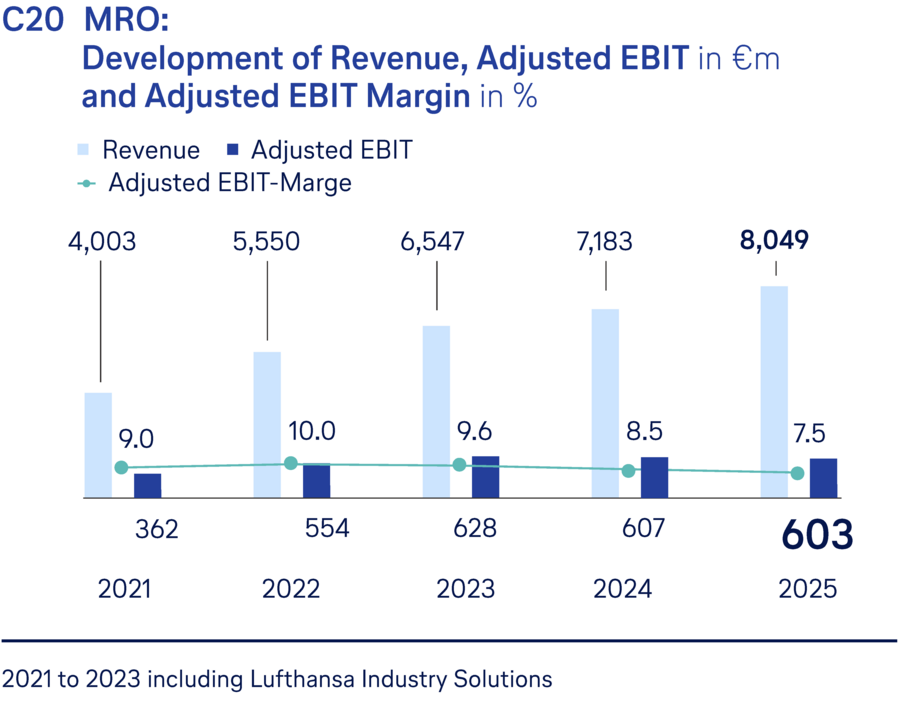
EBIT amounted to EUR 609m (previous year: EUR 555m). In the reporting year, the difference in relation to Adjusted EBIT mainly stems from the reversal of provisions relating to Russia, while the previous year had been impacted by write-downs on joint ventures and expenses for restructuring.
Segment capital expenditure up by 12%
Segment capital expenditure in the MRO business segment has risen by 12% to EUR 230m (previous year: EUR 206m). Capital expenditure was mainly concentrated on property, plant and equipment and financial investments. Within property, plant and equipment, it focused particularly on ongoing new building projects, technical equipment, machinery and operating materials for MRO services for various next-generation aircraft and engine models. Capital expenditure on financial investments mainly went to affiliated (not consolidated) companies and joint ventures. In addition to segment capital expenditure, in the reporting year EUR 182m of cash outflows arose in connection with the expansion of the pool of repairable spare parts (previous year: EUR 194m).
Number of employees rises by 3%
The number of employees at the end of 2025 was up by 3% year-on-year to 22,989 (previous year: 22,313). This growth in the workforce reflects recruitment activities as a result of the increased volume of business. Two thirds of this growth has occurred outside Germany and one third in Germany. However, the growth figure for Germany was influenced by the transfer of the remaining line maintenance stations to Lufthansa Airlines.