
Logistics business segment
| T036 | Key figures Logistics | ||||
|---|---|---|---|---|---|
| 2025 | 2024 | Change in % | |||
| Revenue | in €m | 3,403 | 3,263 | 4 | |
| of which traffic revenue | in €m | 3,189 | 3,054 | 4 | |
| Operating income | in €m | 3,485 | 3,356 | 4 | |
| Operating expenses | in €m | 3,209 | 3,147 | 2 | |
| Adjusted EBITDA | in €m | 525 | 449 | 17 | |
| Adjusted EBIT | in €m | 324 | 251 | 29 | |
| EBIT | in €m | 325 | 252 | 29 | |
| Adjusted EBIT margin | % | 9.5 | 7.7 | 1.8 pts | |
| Adjusted ROCE1) | % | 14.7 | 10.9 | 3.8 pts | |
| Segment capital expenditure | in €m | 110 | 149 | -26 | |
| Employees as of 31 Dec | number | 4,322 | 4,261 | 1 | |
| Average number of employees | number | 4,308 | 4,223 | 2 | |
| 1) Last year’s figure adjusted in line with new calculation method. ↗ Financial strategy. | |||||
Business activities
Lufthansa Cargo is one of the leading cargo airlines worldwide
Lufthansa Cargo is the Lufthansa Group’s logistics specialist. The Logistics business segment also includes the Jettainer group, which is a world leader in the management of airfreight containers, as well as the time:matters group which specialises in time-critical shipments. The two subsidiaries CB Customs Broker, an EU customs clearance expert, and heyworld GmbH, a provider of digital, modular logistics solutions for cross-border e-commerce, likewise form part of the Logistics business segment. This business segment also encompasses the Lufthansa Group’s 50% stake in the cargo airline AeroLogic as well as equity investments in handling companies (including in the high-growth Asian market) and other companies focusing on digitalisation.
With the leading network from, to and within Europe, Lufthansa Cargo links all of the key economic centres and enables companies to access the world market. It does so via five cargo hubs – Frankfurt, Munich, Vienna, Brussels and, since mid-June 2025, Rome – as well as the capacities of eight airlines with around 350 destinations and over 7,500 weekly flights worldwide. An extensive road feeder service (RFS) with over 115 European destinations supplements the airline’s route network on the ground. In addition, in future Lufthansa Cargo will deepen its partnership with Swiss WorldCargo and establish synergies in various commercial and operational areas. The customers of both companies will thus benefit from a clearly defined and more comprehensive product and service portfolio as well as one of the most extensive networks in the industry.
The focus of Lufthansa Cargo’s operations lies in the airport-to-airport airfreight business. Its product portfolio encompasses standard and express freight as well as highly specialised products. Cross-border e-commerce shipments are the fastest-growing airfreight segment. Lufthansa Cargo offers specific industry solutions for the pharma, automotive, aviation, semiconductor and airmail sectors. Its services also include specialist products such as the transport of live animals, valuable cargo, works of art and dangerous goods. For these challenging shipments, Lufthansa Cargo uses a global network of specialised infrastructure. In Germany, these include pharma hubs in Frankfurt and Munich, the Frankfurt Animal Lounge and the Art Cube in Frankfurt.
As well as its own twelve Boeing 777F cargo aircraft and four Airbus A321Fs, Lufthansa Cargo uses the belly capacities of Lufthansa Airlines, Austrian Airlines and Brussels Airlines, among others.
In addition, the AeroLogic joint venture in Leipzig operates 28 Boeing 777F cargo aircraft on behalf of its two shareholders, Lufthansa Cargo and DHL Express. Lufthansa Cargo is responsible for marketing the capacities of six of these aircraft.
Lufthansa Cargo also has successful international partnerships with Cathay Cargo and United Cargo. On 1 August 2025, Swiss WorldCargo joined the existing partnership between Lufthansa Cargo and United Cargo.
Course of business
Lufthansa Cargo markets freight capacities of ITA Airways and adds Rome as a fifth hub
Lufthansa Cargo has marketed ITA Airways’ freight capacities on selected routes since June 2025. Since the start of the winter timetable at the end of October 2025, this has been expanded to cover almost all of the additional cargo capacities on ITA Airways’ short-haul and intercontinental routes. For the time being, routes to and from the USA and Canada are excluded pending regulatory approval.
By integrating Rome as a cargo hub in southern Europe, Lufthansa Cargo has added further routes, capacities and destinations to its dense network. Global additional cargo capacities for Lufthansa Cargo’s customers have thus increased overall by almost 20%. This means that in future, cargo customers will have an even more closely meshed global network at their disposal.
Lufthansa Cargo strengthens position in focus industries
In 2025, Lufthansa Cargo further deepened its commitment to the strategically relevant pharma, automotive, aviation, semiconductor and airmail focus industries and pursued a number of initiatives targeting these sectors’ specific requirements.
By joining Silicon Saxony, Europe’s largest association of companies in the microelectronics, semiconductor and IT sectors, Lufthansa Cargo is strengthening its presence in high-tech industry. The freight airline intends to work in committees and working groups on optimised logistics solutions for sensitive electronics components as well as joint quality and process standards.
In the automotive segment, Lufthansa Cargo has further professionalised its transport process for entire vehicles and developed a new, standardised procedure for lashing down cargo and ready-for-loading delivery. Its new solutions reduce the volume of handling work, improve process quality and create additional revenue potential.
The airline has also further expanded its sector-specific offering in the aviation field. In 2025, Lufthansa Cargo transported more than 1,000 aircraft engines. Safe transportation of these valuable and sensitive components requires the utmost precision from the point of view of planning and handling. Lufthansa Cargo has further standardised procedures in this area, adjusted loading parameters for selected engine types and strengthened coordination between global stations and specialist operational areas.
With these initiatives, Lufthansa Cargo is underlining its role as an innovation and quality driver in key customer industries and creating additional potential for profitable growth.
Lufthansa Cargo optimises digital offering and steps up use of AI
Lufthansa Cargo has overhauled its digital customer offering. Since August 2025, it has offered a considerably simplified and more efficient online booking process. Standard shipments can now be booked roughly twice as fast as previously. This offering is supplemented with a revised shipment tracking system, with an improved overview and proactive notifications throughout the transport chain. The changes made underline Lufthansa Cargo’s strategic focus on deliberately optimising digital processes and further enhancing its quality of service through the use of AI and new technologies. This includes the introduction of specially developed software, which automatically transfers booking enquiries received by email to the airline’s booking system, and the development of innovative virtual reality training for aircraft loading supervisors.
Investments in the Frankfurt hub as a clear commitment to the economic location
In September 2024, Lufthansa Cargo presented the future of its central cargo hub at Frankfurt Airport. This project has a total investment volume of almost EUR 600m. The cargo airline intends to complete a comprehensive modernisation project by 2030 which will make its Lufthansa Cargo Center (LCC) Europe’s cutting-edge airfreight hub.
The milestones reached in 2025 included the completion of the first major construction phase, including the central high-bay warehouse. This will pave the way for even more efficient and customer-oriented freight handling with further automation, modernised storage and conveyor technology and faster freight handling. In addition, at the end of 2025 the first construction phase of the new Lufthansa Cargo Campus was completed. In the 2025 financial year, the airline’s capital expenditure relating to the modernisation of its new headquarters totalled EUR 17m.
Lufthansa Cargo is actively pursuing sustainability activities
Lufthansa Cargo further expanded its sustainability activities in 2025 and successfully confirmed its high environmental and compliance standards. It also once again successfully completed its global monitoring audit pursuant to ISO 14001, the international standard for systematic environmental management.
Lufthansa Cargo has ensured its fulfilment of the 2% sustainable aviation fuel (SAF) quota applicable since 2025 with the airfreight surcharge (ASC). This partially covers the additional costs for the mandatory SAF portion. At the same time, this airline has fully integrated voluntary use of SAF in its booking systems through its “Sustainable Choice” add-on service – an important step to ensure broad market coverage from 2026. In addition, standardised SAF volume contracts are available for freight forwarders and industry customers. In 2025, Lufthansa Cargo sold a total of around 2,300 tonnes of SAF and thus made a contribution to the decarbonisation of airfreight logistics. ↗ Combined non-financial declaration.
Changes in the management of Lufthansa Cargo
Frank Bauer, previously Lufthansa Cargo AG’s Chief Financial Officer and Labour Director, took over as Lufthansa Cargo’s Chief Operating Officer on 1 July 2025. On 1 July 2025, Gregor Schleussner joined Lufthansa Cargo’s Executive Board as its new Chief Financial Officer and Chief Human Resources Officer. He previously served as Eurowings’ Head of Finance, Controlling & Accounting. The Executive Board team led by Ashwin Bhat, Chief Executive Officer of Lufthansa Cargo, has thus been back at full strength since 1 July 2025.
Operating performance
Lufthansa Cargo registers positive course of business
In the Logistics business segment, the positive operating and financial trend which was already apparent in the second half of 2024 continued in the 2025 financial year. This development was buoyed by business from Asia, which remains strong, as well as a generally stable level of market demand. In particular, the latter was reflected in an increase in cargo tonnage alongside a slight decrease in yields.
Lufthansa Cargo further expanded its traffic volume in the reporting year. Capacity was 5% higher than in the previous year due to extra freighter capacities resulting from the addition of a Boeing 777F in the second half of 2024 as well as the expansion of passenger flight operations and the related increase in belly capacities. Capacity thus matched the 2019 pre-crisis level for the first time. Sales were up by 7% year on year. The cargo load factor increased by 1.1 percentage points to 63.0% (previous year: 61.9%). Over the course of the year, yields fell in all traffic areas, with the exception of the stable trend in the Asia/Pacific traffic region. Overall, they were 2.8% lower than in the previous year.
| T037 | Traffic figures and operating figures Logistics | ||||
|---|---|---|---|---|---|
| 2025 | 2024 | Change in % | |||
| Available cargo tonne-kilometres | millions | 14,450 | 13,707 | 5 | |
| Revenue cargo tonne-kilometres | millions | 9,103 | 8,482 | 7 | |
| Cargo load factor | % | 63.0 | 61.9 | 1.1 pts | |
| Yields | in € cent | 35.0 | 36.0 | -2.81) | |
| 1) Exchange rate-adjusted change: 0.6%. | |||||
Despite the lower yields, traffic revenue increased by 4% to EUR 3,189m (previous year: EUR 3,054m). Traffic revenue increased in all traffic regions year-on-year. The Asia/Pacific region registered the strongest increase.
The Americas and Asia/Pacific remain Lufthansa Cargo’s main traffic regions. These two regions accounted for nearly 90% of capacity and sales.
Lufthansa Cargo significantly expanded its capacity and likewise increased its sales in all of its traffic regions. It increased its cargo load factor in the Americas and Europe traffic regions, while Asia/Pacific and the Middle East/Africa registered slight declines.
| T038 | Trends in traffic regions Logistics | ||||||||
|---|---|---|---|---|---|---|---|---|---|
| Net traffic revenue external revenue | Available cargo tonne-kilometres | Revenue cargo tonne-kilometres | Cargo load factor | ||||||
| 2025 | Change | 2025 | Change | 2025 | Change | 2025 | Change | ||
| in €m | in % | in millions | in % | in millions | in % | in % | in pts | ||
| Europe | 236 | 2 | 783 | 8 | 364 | 11 | 46.5 | 1.4 | |
| Americas | 1,253 | 2 | 6,573 | 3 | 3,929 | 8 | 59.8 | 2.6 | |
| Asia/Pacific | 1,447 | 7 | 6,006 | 7 | 4,171 | 6 | 69.4 | -0.5 | |
| Middle East/Africa | 253 | 5 | 1,089 | 7 | 639 | 7 | 58.7 | -0.3 | |
| Total traffic | 3,189 | 4 | 14,450 | 5 | 9,103 | 7 | 63.0 | 1.1 | |
Financial performance
Revenue up 4% year-on-year
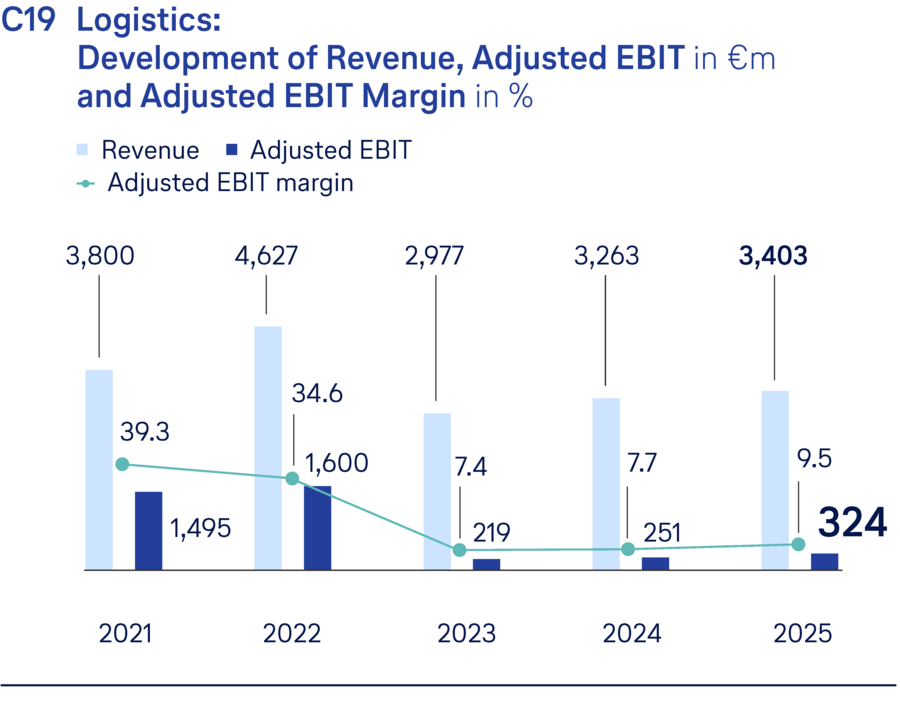
Revenue in the Logistics business segment rose by 4% to EUR 3,403m in the 2025 financial year (previous year: EUR 3,263m). Stable market demand and continued strong business from Asia were the key factors behind this growth. Operating income increased overall by 4% to EUR 3,485m (previous year: EUR 3,356m).
Expenses up by 2%
Operating expenses of EUR 3,209m were 2% up on the previous year (previous year: EUR 3,147m) in the reporting year.
| T039 | Operating expenses Logistics | |||
|---|---|---|---|---|
| 2025 | 2024 | Change | ||
| in €m | in €m | in % | ||
| Cost of materials and services | 2,263 | 2,241 | 1 | |
| of which fuel | 351 | 368 | -5 | |
| of which fees and charges | 390 | 361 | 8 | |
| of which charter expenses | 1,243 | 1,232 | 1 | |
| of which MRO services | 133 | 131 | 2 | |
| Staff costs1) | 470 | 443 | 6 | |
| Depreciation and amortisation2) | 201 | 198 | 2 | |
| Other operating expenses3) | 275 | 265 | 4 | |
| Total operating expenses | 3,209 | 3,147 | 2 | |
| 1) Without past service expenses/plan settlement. 2) Without impairment loss. 3) Without book losses. | ||||
The cost of materials and services rose by 1% (EUR +22m) year-on-year to EUR 2,263m (previous year: EUR 2,241m). Fuel expenses decreased by 5% or EUR 17m, largely due to prices. Expenses associated with flight volume-dependent fees and charges (EUR +29m) were higher due to cost increases and the expansion of the airline’s fleet. Charter expenses were up by 1% or EUR 11m, due mainly to increased belly expenses paid to Group companies, above all as a result of the integration of ITA Airways.
In the 2025 financial year, staff costs increased by 6% to EUR 470m (previous year: EUR 443m), primarily due to wage and salary increases, higher variable remuneration components as well as a 2% increase in the average number of employees.
Depreciation and amortisation increased by 2% year-on-year to EUR 201m (previous year: EUR 198m) owing to the expansion of the freighter fleet.
Other operating expenses went up by 4% to EUR 275m (previous year: EUR 265m).
Adjusted EBIT of EUR 324m
Adjusted EBIT increased by 29% in the 2025 financial year to EUR 324m (previous year: EUR 251m). The Adjusted EBIT margin improved by 1.8 percentage points to 9.5% (previous year: 7.7%).
EBIT of EUR 325m was 29% higher than in the previous year (previous year: EUR 252m).
Segment capital expenditure down 26% on the previous year
Capital expenditure in the Logistics business segment decreased by 26% in the reporting year to EUR 110m (previous year: EUR 149m) and mainly related to the expansion and conversion of Lufthansa’s Frankfurt freight centre.
Number of employees up by 1%
The number of employees at year-end had increased by 1% to 4,322 (previous year: 4,261).